GENEVA: Freedom in Russia and the end of President Vladimir Putin’s rule depends on Ukraine winning the war, Kremlin critic Garry Kasparov said Tuesday as Moscow and Washington held talks.
As US Secretary of State Marco Rubio and Russian Foreign Minister Sergei Lavrov held talks in Saudi Arabia, former chess world champion Kasparov said any outcome that Putin could present as a victory would only extend his grip on power.
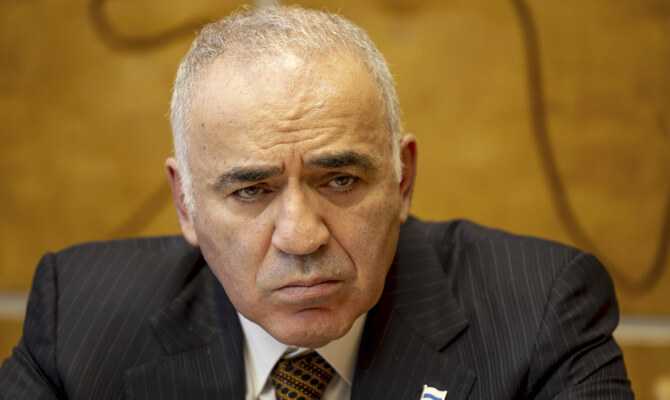
“There is no freedom of Russia, no end of the Putin regime, without Ukrainian victory,” the chess grandmaster told a press conference after addressing the annual Geneva Summit for Human Rights and Democracy conference.
“Even a partial victory; inflicting defeat on Putin will lead to a change in Russia.
“If Putin wins, or presents the outcome as victory,” which could involve “keeping territories and lifting sanctions... he’ll stay there. A dictator is never in danger if he is still on the rise.”
Kasparov, 61, retired from chess in 2005 to focus on political activism and has lived in exile in New York for the past decade. The longtime Putin opponent was added to Russia’s list of “extremists” in March 2024.
Kasparov spoke as many in Europe fear that US President Donald Trump’s overhaul of US policy on Russia will upend Europe’s decades-long security structure.
Kasparov said Trump did “absolutely not” understand the complexity of the conflict, and those around him were too scared to tell him that his geopolitical knowledge was insufficient.
He expected Trump would have to make “massive concessions” to secure his objective of ending the war.
Kasparov said Rubio was “not an idiot — he’s spineless, but he still has brains,” and therefore understands that he can’t deliver “unless they have to give up everything to Putin.”
He said Putin was pretending he was in a strong position but the Russian economy “will probably collapse within the next 12 to 18 months.”
Meanwhile Ukraine could keep fighting if Europe provided the money to buy US weaponry — and “as long as money is being paid, I don’t think he (Trump) cares.”
“If Trump wants to end the war, it’s not difficult: just cut Russian oil exports,” Kasparov added.
The chess great said the West had sorely lacked a collective strategy since Russia annexed the Crimean peninsula from Ukraine in 2014.
Meanwhile “Putin has a very simple idea: stay in power. That’s it. There’s no other idea,” said Kasparov.
“The cause of the war is Putin and his imperial ambitions that will never disappear, because there’s nothing else that can justify him staying in power for life.”
Kasparov said Russia’s biggest problem was not what happens in Putin’s inner circle but that many average citizens still “live in imperial dreams.”
“The Russian empire must go, and the future of Russia may not be in the current borders of Russia. The way I see the future, Russia must return all the occupied territories — Crimea included.”


![]()

Russian freedom depends on Ukraine winning war: Kasparov
Short Url
https://arab.news/9gbdx
Russian freedom depends on Ukraine winning war: Kasparov
- “There is no freedom of Russia, no end of the Putin regime, without Ukrainian victory,” the chess grandmaster told a press conference


Latest updates


© 2026 SAUDI RESEARCH & PUBLISHING COMPANY, All Rights Reserved And subject to Terms of Use Agreement.