DEIR MIMAS, Lebanon: Israeli forces withdrew Tuesday from border villages in southern Lebanon under a deadline spelled out in a US-brokered ceasefire agreement that ended the latest Israel-Hezbollah war, but stayed put in five strategic overlook locations inside Lebanon.
Top Lebanese leaders denounced the continued presence of the Israel troops as an occupation and a violation of the deal, maintaining that Israel was required to make a full withdrawal by Tuesday. The troops’ presence is also a sore point with the militant Hezbollah group, which has demanded action from the authorities.
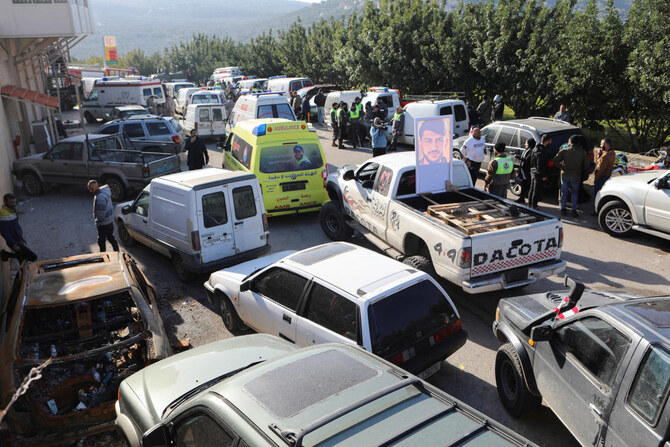
Lebanese soldiers moved into the areas from where the Israeli troops pulled out and began clearing roadblocks set up by Israeli forces and checking for unexploded ordnance. They blocked the main road leading to the villages, preventing anyone from entering while the military was looking for any explosives left behind.
Most of the villages waited by the roadside for permission to go and check on their homes but some pushed aside the roadblocks to march in. Elsewhere, the army allowed the residents to enter.
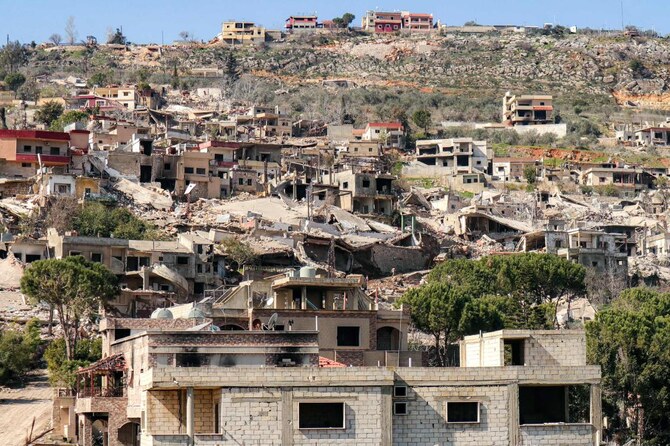
Many of their houses were demolished during the more than year-long conflict or in the two months after November’s ceasefire agreement, when Israeli forces were still occupying the area.
In the border village of Kfar Kila, people were stunned by the amount of destruction, with entire sections of houses wiped out.
“What I’m seeing is beyond belief. I am in a state of shock,” said Khodo Suleiman, a construction contractor, pointing to his destroyed home on a hilltop.
“There are no homes, no plants, nothing left,” said Suleiman, who had last been in Kfar Kila six months ago. “I am feeling a mixture of happiness and pain.”
In the main village square, Lebanese troops deployed as a military bulldozer removed rubble from the street.
Israeli Defense Minister Israel Katz said the Israeli army “will stay in a buffer zone in Lebanon in five control posts” to guard against any ceasefire violations by Hezbollah. He also said the army had erected new posts on the Israeli side of the border and sent reinforcements there.
“We are determined to provide full security to every northern community,” Katz said.
However, Lebanon’s three top officials — the country’s president, prime minister and parliament speaker — in a joint statement said that Israel’s continued presence at the five locaions was in violation of the ceasefire agreement. They called on the UN Security Council to take action to force a complete Israeli withdrawal.
“The continued Israeli presence in any inch of Lebanese territory is an occupation, with all the legal consequences that result from that according to international legitimacy,” the statement said.
The Israeli troop presence was also criticized in a joint statement by the UN special coordinator for Lebanon, Jeanine Hennis-Plasschaert, and the head of the UN peacekeeping force in the country, Lt. Gen. Aroldo Lázaro.
The two, however, warned that this should not “overshadow the tangible progress that has been made” since the ceasefire agreement.
Near the Lebanese villages of Deir Mimas and Kfar Kila, hundreds of villagers were gathered early on Tuesday morning as an Israeli drone flew overhead.
Atef Arabi, who had been waiting with his wife and two daughters before sunrise, was eager to see what’s left of his home in Kfar Kila.
“I am very happy I am going back even if I find my home destroyed,” said the 36-year-old car mechanic. “If I find my house destroyed I will rebuild it.”
Later on Tuesday, Kfar Kila’s mayor Hassan Sheet told The Associated Press that 90 percent of the village homes are completely destroyed while the remaining 10 percent are damaged. “There are no homes nor buildings standing,” he said, adding that rebuilding will start from scratch.
The Lebanese militant group Hezbollah began firing rockets across the border on Oct. 8, 2023, one day after a deadly Hamas-led incursion into southern Israel that sparked the war in Gaza. Israel responded with shelling and airstrikes in Lebanon, and the two sides became locked in an escalating conflict that became a full-blown war last September.
More than 4,000 people were killed in Lebanon and more than 1 million were displaced at the height of the conflict, more than 100,000 of whom have not been able to return home. On the Israeli side, dozens of people were killed and some 60,000 are displaced.
Hussein Fares left Kfar Kila in October 2023 for the southern city of Nabatiyeh. When the fighting intensified in September he moved with his family to the city of Sidon where they were given a room in a school housing displaced people.
Kfar Kila saw intense fighting and Israeli troops later detonated many of its homes.
“I have been waiting for a year and the half to return,” said Fares who has a pickup truck and works as a laborer. He said he understands that the reconstruction process will take time.
“I have been counting the seconds for this day,” he said.


![]()
![]()
![]()

Villagers in southern Lebanon prepare to return home as Israeli army withdraws under ceasefire deal

Short Url
https://arab.news/pseby
Villagers in southern Lebanon prepare to return home as Israeli army withdraws under ceasefire deal
- Most of the villages waited by the roadside for permission to go and check on their homes but some pushed aside the roadblocks to march in
- In the border village of Kfar Kila, people were stunned by the amount of destruction, with entire sections of houses wiped out


Latest updates


Recommended


© 2026 SAUDI RESEARCH & PUBLISHING COMPANY, All Rights Reserved And subject to Terms of Use Agreement.