

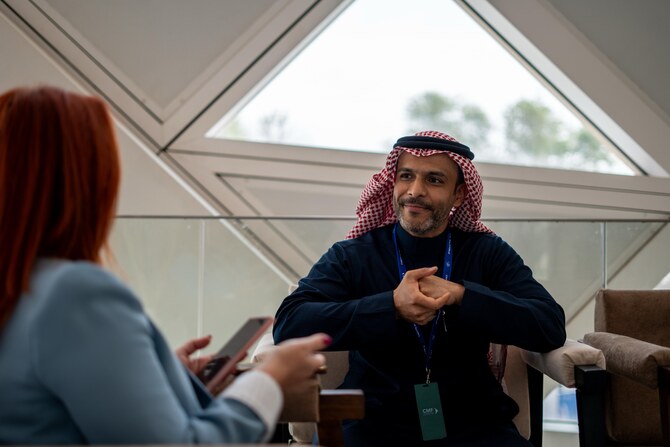

RIYADH: Saudi Arabia’s stock exchange has introduced a new Capital Management System to streamline the initial public offering process, lowering costs for companies, and broadening investor participation.
In an interview with Arab News at the Capital Markets Forum in Riyadh on Tuesday, Mohammed Al-Rumaih, CEO of Saudi Exchange, explained that the new system is set to transform the Kingdom’s capital markets by making IPOs faster, more affordable, and accessible to a wider range of investors.
“It’s a revolutionary system that will serve three main goals. One, make it quicker for companies to do their IPO, also cheaper for them and as well, open the opportunity for a bigger set of investors, so it used to be only for receiving banks usually for three,” Al-Rumaih said.
He further elaborated, saying: “Now we have 15 connected to our system, resulting in greater coverage, more investors, and quicker listings after book closing. This was a soft launch, but today we announced its expansion to all markets, including the main market.”
Regarding international investor participation in the Saudi market, Al-Rumaih dismissed concerns about significant barriers, pointing to the steady growth in foreign investment inflows.
“As of today, we don’t see major barriers. We can see from the numbers that we publish weekly that foreign investors have been growing on a weekly basis,” he noted.
Al-Rumaih also disclosed that foreign investors have been net buyers of Saudi stocks for the past three years, with foreign ownership surpassing SR400 billion and continuing to grow.
He emphasized that ongoing market infrastructure improvements, including enhancements for high-frequency trading, market makers, and regulatory reforms, are further strengthening foreign investor involvement.
“We see a lot of excitement. Today, we’ve met with many investors—some for the first time—while others are looking to double down on the Saudi market. Everyone is optimistic about its future, and we believe this year will continue the trend of foreign investors being net buyers of Saudi equities,” Al-Rumaih stated.
He also emphasized the Saudi Exchange’s efforts to strengthen the debt market, where foreign ownership remains relatively low.
“The debt market still has low ownership from foreign investors for many reasons. Most importantly, we have only had a few corporate issuances, but there is a strong and growing market for government sukuk,” Al-Rumaih said.
The Saudi Exchange is working toward inclusion in international sukuk indices, following a similar successful push for equity market inclusion.
“We believe we are on the right track based on the feedback we’ve received from investors. Hopefully, this year will be another successful year for Tadawul,” he said.
Discussing Saudi Arabia’s expanding role as a global financial hub, Al-Rumaih highlighted the Kingdom’s strong leadership and its commitment to Vision 2030 goals, which have already seen successes ahead of schedule in certain areas.
“Whoever invested in the Saudi market knows that we have great leadership with a great vision. They have been committed to the goals of Vision 2030, and we have reached some targets ahead of time, so we raised the bar,” he stated.
Al-Rumaih also pointed out that Saudi Arabia ranked first globally in IPO listings in 2023, surpassing all other markets. Foreign investment activity surged by 80 percent last year, with further growth expected as more market makers, HFTs, and IPOs enter the scene.
“We believe this year will see even greater foreign investment inflows as we continue to introduce more market enhancements,” Al-Rumaih said.
Saudi Exchange is also actively working to expand cross-border partnerships, signing agreements with foreign exchanges and facilitating the listing of more exchange-traded funds.
Following the interview, Saudi Exchange announced the signing of a memorandum of understanding with Jakarta Futures Exchange, aimed at encouraging large Indonesian firms to explore opportunities within the Kingdom’s capital market.
“We are working even more and connecting with international markets. You would see more ETFs and more agreements. We are signing an agreement just after this meeting with another exchange in a country that looks at Saudi as a great investment destination,” Al-Rumaih said.
He further emphasized: “You will see more ETFs and more agreements. We are signing an agreement right after this meeting with another exchange in a country that sees Saudi Arabia as a great investment destination,” Al-Rumaih revealed.
Additionally, Saudi regulators have updated listing requirements to unlock the full potential of the debt market, making it easier for companies to raise funds through bond issuances.
“Every company needs liquidity and long-term financing. What we have done is shorten the time, reduce the requirements, and make it more attractive,” he explained.
The Kingdom is on track to achieve a record number of debt issuances in 2024, with the total percentage of debt market activity expected to grow significantly.
“We are currently at 18 percent debt market penetration, including both government and private sector issuances. This is far below the G20 average of over 80 percent, which means there is a lot of room to grow,” Al-Rumaih concluded.


