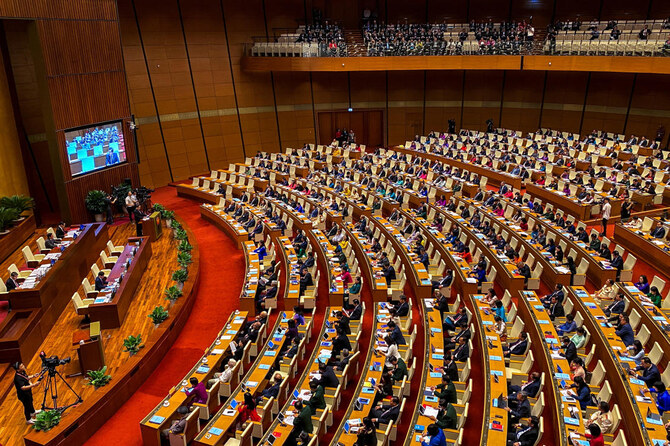
HANOI: Vietnam’s National Assembly on Tuesday approved a bold bureaucratic reform plan that will slash up to a fifth of government bodies, as the country tries to cut costs and improve administrative efficiency.
The number of government ministries will be reduced to 14 from the current of 18, to be up and running from March 1, the assembly said in a statement.
More than 97 percent of the lawmakers present approved the plan.
The assembly earlier on Tuesday passed an amendment to a law on organizing government, paving the way for approval of the planned cull of 15 percent to 20 percent of the state apparatus, which will also include four agencies and five state television channels, among other cuts.
The move would “not only save money for the state budget but more importantly, boost the efficiency of the system,” General Secretary of Vietnam’s ruling Communist Party, To Lam, told parliament last week. Investors, diplomats and officials have broadly welcomed the plan but expect some administrative delays in the short term in Vietnam, a regional industrial hub that relies heavily on foreign investment. The government has said the overhaul would not impact project approvals.
The planning and investment ministry, which approves foreign investment projects, will join the finance ministry, while the transport ministry and the construction ministry will be merged.
The natural resources and environment ministry and the agriculture ministry will also be merged.
Lawmakers on Tuesday ratified the appointment of two new deputy premiers, including the incumbent investment minister. That will increase the number of deputy prime ministers from five to seven.
The plan coincides with similar post-pandemic government cost-cutting measures being implemented or pledged across the world, including by Argentina’s libertarian President Javier Milei and US President Donald Trump.
Vietnam’s state media last month reported the restructuring would affect 100,000 state officials. It did not elaborate.
“Poor-performing employees must be removed from the system,” it quoted Deputy Prime Minister Nguyen Hoa Binh, as saying.
“State agencies must not be safe shelters for incompetent officials.”


![]()

Vietnam parliament approves plan for leaner government
Short Url
https://arab.news/ye88k
Vietnam parliament approves plan for leaner government
- The number of government ministries will be reduced to 14 from the current of 18
- More than 97% of lawmakers present in Vietnam’s National Assembly approved the plan


Latest updates


© 2026 SAUDI RESEARCH & PUBLISHING COMPANY, All Rights Reserved And subject to Terms of Use Agreement.