KHIAM: Sabah Abdullah comes to her hometown in Lebanon every morning and sits next to her destroyed home. She is waiting for experts from Hezbollah’s construction arm to compensate her for the damage caused by the Israel-Hezbollah war that has left her homeless.
The 66-year-old from Khiam now rents a home in the nearby village of Kawkaba and is repairing her small grocery store, which was badly damaged by the 13-month war that ended in late November as a result of a US-brokered ceasefire. The war has left more than 4,000 people dead and over 16,000 wounded in Lebanon and caused damage worth billions of dollars.
“Damage can be compensated but the loss of souls cannot be replaced,” said Abdullah as she sat on a plastic chair in the sun outside her shop.
Israeli forces will remain in parts of southern Lebanon
The 60-day ceasefire that was supposed to end on Jan. 27 — with an Israeli withdrawal from Lebanon and the militant Hezbollah group ending its armed presence along the border area — was extended until Tuesday. But an Israeli official said on Monday that Israeli forces will remain in five strategic locations in southern Lebanon after the deadline.
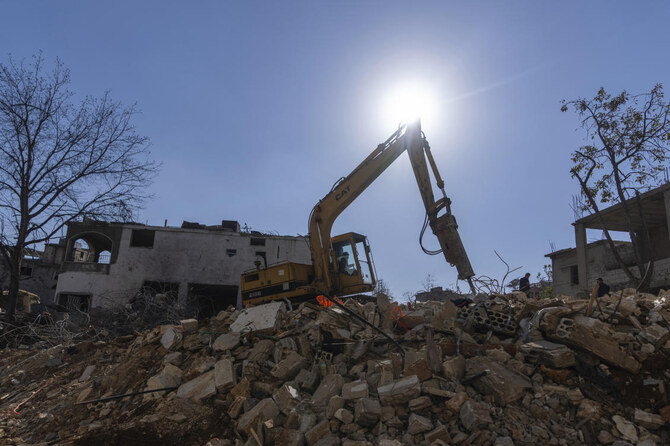
One of these locations is the Hamamis hill on the southern outskirts of Khiam. On Monday, bulldozers could be seen from a distance at work building what appeared to be fortifications in an apparent sign that Israel’s military is planning to stay long beyond Tuesday’s deadline.
Hezbollah leader Naim Kassem said in a speech on Sunday that Israel must withdraw fully from Lebanon on Tuesday, adding that “there is no pretext for five points nor other details.” He said the Lebanese state should prevent Israel from staying in the country after Tuesday as stated in the ceasefire deal.
The Israel-Hezbollah war began a day after Hamas carried out its deadly attack in southern Israel on Oct. 7, 2023, killing 1,200 people and taking about 250 people hostage and triggering the Israel-Hamas war. The Israel-Hezbollah war intensified as of Sept. 23, when Israel expanded its attacks and killed Hezbollah’s longtime top leader and one of its founders, Hassan Nasrallah.
Widespread damage in Khiam
Khiam, one of the largest towns close to the Israeli border, suffered widespread damage, including entire blocks that were turned to piles of debris. Graffiti left behind by Israeli troops could be seen on the walls as well as inside homes. The town’s cemetery suffered severe damage, with many graves blown out.
On Monday, workers were removing debris in different locations in Khiam as many residents come during the day to spend a few hours at their homes and leave before sunset since the town still has no electricity or running water. New poles were being put in place by the country’s state-run electricity company as the infrastructure suffered severe damage.
“In Khiam everyone was martyred,” read a graffiti on a wall in Arabic. “Khiam is Golani’s graveyard,” another one read, referring to Israel’s Golani Brigade.
In a building on the eastern edge of Khiam, a woman showed a journalist a Star of David sprayed in red at the entrance of her apartment. The woman, who asked not to be named for safety reasons, then walked through her apartment, showing a reporter the damage in the sitting room and kitchen.
Abdallah said when she first came to Khiam days after the ceasefire went into effect in late November, she found that hungry cats and dogs inside her badly damaged shop had eaten cakes, croissants and chocolates. The metal door of her shop was blown wide open, she said.
Seeing her home, built by her late father, destroyed saddened her but Abdallah said she is happy that none of her siblings or relatives were hurt during the war.
‘The future is obscure’
Abdallah said that soon after the war ended, Hezbollah’s construction arm Jihad Al-Binaa paid her $12,000, of which $8,000 were to compensate her for lost furniture and $4,000 for a year’s rent.
Abdallah said that since the Israel-Hezbollah war began, she rented a house in Marakaba and had spent most of her savings and was selling some of her jewelry. She said she is now waiting for government experts to visit her and estimate the losses to pay her for rebuilding her two-story house that she shared with her brother.
“I will rebuild my house but the future is obscure. We live close to the border,” Abdallah said, referring to repeated wars with Israel over the past decades.
Another Khiam resident, Dalal Abdallah, said if Israel decides to stay in Lebanon, Israel will be eventually forced to leave again.
“Valuable blood and souls were paid for this land,” she said. “No one should think that we will leave our land.”


![]()

Border town’s residents rebuild in south Lebanon as Hezbollah leader calls for Israeli withdrawal
Short Url
https://arab.news/8485s
Border town’s residents rebuild in south Lebanon as Hezbollah leader calls for Israeli withdrawal
- The war has left more than 4,000 people dead and over 16,000 wounded in Lebanon and caused damage worth billions of dollars
Latest updates


© 2026 SAUDI RESEARCH & PUBLISHING COMPANY, All Rights Reserved And subject to Terms of Use Agreement.