

Pakistan heightens security measures in Karachi, Lahore and Rawalpindi ahead of Champions Trophy 

Pakistan's police commando walks past posters displayed ahead of the Champions Trophy, outside the National Stadium in Karachi on February 17, 2025. (AFP)
Short Url
Updated 18 February 2025
Follow

Pakistan heightens security measures in Karachi, Lahore and Rawalpindi ahead of Champions Trophy 

  • Pakistan will host eight-nation Champions Trophy cricket tournament from Feb. 19-Mar. 9 
  • Police in Lahore, Karachi and twin cities have deployed over 20,000 troops for security 

ISLAMABAD: Pakistani authorities have started implementing sweeping security measures in the southern port city of Karachi and Punjab’s Lahore and Rawalpindi ahead of the Champions Trophy tournament, the first multi-country cricket event in nearly 30 years to take place in the country. 

The South Asian nation hopes to erase worries of instability in the country and restore confidence in it as a tourism and investment destination despite its security challenges. Pakistan has suffered a surge in militant attacks in its western provinces bordering Afghanistan since November 2022 after a fragile truce between militants and the state broke down. 

A near fatal militant attack on the Sri Lankan cricket team in 2009 in Lahore scared away international teams from touring Pakistan for several years. For the Champions Trophy, police in Lahore, Karachi and the twin cities of Rawalpindi and Islamabad have deployed over 20,000 troops, including snipers on rooftops along key routes. Hotels where players will stay, stadiums and airports will be heavily guarded as will the roads connecting these locations.

“My team and all the members of all the relevant forces are engaged in this, and from the police side 5000 plus police officers will be deployed,” Maqsood Ahmed, the deputy inspector general of security in Karachi, told Reuters. “They will be doing the traffic duties, the rout protection, the venue protection, the crowd management and other duties along with the intelligence gathering and the operations before the event.”
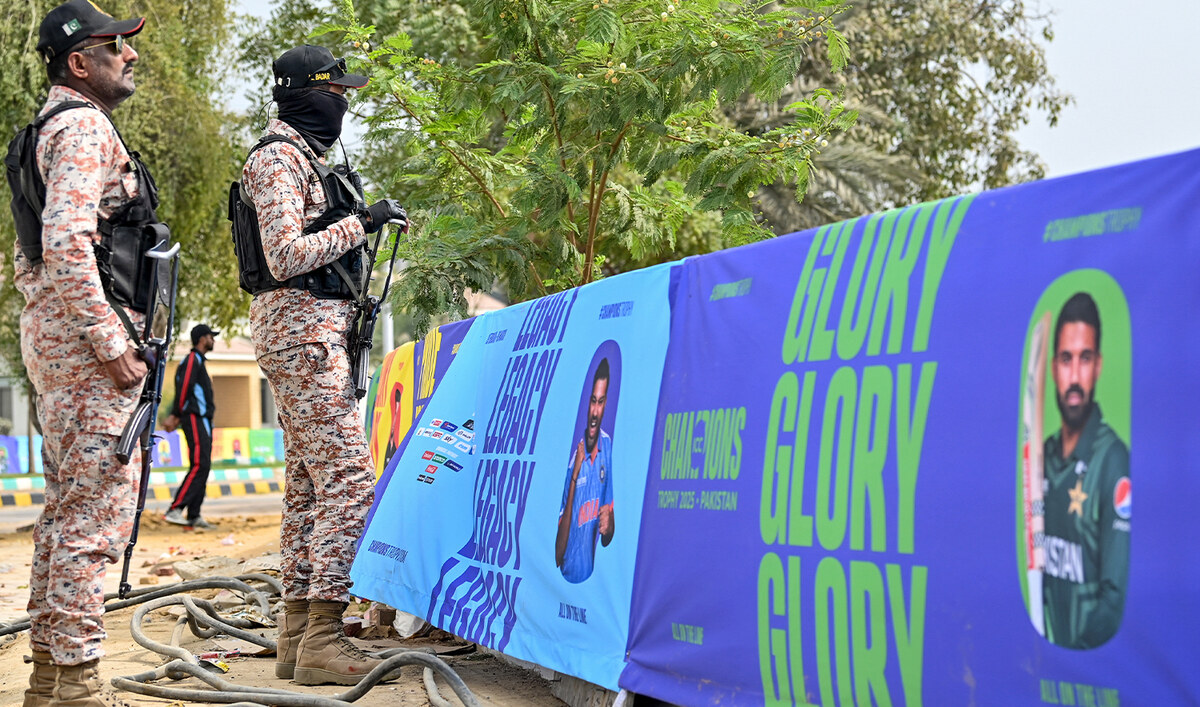


Pakistan's para-military soldiers stand guard at the National Stadium in Karachi on February 17, 2025. (AFP)

Karachi police said they have set up an additional SWAT unit to respond to emergencies and conducted preventive intelligence operations to identify potential threats. Ahmed said other law enforcement agencies such as Rangers and the Pakistan Army will cover emergency situations as a secondary reaction force.

Meanwhile, Punjab Police have updated surveillance systems and installed around 10,000 AI-powered facial recognition cameras and additional CCTV cameras across the two cities.

Mohammad Taha, a Karachi resident, pointed out that in the past, authorities would not only block the main thoroughfare but all streets surrounding the National Stadium in the city when international cricket newly returned to Pakistan.

“Now the situation is different,” he told Reuters. “Yes, the main thoroughfare Shahrah-e-Faisal will be closed but the traffic will keep flowing on other roads and flyovers surrounding the stadium.”
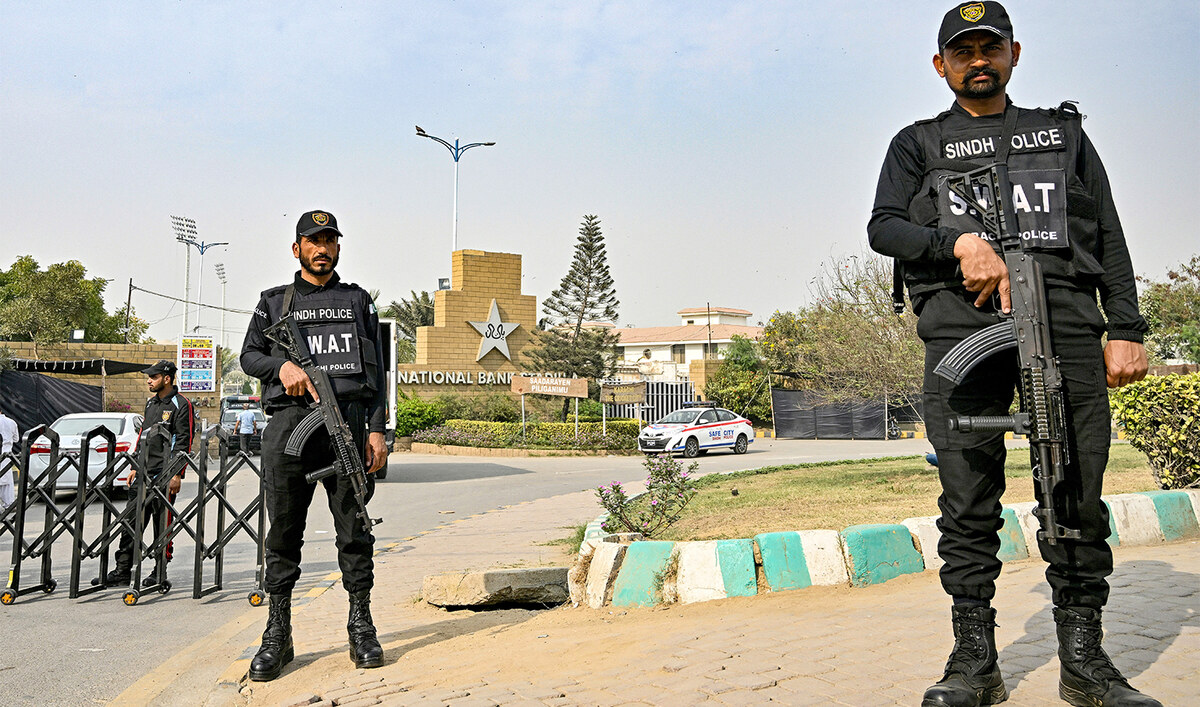


Pakistan's police commandos stand guard outside the National Stadium in Karachi on February 17, 2025. (AFP)

Mohammad Munaf, another Karachi resident, agreed. 

“This time the planning seems to be good that the matches are going on and there is no hindrance in traffic flow,” Munaf told Reuters. “The security is also very good. We can easily go to watch matches. We can go toward stadium or anywhere near it anytime. So, we don’t face these issues.”


IMF hails Pakistan privatization drive, calls PIA sale a ‘milestone’

Updated 52 min 54 sec ago
Follow

IMF hails Pakistan privatization drive, calls PIA sale a ‘milestone’

  • Fund backs sale of national airline as key step in divesting loss-making state firms
  • IMF has long urged Islamabad to reduce fiscal burden posed by state-owned entities

KARACHI: The International Monetary Fund (IMF) on Saturday welcomed Pakistan’s privatization efforts, describing the sale of the country’s national airline to a private consortium last month as a milestone that could help advance the divestment of loss-making state-owned enterprises (SOEs).

The comments follow the government’s sale of a 75 percent stake in Pakistan International Airlines (PIA) to a consortium led by the Arif Habib Group for Rs 135 billion ($486 million) after several rounds of bidding in a competitive process, marking Islamabad’s second attempt to privatize the carrier after a failed effort a year earlier.

Between the two privatization attempts, PIA resumed flight operations to several international destinations after aviation authorities in the European Union and Britain lifted restrictions nearly five years after the airline was grounded following a deadly Airbus A320 crash in Karachi in 2020 that killed 97 people.

“We welcome the authorities’ privatization efforts and the completion of the PIA privatization process, which was a commitment under the EFF,” Mahir Binici, the IMF’s resident representative in Pakistan, said in response to an Arab News query, referring to the $7 billion Extended Fund Facility.

“This privatization represents a milestone within the authorities’ reform agenda, aimed at decreasing governmental involvement in commercial sectors and attracting investments to promote economic growth in Pakistan,” he added.

The IMF has long urged Islamabad to reduce the fiscal burden posed by loss-making state firms, which have weighed public finances for years and required repeated government bailouts. Beyond PIA, the government has signaled plans to restructure or sell stakes in additional SOEs as part of broader reforms under the IMF program.

Privatization also remains politically sensitive in Pakistan, with critics warning of job losses and concerns over national assets, while supporters argue private sector management could improve efficiency and service delivery in chronically underperforming entities.

Pakistan’s Cabinet Committee on State-Owned Enterprises said on Friday that SOEs recorded a net loss of Rs 122.9 billion ($442 million) in the 2024–25 fiscal year, compared with a net loss of Rs 30.6 billion ($110 million) in the previous year.