

‘Life-threatening cold’ hits parts of US following deadly weekend flooding

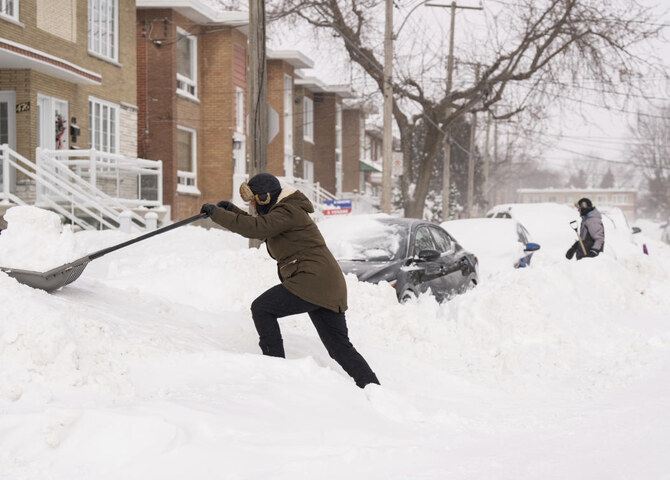
People shovel snow to dig out their cars in Montreal, Monday, Feb. 17, 2025, after over 70 centimeters of snow fell in 4 days, breaking a snowfall record in the city. (AP)
Short Url
Updated 18 February 2025
Follow

‘Life-threatening cold’ hits parts of US following deadly weekend flooding

  • The National Weather Service is warning of life-threatening cold as wind chills drop to minus 60 Fahrenheit in parts of North Dakota
  • Extreme cold warnings have been issued for an 11-state swath of the US stretching from the Canada border to Oklahoma and central Texas

BISMARCK: Harsh cold descended on the nation’s midsection Monday as a polar vortex gripped the Rockies and Northern Plains on the heels of weekend storms that pummeled the Eastern US with floods, killing at least 14 people.
The National Weather Service warned of “life-threatening cold” as wind chills dropped to minus 60 Fahrenheit (minus 51 Celsius) in parts of North Dakota on Monday and minus 50 F (minus 46 C) in parts of Montana. Tuesday morning was forecast to be even colder.
Extreme cold warnings were issued for an 11-state swath of the US stretching from the Canadian border to Oklahoma and central Texas, where the Arctic front was expected to bring near-record cold temperatures and wind chills in the single digits by midweek.
Meteorologists had predicted that parts of the US would experience the 10th and coldest polar vortex event this season. Weather forces in the Arctic are pushing chilly air that usually stays near the North Pole into the US and Europe.
Kentucky, Appalachia battered by flooding with at least 13 dead

The death toll in flood-battered Kentucky rose to 12, Gov. Andy Beshear said Monday night. Two fatal vehicle crashes were connected to the severe weather, he said, and at least 1,000 people stranded by floods had to be rescued.
Parts of Kentucky and Tennessee received up to 6 inches (15 centimeters) of rain as severe storms swept across the South. Water submerged cars and buildings in Kentucky and mudslides blocked roads in Virginia.
In West Virginia, where there was one confirmed fatality with several people still missing, Gov. Patrick Morrisey asked President Donald Trump to issue a disaster declaration for a 13-county region ravaged by flooding.
Near Logan, West Virginia, authorities responded Monday night to the spill of acidic water from an abandoned coal mine. The mine blowout damaged a road, making it impassable, fire officials said.
In Atlanta, a person was killed when a large tree fell on a home early Sunday.
Flood warnings were extended Monday across most of Kentucky and portions of Arkansas, Tennessee, Mississippi, Alabama, West Virginia, Virginia and Ohio.
Rockies, Midwest, Northeast hit with snow storms
In Nebraska, where much of the state was under a winter weather advisory, a state trooper was killed Monday morning while responding to a crash on Interstate 80 near the town of Greenwood. The trooper’s name and further circumstances of the fatality were not immediately released.
Ice and snow made travel treacherous in large swaths of Michigan, which remained under a winter weather advisory until Monday afternoon.
Authorities in Colorado reported eight people were killed in fatal vehicle crashes since Valentine’s Day and warned drivers to be cautious.
Avalanche warnings were issued for numerous areas of the Rocky Mountains, with the danger rated high in portions of Colorado, Utah, Idaho and Wyoming.
The Mount Washington Avalanche Center issued an avalanche warning Monday for areas of the White Mountains in New Hampshire. Two ice climbers were rescued in the White Mountains on Sunday after triggering an avalanche that partially buried one of them, officials said.
Part of Detroit is submerged in water after pipe burst
Parts of a southwest Detroit neighborhood were submerged after a nearly century-old water main burst Monday, flooding streets, sidewalks and yards under several feet of water.
Firefighters used a ladder to help one person from the roof of a car in waist-deep water and a bulldozer was used to navigate a flooded street and help people leave a home, according to the fire department.
The 54-inch (137-centimeter) transmission main was built in 1930, according to the Great Lakes Water Authority.
Crews were attempting to isolate the break. It was not clear what caused it, but overnight temperatures had been well below freezing. No injuries have been reported.
Mayor Mike Duggan says people impacted by the flooding can shelter in place if they have power and feel safe. Those who want to leave can call 911 and fire crews will help them from their homes and take them to a temporary shelter.
Extreme cold gives the US a taste of the Arctic
This is the coldest month of the year for many locations, and air temperatures may approach record lows in some areas, said National Weather Service meteorologist Jason Anglin in Bismarck.
People should cover exposed skin and limit time outside to avoid frostbite, which can happen in minutes in such low temperatures, Anglin said. Neighbors should check on each other and those who are vulnerable and monitor heater vents to make sure they don’t ice up.
Due to the frigid conditions and a “lack of adequate heating fuel,” North Dakota Gov. Kelly Armstrong on Monday waived hours-of-service requirements for commercial-vehicle drivers hauling propane and petroleum products. The waiver is for 30 days.
The cold snap in North Dakota was expected to reduce oil production by about 5 percent, or about 50,000 to 80,000 barrels a day — pretty typical for such conditions, North Dakota Pipeline Authority Director Justin Kringstad said. It takes about a week once temperatures warm up for volumes to rebound, he said.
Death can happen in minutes for animals in such cold, said Julie Schirado, a founder of the Bismarck-based Furry Friends Rockin’ Rescue animal shelter. The shelter works with other rescues, and uses floor kennels, heated garages and basements to house animals, she said.
“We see death a lot but when the cold temperatures hit, then it’s jumped up some more. We lose kittens, puppies that are out in this weather ... Frostbite can be wicked,” Schirado said. People should bring their pets indoors in extreme cold.
At the Dakota Zoo in Bismarck, which closed last weekend due to cold, critters such as bison, elk and bighorn sheep don’t mind the temperatures as they munch food to stay warm and have shelters to enter, Director Terry Lincoln said. And staff are still out, breaking through ice for their water, he said.
Lincoln, who lives at the zoo, said he walked to his office on Monday morning “and I had an ice-cream headache halfway there. You know it’s cold when you have an ice cream headache without eating ice cream.”


Analysis: Understanding the illegitimacy of Somaliland independence

Updated 5 sec ago
Follow

Analysis: Understanding the illegitimacy of Somaliland independence

  • Israel’s recognition of Somaliland has drawn condemnation as a violation of international law and Somalia’s sovereignty
  • Regional and global critics warn the move risks militarizing the Red Sea and destabilizing the Horn of Africa

LONDON: For 34 years, the breakaway state of Somaliland, which declared independence from Somalia in 1991, has wandered in the diplomatic wilderness, its claim to sovereignty unrecognized by the entire world.

All that changed on Dec. 26 with the surprise announcement by the Israeli government that it was establishing full diplomatic relations with the territory, which occupies a strategically sensitive position along the northern coast of the Horn of Africa, overlooking the Gulf of Aden and the mouth of the Red Sea.

On Dec. 28, Israel’s Foreign Minister Gideon Sa’ar, took to Facebook to publish the declaration of recognition, signed by himself and Prime Minister Benjamin Netanyahu.

The recognition, it read, had been made “in light of the shared values, strategic interests, and the spirit of mutual respect that binds our people.”


The relationship, it added, “will contribute to advancing peace, stability, and prosperity in the Horn of Africa, the Middle East, and beyond.”

But for the many international critics of the move, including Turkiye, Saudi Arabia, the EU, the UK, China and the African Union, the Israeli recognition of Somaliland’s sovereignty is likely to only increase tensions in an already turbulent region.

Somalia’s President Hassan Sheikh Mohamud has claimed that, as the price for Israel’s recognition, Somaliland has agreed to accept Palestinians displaced from Gaza by Israel. The Somaliland regime has denied this, but pro-Palestinian states are not convinced.

On Dec. 27, Saudi Arabia was among 21 Arab, Islamic and African nations that issued a joint statement declaring their “unequivocal rejection of Israel’s recognition of the ‘Somaliland’ region of the Federal Republic of Somalia.”

They rejected “any potential link between such a measure and any attempts to forcibly expel the Palestinian people out of their land, which is unequivocally rejected in any form as a matter of principle.”

Israel’s recognition of Somaliland, they added, constituted “a grave violation of the principles of international law and the UN Charter, which explicitly stipulates the imperative of protecting the sovereignty of states and their territorial integrity.”

There would, they added, be “serious repercussions of such an unprecedented measure on peace and security in the Horn of Africa, the Red Sea, and … serious effects on international peace and security as a whole.”

Much of the rest of the world, including Europe, is in lockstep with the Arab states on the issue.


On Dec. 26, the EU issued a statement in which it “reaffirms the importance of respecting the unity, the sovereignty and the territorial integrity of the Federal Republic of Somalia pursuant of its constitution, the Charters of the African Union and the UN.”

It added: “This is key for the peace and stability of the entire Horn of Africa region.”

China, too, has criticized the Israeli move. In a statement, the Foreign Ministry said that “no country should encourage or support other countries’ internal separatist forces for its own selfish interests.”

At a meeting of the UN Security Council on Dec. 29, Khaled Khiari, assistant secretary-general for the Middle East, Asia and the Pacific, relayed Somalia’s indignation at what it called “a deliberate attack” on its sovereignty.

Khiari said Somalia had “also underscored that it would not permit the establishment of any foreign military bases or arrangements that would draw the country into proxy conflicts.”

Somalia declared that “no external actor has the authority” to alter its territorial configuration.


The UK was among numerous countries that spoke up for Somalia, with its charge d’affaires reaffirming his country’s continuing “support for the sovereignty, territorial integrity, political independence, and unity of Somalia.”

The UK, added Ambassador James Kariuki, “does not recognize Somaliland’s independence.

“We maintain that any change to Somaliland’s status depends on mutual agreement between Mogadishu and Hargeisa, through dialogue, and must conform to the purposes and principles of the UN Charter.”

Israel’s Sa’ar, who visited Somaliland on Tuesday, brushed aside the chorus of criticism. “Somaliland was not created this past weekend,” he wrote on Facebook. “It has existed as a functioning state for more than 34 years.

“The attacks on Israel’s recognition of Somaliland are hypocritical. Only Israel will decide who to recognize and with whom to maintain diplomatic relations.”

Netanyahu, meanwhile, has said he only wants to “support a democratic, moderate country, a Muslim country, that wants to join the Abraham Accords.”


But some observers believe Israel may be planning to use Somaliland as a military base from which to attack the Houthis in Yemen. Since 2023, the Houthis have launched several missile attacks on Israel, and Israel has struck many targets in Yemen in response.

Now the Houthis have warned that any Israeli military presence in Somaliland would be considered a target, which puts Somalis in the firing line of a war that has nothing to do with them.

Israel’s act of recognition appears likely to stoke tensions in the region.

For example, relations between Somalia and Ethiopia, its western neighbor, are already fraught following talks between Somaliland and Addis Ababa aimed at giving the landlocked state access to the Red Sea.

Ethiopia lost its own coastline in 1993 when its northern region of Eritrea declared independence.

The plan to give Ethiopia a naval base on Somaliland’s Red Sea coast is bitterly opposed by Somalia, which resents what it sees as its territory being given away.

It has also angered Egypt. Cairo has its own dispute with Ethiopia over the Grand Ethiopian Renaissance Dam, which the country has built on the Blue Nile and which Egypt says is threatening its water supplies.

The region’s current crisis is rooted in colonialism.


Before the European “scramble for Africa,” there was no central “Somalian” state. Instead, a region roughly equivalent to modern-day Somaliland, Somalia, Djibouti, the eastern Ogaden region of Ethiopia and parts of northern Kenya was occupied by scattered groups of Somali-speaking pastoral tribes.

In the 19th century, European powers divided up the area into French Somaliland (Djibouti) in the extreme northwest, British Somaliland (today’s Somaliland), and Italian Somaliland (now Somalia).

The British and Italian-held territories gained their independence in 1960 and came together briefly as the Somali Republic. The union proved fragile, however, and in 1969 ended with the assassination of President Abdirashid Ali Sharmarke and a subsequent military coup.

The leader of the coup was Mohamed Siad Barre, the commander of the army, who declared himself president.

In 1991, widespread anger at the regime escalated into civil war. Barre fled to Kenya (reportedly in a tank loaded with millions of dollars of the state’s money), and the government collapsed.

This was the moment, in May 1991, that political leaders in the former British Somaliland declared independence as the Republic of Somaliland, an entity that until now had received no international recognition.

Abdirahman Sahal Yusuf, former media adviser to the Office of the Prime Minister of Somalia and editor of the Qiraat Somali online news platform, says it is clear that “Israel has no right to recognize Somaliland. It is a move that violates international law.”


In doing so, he told Arab News, he believes Israel has two strategic goals: “Establishing a military base in this region to confront the Houthis, but at the same time there is an agreement to transfer Palestinians to Somaliland, which is a red line.”

Establishing an Israeli military base in Somaliland, he said, “would pose a threat to the national security of Egypt and Saudi Arabia, since this region is very sensitive.

“Israel wants to move its battles to this region, ruining Arab national security and dividing countries. The unity of Somalia must be protected.”

For Abdihakim Kalale, an Ethiopian political and security analyst, “the core issue is not recognition itself. States recognize one another, exchange interests, and recalibrate alliances as part of normal international politics.

“The problem lies in how Israel recognized Somaliland and the assumptions that informed that decision.”

Israel, he told Arab News, “appears to have treated Somaliland as a single, unified separatist movement. In reality, it is neither politically nor socially homogeneous. Fragmentation exists, not only in the east, but also in the west.”

In western Somaliland, two major clans inhabiting territories that represent roughly 15-20 percent of the claimed area have not fully integrated into the Somaliland system.

“These groups are actively pursuing the creation of a separate federal member state aligned with Mogadishu rather than Hargeisa. This alone demonstrates that Somaliland lacks internal political cohesion.”


In the east, the situation is even more fragmented. Here, following clan-based fighting in 2023, “a new federal member state, the Northeastern State of Somalia, emerged from territories internationally referred to as Somaliland.

“This entity is now aligned with Mogadishu and exercises effective control over large areas where the Somaliland government has no presence. These eastern territories account for approximately 40 to 45 percent of the land Somaliland claims.”

Furthermore, he said: “Somaliland is neither institutionally nor socially prepared to be integrated into larger geopolitical frameworks such as the Abraham Accords,” which Netanyahu has suggested is on the cards.

“Israel engaged with a leadership eager for recognition but lacking the capacity to manage the profound internal and regional consequences that recognition entails. This creates a governance vacuum that radical and violent actors are well positioned to exploit.

“There is a real risk that this decision could accelerate radicalization and a region long regarded as relatively stable compared to southern Somalia could, in the coming years, evolve into a new security hotspot.”

Liban Abd Ali, a consultant and former media and communications director in the Office of the Prime Minister of Somalia, agrees that Israeli recognition of the breakaway territory is “a very bad move.

“It’s a violation of a sovereign state and a violation of international laws and norms, and Israel is going to divide Somalia’s territorial integrity, fuel conflicts and destroy domestic cohesion,” he told Arab News.


He believes “the main objective is to forcibly move over 1.5 million Palestinians from their own land to northern Somalia.

“They also want to use this area as a launchpad for their fight against the Houthis in Yemen, and beyond that to control the Gulf of Aden and the Red Sea. Israel’s main goal is to destabilize the region by dividing countries.”