

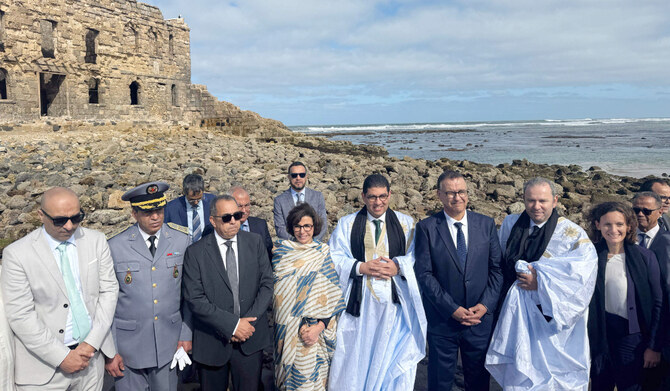
In first, French minister visits Western Sahara claimed by Morocco

Morocco's Minister of Youth, Culture, and Communication Mohamed Mehdi Bensaid (C-R) and France's Culture Minister Rachida Dati (C-L) visiting Tarfaya, in southern Morocco. (AFP)
Short Url
Updated 17 February 2025
Follow

In first, French minister visits Western Sahara claimed by Morocco

  • Algeria has backed the separatist Polisario Front and had already cut diplomatic relations with Rabat in 2021 — the year after Morocco normalized ties with Israel under a deal that awarded it US recognition of its annexation of the Western Sahara

LAAYOUNE: France’s Culture Minister Rachida Dati became on Monday the first French official to make a formal visit to the Western Sahara, a sign of Paris’s recognition of Moroccan sovereignty over the disputed territory.
“This is the first time that a French minister has come to the southern provinces,” Dati told AFP, using Morocco’s name for the area, a former Spanish colony controlled by Rabat but claimed by the Algeria-backed Polisario Front.
Dati described the visit as “historic.”
The United Nations considers Western Sahara a “non-self-governing territory” and has had a peacekeeping mission there since 1991, whose stated aim is to organize a referendum on the territory’s future.
But Rabat has repeatedly rejected any vote in which independence is an option, instead proposing autonomy under Morocco.
Dati, accompanied by Moroccan Culture Minister Mohamed Mehdi Bensaid, launched a French cultural mission in Laayoune, Western Sahara’s main city.
She promised to open the territory’s first French culture center to “benefit children in the region, but also teachers, schools, students and teacher trainers.”
In Dakhla, the Western Sahara’s second city some 530 kilometers (330 miles) south of Laayoune, Dati said she is set to sign a cooperation agreement in the field of cinema and audiovisual art.
France’s stance on Western Sahara has been ambiguous in recent years, often straining ties between Rabat and Paris.
But in July, French President Emmanuel Macron said that Morocco’s autonomy plan was the “only basis” to resolve the Western Sahara dispute.
The turnabout marked by Macron’s statement drew a strong reaction from Algiers.
Algeria has backed the separatist Polisario Front and had already cut diplomatic relations with Rabat in 2021 — the year after Morocco normalized ties with Israel under a deal that awarded it US recognition of its annexation of the Western Sahara.
Macron renewed French support for Morocco’s plan in October, pledging investments and a “strong and exceptional partnership.”
Also in October, the UN Security Council called for parties to “resume negotiations” to reach a “lasting and mutually acceptable solution” for the Western Sahara dispute.


Syrian troops, Kurdish forces poised on front lines as truce deadline looms

Updated 10 sec ago
Follow

Syrian troops, Kurdish forces poised on front lines as truce deadline looms

  • One-week deadline extension is possible, officials say
  • US mediators want to firm up ceasefire, see SDF integrate
QAMISHLI, Syria: Syrian troops and Kurdish forces were massed on opposing sides of front lines in northern Syria on Saturday, as the clock ticked down to an evening deadline that would determine whether they resume fighting or lay down their arms.
Neighboring Turkiye, as well as some officials in Syria, said late on Friday that the deadline could be extended.
Government troops have seized swathes of northern and eastern territory in the last two weeks from the Kurdish-led Syrian Democratic Forces in a rapid turn of events that has consolidated President Ahmed Al-Sharaa’s rule.
Sharaa’s forces were approaching a last cluster of Kurdish-held cities in the northeast earlier this week when he abruptly announced a ceasefire, giving the SDF until Saturday night to come up with a plan to ‌integrate with Syria’s ‌army.
Culmination of a year of rising tensions
As the deadline approached, ‌SDF ⁠forces also reinforced ‌their defensive positions in the cities of Qamishli, Hasakah and Kobani for a possible fight, Kurdish security sources said.
Syrian officials and SDF sources said it was likely the Saturday deadline would be extended for several days, possibly up to a week.
“Extending the ceasefire for a little longer may come onto the agenda,” said Hakan Fidan, the foreign minister of Turkiye, which is the strongest foreign backer of Sharaa’s government and sees the SDF as an arm of the outlawed Kurdistan Workers Party, or PKK.
The possible showdown in northern Syria is the culmination of ⁠rising tensions over the last year.
Sharaa, whose forces toppled longtime ruler Bashar Assad in late 2024, has vowed to bring all of ‌Syria under state control — including SDF-held areas in the northeast.
But Kurdish ‍authorities who have run autonomous civilian and military institutions ‍there for the last decade have resisted joining up with Sharaa’s Islamist-led government.
After a year-end deadline ‍for the merger passed with little progress, Syrian troops launched an offensive this month.
US, France caution Sharaa on Kurds, sources say
They swiftly captured two key Arab-majority provinces from the SDF, bringing key oil fields, hydroelectric dams and some facilities holding Islamic State fighters and affiliated civilians under government control.
The US has been engaging in shuttle diplomacy to establish a lasting ceasefire and facilitate the integration of the SDF — once Washington’s main partner in Syria — into the state led by its new US-favored ally, Sharaa.
Senior officials from the ⁠United States and France, which has also been involved in talks, have urged Sharaa not to send his troops into remaining Kurdish-held areas, diplomatic sources said.
They fear that renewed fighting could lead to mass abuses against Kurdish civilians. Government-affiliated forces killed nearly 1,500 people from the Alawite minority and hundreds of Druze people in sectarian violence last year, including in execution-style killings.
Amid the instability in the northeast, the US military has been transferring hundreds of detained fighters from the Daesh group from Syrian prisons across the border into Iraq.
Iraq’s Foreign Minister Fuad Hussein told the EU’s foreign policy chief, Kaja Kallas, in a phone call on Saturday that Baghdad should not bear the “security and financial burdens” of the transfer of IS prisoners alone, the Iraqi foreign ministry said in a statement.
Turkiye’s Fidan, speaking on broadcaster NTV late on Friday, cited these transfers as possibly necessitating ‌an extension to the Saturday deadline.