SINGAPORE: Singapore’s opposition leader was fined on Monday for lying to parliament while helping a fellow party member cover up a false witness account, but narrowly avoided being barred from contesting upcoming national elections.
Pritam Singh, 48, secretary-general of the Workers’ Party, was found guilty on two counts of lying to a parliamentary committee probing a fellow MP.
The conviction comes as the Southeast Asian nation’s struggling political opposition is seeking to challenge the overwhelming dominance of the ruling People’s Action Party (PAP) in elections expected within months.
The PAP has ruled the wealthy city-state since 1959.
District court judge Luke Tan said that contrary to what Singh told the committee, he had not done enough to get rookie MP Raeesah Khan to admit to her lie in parliament.
The judge also gave credence to Khan’s testimony that Singh had told her during a meeting to “take the lie to the grave.”
Singh, who said he would appeal the court’s decision, was fined S$7,000 ($5,200) for each charge.
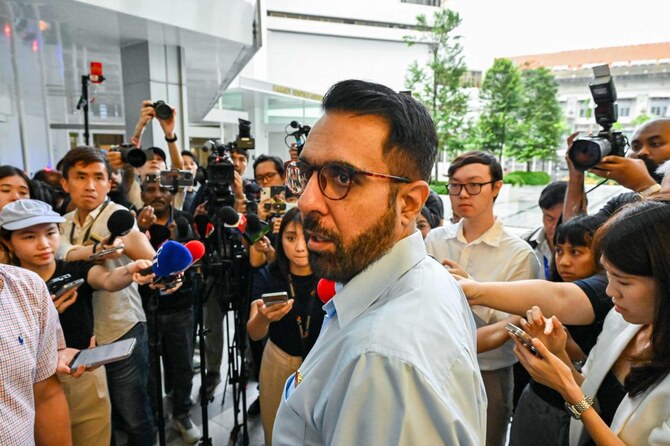
“It’s not going to be an easy election... we’ll have to fight hard, and that’s what we will do,” Singh told reporters outside the court.
“The path of choosing opposition politics is not for the faint hearted.”
Under the constitution, a person fined a minimum of Sg$10,000 or jailed for at least one year, is disqualified from running for election or holding a parliamentary seat for five years.
“He will not be disqualified as the threshold of $10,000 fine per charge is not crossed. You can’t stack up the fines,” Eugene Tan, who teaches constitutional law at Singapore Management University, said.
The Elections Department later confirmed this via a statement on Facebook.
Khan, who resigned from the legislature following the scandal, had admitted to making up a story she told in parliament about a female rape victim she accompanied to make a police report.
The former MP confessed that she lied when telling parliament in 2021 that a police officer supposedly made “insensitive comments” about the way the alleged victim was dressed and that she had drunk alcohol.
But Home Affairs Minister K. Shanmugam had said there was no record in the police files of such an incident and Khan eventually admitted to lying.
Singh was then accused of lying to the parliamentary committee investigating Khan.
He allegedly told the committee that he was not aware that Khan had made up the story about the rape victim, in an apparent attempt to downplay his responsibility as party leader, court documents said.
But the judge tore through Singh’s credibility as a witness.
In the 2020 general elections, the PAP won 83 of the 93 seats at stake to retain its dominance.
The main opposition Workers’ Party captured 10 seats – four more than previously held – in its strongest performance since independence in 1965.
Its leaders have said they hope to further increase the party’s numbers in parliament in the upcoming elections, which will be new premier Lawrence Wong’s first major political test.

Singapore opposition leader fined for lying to parliament
https://arab.news/nuhvq
Singapore opposition leader fined for lying to parliament
- Pritam Singh, secretary-general of the Workers’ Party, was found guilty on two counts of lying
- Singh, who said he would appeal the court’s decision, was fined S$7,000 ($5,200) for each charge
Isolated Kremlin critics lament lost future at Nemtsov memorial
- Hundreds used to flock to the makeshift memorial on the anniversary of his death
- Since Russia ordered troops into Ukraine it has intensified a crackdown on dissent, with almost no opposition to the Kremlin visible on the street
MOSCOW: On a bridge next to the Kremlin on a drizzly Friday morning, a lone Russian police officer stood looking at the half-dozen bunches of flowers laying in memory of slain opposition figure Boris Nemtsov.
The symbolism was almost too much.
Four years into Moscow’s full-scale offensive on Ukraine, which has seen President Vladimir Putin eradicate all forms of dissent and usher in strict military censorship laws that have silenced his critics, few Russians dared, or wanted, to pay tribute.
Nemtsov, a longtime Putin opponent, was shot and killed on February 27 2015, meters from the Kremlin’s red walls. He was 55.
Hundreds used to flock to the makeshift memorial on the anniversary of his death, which came on Friday.
This year, there was barely a trickle. Those who turned up were visibly nervous.
“So few people, they’ve all forgotten,” lamented one elderly man, who refused to give his name.
“Everybody is afraid,” a woman standing nearby added.
Since Russia ordered troops into Ukraine it has intensified a crackdown on dissent, with almost no opposition to the Kremlin visible on the street.
AFP reporters on Friday morning saw only around a dozen mourners alongside Western ambassadors laying red carnations.
“Keep moving, don’t gather in a crowd, don’t block the way for other citizens,” a police officer said through a megaphone.
Three days after Russia launched its offensive on Ukraine in 2022, protesters had staged an impromptu rally against the war at the memorial on the anniversary of Nemtsov’s death.
Nemtsov’s supporters have always accused Chechen leader and key Putin ally Ramzan Kadyrov of ordering his killing.
Kadyrov has rejected the claims.
Five Chechens were convicted of a contract killing but investigators never said who it was ordered by.
- ‘Everything is persecuted’ -
For his followers, Nemtsov is a totemic figure in Russian political life — seen as a once-future leader who might have taken the country on a different path.
“I come here every year,” said 79-year-old scientist Sergei at the bridge on Friday.
“Russia should have had — though unfortunately it didn’t work out — a leader exactly like Nemtsov,” he told AFP, declining to give his surname.
“Right now everything here is suppressed, everything is persecuted, people are sitting in prisons.”
A physicist by education, Nemtsov rose to fame in the 1990s as a young, liberal provincial governor, and was widely tipped to take over from Boris Yeltsin.
He gave his hesitant backing to Putin when the ex-KGB spy was tapped to enter the Kremlin instead, but became an early — and fierce — opponent of what he cast as the Russian leader’s creeping authoritarianism.
He had largely lost popularity and was only a marginal figure in Russian politics when he was killed in 2015. Still, his murder shocked the country and the world.
“The hopes of the whole country were pinned on him — of all the people who wanted it to be free here,” said Olga Vinogradova, a 66-year-old volunteer who tends to the pop-up memorial to Nemtsov on the bridge.
“When this man was killed, naturally, all of us were, we were all just executed at that moment. Because our hopes were destroyed,” she said.
“With this memorial, we remind people that there was a different path for Russia. And that there was a real person who could have led us down this path.”
- ‘Forced out’ -
Nemtsov had strongly opposed Putin’s 2014 annexation of Crimea from Ukraine and Moscow’s military backing for pro-Russian separatists in eastern Ukraine.
He was also a close and early ally of Alexei Navalny, who died in 2024 in an Arctic prison in what his supports say was a poisoning.
Open opposition to the Kremlin is unheard of inside Russia since the first days of the Ukraine offensive — when riot police cracked down hard on the thousands that took to the streets to protest.
All major critics of the Kremlin are in exile, prison or dead.
Those that remain have been silenced.
“Many have been forced out of the country, some have been killed,” said Gleb, a 23-year-old photographer.
A movement or person like Nemtsov was “impossible” to imagine right now, he said.
Still, he held on to a slither of hope.
“But everything can change at any moment.”