

Pakistan to deploy thousands of police for ICC Champions Trophy 

1 / 2
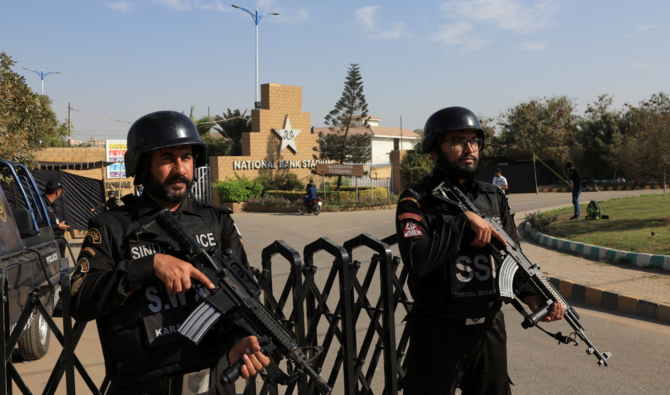
Members of the Special Security Unit (SSU) stand guard outside National Bank Stadium ahead of the ICC Champions Trophy 2025 tournament in Karachi, Pakistan February 14, 2025. (REUTERS)
2 / 2
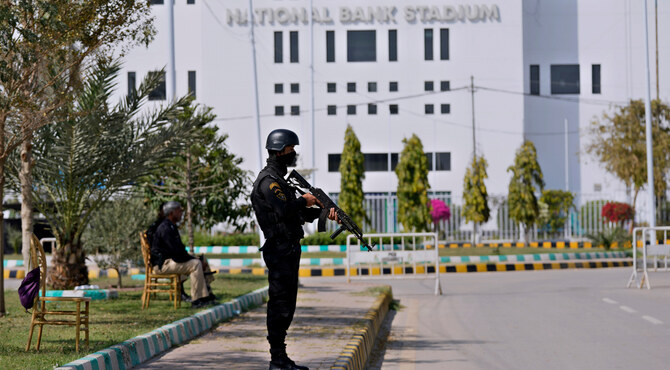
olice officers stand guard to ensure security outside the National Bank Stadium, where final preparations are going on for upcoming ICC Champions Trophy 2025, in Karachi, Pakistan, on Feb. 16, 2025. (AP)
Short Url
Updated 18 February 2025
Follow

Pakistan to deploy thousands of police for ICC Champions Trophy 

  • Over 12,000 police officers and personnel will perform security duties in cities of Lahore and Rawalpindi 
  • Various police units to carry out patrols during matches with snipers stationed on tall buildings around stadiums

ISLAMABAD: Over 12,000 police personnel will be deployed in the cities of Lahore and Rawalpindi as Pakistan stages its first major International Cricket Council (ICC) tournament in nearly three decades from Feb. 19, police said on Monday. 

A 2009 militant attack on the Sri Lanka team in the eastern city of Lahore led to international teams avoiding tours to Pakistan for almost a decade because of security concerns. The Sri Lankan test team returned in 2019 as international cricket made slow inroads back and foreign players were drafted for a men’s T20 domestic cricket league held annually in Pakistan. 

Later this week, Pakistan will host the eight-team ICC Champions Trophy in Lahore, Karachi and Rawalpindi. However, arch-rival India’s matches will take place in the United Arab Emirates after its government refused to give permission for the squad to travel to Pakistan. 

“For the Lahore and Rawalpindi matches, over 12,000 police officers and personnel will perform security duties,” a Punjab police spokesperson said in a statement. “More than 8,000 officers and personnel will perform security duties in Lahore and more than 5,000 in Rawalpindi.”

Senior officers, district superintendents of police, inspectors and women police personnel would be on duty for the series.

The statement quoted Punjab Inspector General of Police, Dr. Usman Anwar, as saying police were carrying out intelligence-based operations around the residences of players and team routes to stadiums, while Safe Cities Authority cameras would monitor these areas as well as stadiums and hotels.

Various police units would carry out patrols during the matches, with snipers stationed on tall buildings around the stadiums, Anwar added. 

“We will ensure the organization of international matches in a peaceful and secure environment,” he added, calling on fans to follow police instructions on security and safety protocols. 

The tournament will take place from Feb. 19 to Mar. 9 across three venues: Lahore, Karachi, and Rawalpindi. The Lahore and Karachi stadiums have recently reopened after extensive renovations to enhance broadcast quality and spectator comfort.

Pakistan won the Champions Trophy in 2017, defeating India by 180 runs in a one-sided final.

Pakistan’s last ICC event was when it co-hosted the 1996 World Cup with Sri Lanka and India.


Pakistan’s Mahnoor Omer named among TIME’s ‘Women of the Year’ for 2026

Updated 56 min 18 sec ago
Follow

Pakistan’s Mahnoor Omer named among TIME’s ‘Women of the Year’ for 2026

  • Omer moved a Pakistani court against the so-called ‘period tax’ in Sept. 2025 which has since sparked a national debate
  • Taxes on sanitary pads in Pakistan can add up to 40 percent to retail price, UNICEF says only around 12 percent women use such products

ISLAMABAD: Pakistani women’s rights activist Mahnoor Omer, who fought against taxes on menstrual products, has been named among the TIME magazine’s ‘Women of the Year’ for 2026.

Omer’s efforts have been recognized alongside 16 activists, artists, athletes and businesswomen in the TIME’s Women of the Year 2026 list, including Olympic gold medalist Sydney McLaughlin-Levrone and Oscar-nominated filmmaker Chloe Zhao.

Dissatisfied with the efforts to educate Pakistani girls about sexual violence, Omer founded the Noor Foundation at the age of 14 and held her own workshops with village girls about everything from climate change to menstruation, according to the TIME magazine.

Two years later, a conversation with a domestic worker about the price of pads made her realize that not everyone could afford these essentials. She moved a court against the so-called “period tax” in Sept. 2025 and the case has sparked a national debate on the subject, considered a taboo by many in Pakistan, since its first hearing late last year.

“A decade and one law degree after her interest in activism was sparked, Omer, now 25, is putting her passion and expertise to work in the name of gender equity,” TIME wrote about Omer on its website.

Taxes imposed on sanitary products in Pakistan can add up to 40 percent to the retail price. UNICEF estimates just 12 percent of women in the country use commercially produced pads or tampons. The alternative, using cloth, risks health impacts including rashes and infections, and can make it impossible for girls to attend school while menstruating.

Omer’s suit, which awaits the government response, has sparked a national discussion. She says she spoke about menstruation to her father and male cousins, who thanked her for standing up for their daughters.
The 25-year-old, who is currently enrolled in a master’s degree in gender, peace, and security at the London School of Economics, sees this case as just the first of many.

“I’m not free until every woman is free,” she was quoted as saying by TIME. “I want to leave no stones unturned in terms of what I can do with the next few decades, as a lawyer for the women in my country and gender minorities in general.”