

Sweden does not rule out sending peacekeepers to Ukraine, public broadcaster reports

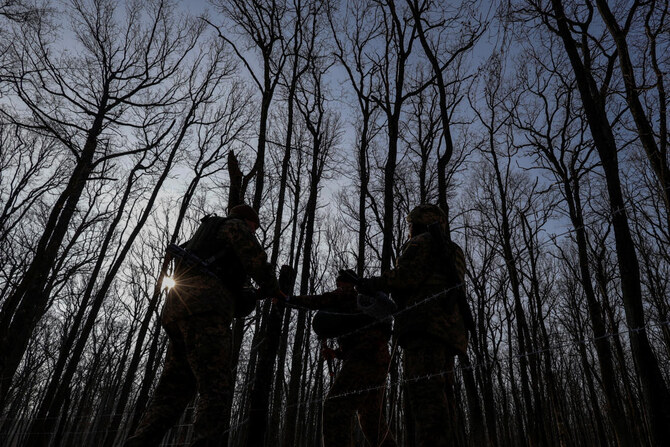
Ukrainian servicemen of the 211th Pontoon Bridge Brigade of the Armed Forces of Ukraine put up barbed wire as part of a system of new fortification, amid Russia's attack on Ukraine, in Kharkiv region, Ukraine February 14, 2025. (Reuters)
Short Url
Updated 17 February 2025
Follow

Sweden does not rule out sending peacekeepers to Ukraine, public broadcaster reports

  • The minister’s comments came after British Prime Minister Keir Starmer said he was ready to send British troops to Ukraine

STOCKHOLM: Sweden does not rule out sending troops to Ukraine as part of any postwar peacekeeping force, public broadcaster Swedish Radio reported on Monday, citing comments by the country’s foreign minister.

The minister’s comments came after British Prime Minister Keir Starmer said he was ready to send British troops to Ukraine for peacekeeping duties as he tried to show the US that European nations should have a role in talks on ending the war.
“We must now first negotiate a just and sustainable peace that respects international law, that respects Ukraine and that first and foremost ensures Russia can’t just pull back, build new strength and attack Ukraine or another country in just a few years’ time,” Foreign Minister Maria Malmer Stenergard said in an interview.
“Once we have such a peace established we need to ensure it can be maintained and then our government doesn’t exclude anything,” she added.
On Monday, US Secretary of State Marco Rubio arrived in Saudi Arabia ahead of expected talks with Russian officials aimed at ending Moscow’s nearly three-year war in Ukraine.


Bangladesh’s Yunus announces resignation, end of interim govt

Bangladesh’s interim leader Muhammad Yunus stepped down on February 16, 2026 in a farewell broadcast to the nation.
Updated 7 sec ago
Follow

Bangladesh’s Yunus announces resignation, end of interim govt

  • Yunus handed over power after congratulating the Bangladesh Nationalist Party and its leader Tarique Rahman

DHAKA: Bangladesh’s interim leader Muhammad Yunus stepped down on Monday in a farewell broadcast to the nation before handing over to an elected government.
“Today, the interim government is stepping down,” the 85-year-old Nobel Peace Prize winner said.
“But let the practice of democracy, freedom of speech, and fundamental rights that has begun not be halted.”
Yunus returned from self-imposed exile in August 2024, days after the iron-fisted government of Sheikh Hasina was overthrown by a student-led uprising and she fled by helicopter to India.
“That was the day of great liberation,” he said. “What a day of joy it was! Bangladeshis across the world shed tears of happiness. The youth of our country freed it from the grip of a demon.”
He has led Bangladesh as its “chief adviser” since, and now hands over power after congratulating the Bangladesh Nationalist Party (BNP) and its leader Tarique Rahman on a “landslide victory” in elections last week.
“The people, voters, political parties, and stakeholder institutions linked to the election have set a commendable example,” Yunus said.
“This election has set a benchmark for future elections.”
Rahman, 60, chief of the BNP and scion of one of the country’s most powerful political dynasties, will lead the South Asian nation of 170 million.
Rebuilt institutions’
Bangladeshi voters endorsed sweeping democratic reforms in a national referendum, a key pillar of Yunus’s post-uprising transition agenda, on the same day as the elections.
The lengthy document, known as the “July Charter” after the month when the uprising that toppled Hasina began, proposes term limits for prime ministers, the creation of an upper house of parliament, stronger presidential powers and greater judicial independence.
“We did not start from zero — we started from a deficit,” he said.
“Sweeping away the ruins, we rebuilt institutions and set the course for reforms.”
The referendum noted that approval would make the charter “binding on the parties that win” the election, obliging them to endorse it.
However, several parties raised questions before the vote, and the reforms will still require ratification by the new parliament.
The BNP alliance won 212 seats, compared with 77 for the Jamaat-e-Islami-led alliance, according to the Election Commission.
Jamaat chief Shafiqur Rahman conceded on Saturday, saying his Islamist party would “serve as a vigilant, principled, and peaceful opposition.”
Newly elected lawmakers are expected to be sworn in on Tuesday, after which Tarique Rahman is set to become Bangladesh’s next prime minister.
Police records show that political clashes during the campaign period killed five people and injured more than 600.
However, despite weeks of turbulence ahead of the polls, voting day passed without major unrest and the country has responded to the results with relative calm.