

Pakistan sees Saudi Vision 2030 as model for its economic transformation

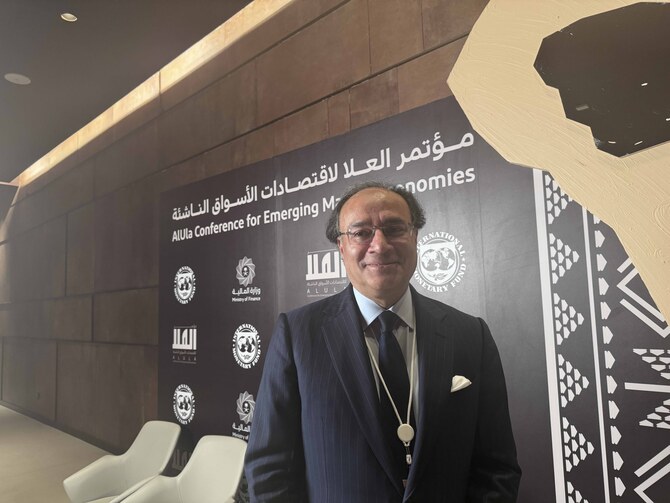
Pakistan’s Finance Minister Muhammad Aurangzeb. AN photo
Short Url
Updated 17 February 2025
Follow

Pakistan sees Saudi Vision 2030 as model for its economic transformation

RIYADH: Saudi Arabia’s influence in regional economic transformation is expanding, with Pakistan acknowledging the Kingdom’s progress under Vision 2030 as a valuable model, according to a senior official.

In an interview with Arab News during the AlUla Conference for Emerging Market Economies, Pakistan’s Finance Minister Muhammad Aurangzeb emphasized that Saudi Arabia’s leadership in economic reforms offers important lessons for Pakistan as it embarks on its own structural changes.

“Pakistan and the Kingdom of Saudi Arabia have been long-standing partners, one of the strongest partnerships that we have,” Aurangzeb said.

“As we go through our own structural reforms at this point in time, on the back of the macroeconomic stability that we have achieved, there’s a lot to learn from Vision 2030,” the minister said.

He also stated that the Kingdom is well ahead of its targets of Vision 2030, “so there’s so much to learn in Pakistan from our partners in Saudi Arabia.”

Saudi investments 

The finance minister also highlighted the growing Saudi investments in Pakistan, particularly in the business-to-business sector. He pointed to recent developments such as Saudi Aramco’s foray into the downstream petroleum industry and ongoing talks concerning government-to-government agreements.

“We’ve already had a few investments coming through from Saudi Arabia in the B2B space, and then of course, we have just seen Aramco coming into downstream, so these are all very, very good investments,” Aurangzeb said.

“There are a number of G2G transactions which are underway at this point in time to be announced later in the year.”

Aurangzeb underscored the potential for boosting exports from Pakistan to Saudi Arabia, especially in the skilled labor sector.

He noted that this aligns with the Kingdom’s expanding workforce needs as it progresses toward its Vision 2030 objectives.

The minister added: “Meanwhile, we remain grateful for the support that we have received from Saudi Arabia, especially with respect to our IMF program.”

The minister noted that the conference serves as an important multilateral platform to discuss economic resilience and cooperation among emerging economies.


Closing Bell: Saudi main index slips to close at 11,228 

Updated 15 February 2026
Follow

Closing Bell: Saudi main index slips to close at 11,228 

RIYADH: Saudi Arabia’s Tadawul All Share Index slipped on Sunday, lost 23.17 points, or 0.21 percent, to close at 11,228.64. 

The total trading turnover of the benchmark index was SR2.99 billion ($797 million), as 170 of the stocks advanced and 82 retreated.    

On the other hand, the Kingdom’s parallel market Nomu gained 449.38 points, or 1.90 percent, to close at 24,093.12. This comes as 43 of the stocks advanced while 27 retreated.    

The MSCI Tadawul Index lost 6.07 points, or 0.40 percent, to close at 1,511.36.     

The best-performing stock of the day was Obeikan Glass Co., whose share price surged 7.54 percent to SR27.66.  

Other top performers included Alamar Foods Co., whose share price rose 6.80 percent to SR47.10, as well as Saudi Kayan Petrochemical Co., whose share price climbed 6.79 percent to SR5.66.   

Saudi Investment Bank recorded the steepest drop, falling 3.21 percent to SR13.56. 

Jahez International Co. for Information System Technology also saw its share price fall 3.15 percent to SR13.55. 

Rabigh Refining and Petrochemical Co. declined 2.78 percent to SR7.34. 

On the announcements front, Tanmiah Food Co. reported its annual financial results for the period ending Dec. 31. According to a Tadawul statement, the company recorded a net loss of SR18.8 million, compared with a net profit of SR95.8 million a year earlier. 

The net loss was mainly due to ongoing market challenges that resulted in continued pricing pressures in fresh poultry, inflationary cost pressures, higher financing expenses, and depreciation and ramp-up costs from new facilities, partially offset by increased production volumes and cost-optimization initiatives.  

Tanmiah Food Co. ended the session at SR58.20, up 3.72 percent. 

United International Holding Co., also known as Tas’heel, announced its annual financial results for the period ending Dec. 31. A bourse filing showed the company recorded a net profit of SR273.64 million in 2025, up 23.05 percent from 2024, primarily driven by a 23.4 percent rise in revenues. The revenue growth helped lift gross profit by 23.7 percent. 

Tas’heel ended the session at SR146.80, down 0.28 percent.