

Myanmar junta criticizes Argentina arrest warrant

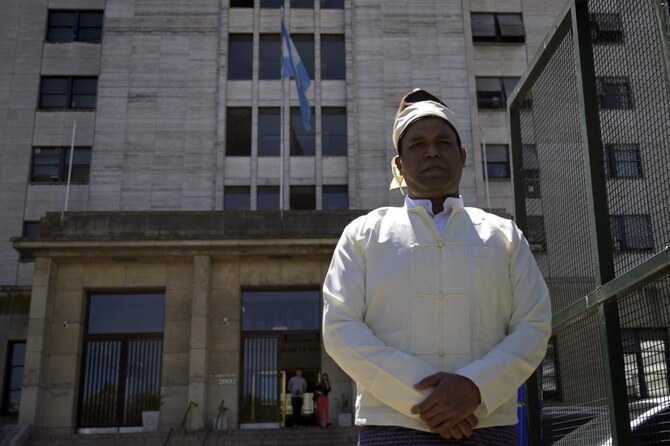
Myanmar’s ruling junta criticized an Argentine court on Saturday for issuing an arrest warrant for its top leader over alleged “genocide and crimes against humanity” toward the Rohingya minority.(AFP)
Short Url
Updated 15 February 2025
Follow

Myanmar junta criticizes Argentina arrest warrant

  • Myanmar’s ruling junta criticized an Argentine court on Saturday for issuing an arrest warrant for its top leader over alleged “genocide and crimes against humanity” toward the Rohingya minority

YANGON: Myanmar’s ruling junta criticized an Argentine court on Saturday for issuing an arrest warrant for its top leader over alleged “genocide and crimes against humanity” toward the Rohingya minority.
The Rohingyas are a predominantly Muslim community from Buddhist-majority Myanmar where, according to Amnesty International, they have been subjected to apartheid conditions.
This week an Argentine court issued warrants for military and civilian officials including junta leader Min Aung Hlaing, ex-president Htin Kyaw, and former elected civilian leader Aung San Suu Kyi.
The ruling, seen by AFP on Friday, was issued in response to a complaint filed in Argentina by a Rohingya advocacy group.
In response, junta spokesman Zaw Min Tun said: “Does Argentina know Myanmar? The Myanmar government does know Argentina.”
“We like to suggest Argentina to appoint their needed and vacant judge positions firstly for their domestic judiciary if they want to criticize Myanmar according to the law,” he told journalists in a message on Saturday.
Zaw Min Tun’s comments appear to reference reports in December that Buenos Aires needed to name 150 judges across all levels of the judiciary.

The legal complaint was filed under the principle of universal jurisdiction, by which countries can prosecute crimes regardless of where they occurred if, like genocide or war crimes, they are considered sufficiently serious.
Of those subject to arrest warrants, Aung San Suu Kyi is named over her role as state counsellor from 2016 to 2021, when she was ousted in a coup.
She has been accused by detractors of doing little to stop the abuse of Rohingya during that time.
Min Aung Hlaing is also under investigation by the International Criminal Court, while the International Court of Justice — the UN’s highest tribunal — is examining a complaint of “genocide” against Myanmar.
Many Rohingya have been forced to flee persecution and violence to refugee camps in Bangladesh or risk their lives on perilous sea journeys to try to reach Malaysia or Indonesia through Thailand.
Myanmar has been in turmoil since the 2021 coup that sparked renewed clashes with ethnic rebels and saw the formation of dozens of “People’s Defense Forces” now battling the junta.
Tun Khin, president of the Burmese Rohingya Organization UK, welcomed the latest ruling as an “historic step toward justice for Rohingya and everyone in Burma suffering under the Burmese military.”
It was “also a victory for international justice at a time of growing violations of international law worldwide,” he said in a statement released Friday.


Junta leader Gen. Mamdi Doumbouya is declared winner of Guinea’s election, provisional results show

Updated 56 min 27 sec ago
Follow

Junta leader Gen. Mamdi Doumbouya is declared winner of Guinea’s election, provisional results show

  • Mamady Doumbouya took power in 2021 coup

CONAKRY, Guinea: Guinea coup leader ​Mamady Doumbouya has been elected president, according to provisional results announced on Tuesday, completing the return to civilian rule in the bauxite- and iron ore-rich West African nation.
The former special forces commander, thought to be in his early 40s, seized power in 2021, toppling then-President Alpha Conde, who had been in office since 2010. It was one in a series of nine coups that have reshaped politics in West and Central Africa since 2020.
The provisional results announced ‌on Tuesday showed Doumbouya ‌winning 86.72 percent of the December 28 vote, ‌an ⁠absolute majority ​that allows ‌him to avoid a runoff.
The Supreme Court has eight days to validate the results in the event of any challenge.
Doumbouya’s victory, which gives him a seven-year mandate, was widely expected. Conde and Cellou Dalein Diallo, Guinea’s longtime opposition leader, are in exile, which left Doumbouya to face a fragmented field of eight challengers.
Doumbouya reversed pledge not to run
The original post-coup charter in Guinea barred junta members from running ⁠in elections, but a constitution dropping those restrictions was passed in a September referendum.
Djenabou Toure, the ‌country’s top election official who announced the results on ‍Tuesday night, said turnout was 80,95 percent. However ‍voter participation appeared tepid in the capital Conakry, and opposition politicians rejected ‍a similarly high turnout figure for the September referendum.
Guinea holds the world’s largest bauxite reserves and the richest untapped iron ore deposit at Simandou, officially launched last month after years of delay.
Doumbouya has claimed credit for pushing the project forward and ensuring Guinea benefits ​from its output.
His government this year also revoked the license of Emirates Global Aluminium’s subsidiary Guinea Alumina Corporation following a refinery dispute, ⁠transferring the unit’s assets to a state-owned firm.
The turn toward resource nationalism — echoed in Mali, Burkina Faso and Niger — has boosted his popularity, as has his relative youth in a country where the median age is about 19.
Political space restricted, UN says
Political debate has been muted under Doumbouya. Civil society groups accuse his government of banning protests, curbing press freedom and restricting opposition activity.
The campaign period was “severely restricted, marked by intimidation of opposition actors, apparently politically motivated enforced disappearances, and constraints on media freedom,” UN rights chief Volker Turk said last week.
On Monday, opposition candidate Faya Lansana Millimono told a press conference the election was marred by “systematic fraudulent practices” and ‌that observers were prevented from monitoring the voting and counting processes.
The government did not respond to a request for comment.