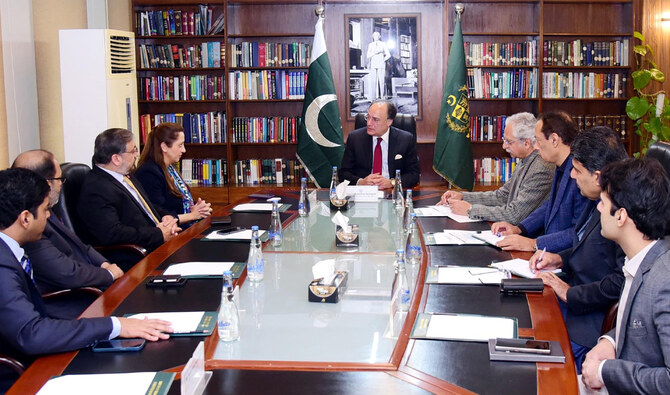
KARACHI: Finance Minister Muhammad Aurangzeb on Friday met a delegation of Association of Chartered Certified Accountants (ACCA) and assured that his country was fostering a robust financial management framework aligned with global best practices amid its efforts for economic recovery.
The ACCA delegation, led by its global president Ayla Majid, briefed the minister about its collaborations with policymakers and government agencies, including the Finance Division, the Auditor General’s Office, and the Securities and Exchange Commission of Pakistan (SECP).
The delegation elaborated on ACCA’s specialized training, certifications and capacity-building programs, particularly in areas such as innovation, technology, public financial management, and financial governance, according to the Press Information Department (PID) of the Pakistani government.
During the meeting, Aurangzeb emphasized the need for outcome-based training and certification programs to ensure accountability and ownership in capacity-building initiatives in the South Asian country.
“He encouraged the organization to engage with other ministries and departments for broader training and development programs,” the PID said in a statement.
“The finance minister also underscored the importance of focusing on climate finance, particularly in terms of its utilization and measurable outcomes, to ensure sustainable economic growth.”
The development comes as Pakistan treads a tricky path to economic recovery under a $7 billion International Monetary Fund (IMF) loan program it secured in September last year.
Since averting an imminent default on its external debt in 2023, Pakistan is now keeping its current account in check primarily through containing imports. The country’s exports rose 10 percent to $19.6 billion in the last seven months till January, while it is keeping tabs on imports that increased by 7 percent to $33 billion, according to Pakistan Bureau of Statistics.
“Both sides reaffirmed their commitment to strengthening cooperation in financial governance and professional development, with a shared vision of enhancing Pakistan’s economic resilience and institutional capacity,” the PID added.


![]()

Pakistan commits to best financial management practices amid efforts to revive economy
Short Url
https://arab.news/wgx9c
Pakistan commits to best financial management practices amid efforts to revive economy
- Pakistan is navigating an economic recovery path under a $7 billion IMF loan program it secured in September last year
- The country is keeping its current account in check primarily through containing imports since averting a default in 2023
Latest updates


© 2026 SAUDI RESEARCH & PUBLISHING COMPANY, All Rights Reserved And subject to Terms of Use Agreement.