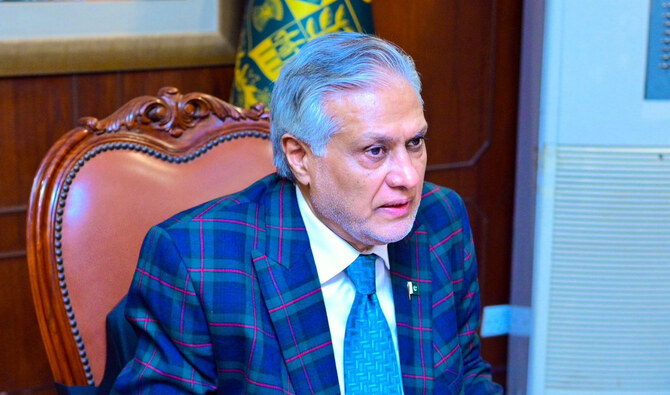
ISLAMABAD: Pakistan’s Deputy Prime Minister Ishaq Dar will travel to New York to attend a United Nations Security Council (UNSC) meeting on global governance and multilateralism next week, the foreign office announced on Friday.
The meeting will be chaired by Chinese Foreign Minister Wang Yi, as China holds the council’s rotating presidency for the month. The deliberations come at a time of growing concerns about multilateralism, particularly after United States President Donald Trump’s return to the White House.
During his previous term, Trump withdrew the US from key international agreements, challenged traditional alliances and took a more unilateral approach to foreign policy. His new administration’s stance on global governance and international institutions remains under close watch by world leaders.
“The Deputy Prime Minister and Foreign Minister of Pakistan, Senator Mohammad Ishaq Dar, will travel to New York to participate in the high-level meeting of the United Nations Security Council (UNSC) on ‘Practicing Multilateralism: Reforming and Improving Global Governance,’ scheduled to be held from 18th February 2025,” foreign office spokesperson Shafqat Ali Khan said on Friday.
“The meeting has been convened by China under its rotating presidency of the Security Council for the month of February 2025. It will be chaired by H.E. Wang Yi, the Foreign Minister of China,” he added.
Dar is also expected to hold bilateral meetings with foreign ministers from other states as well as senior UN officials on the sidelines of the event.
While it is customary for Pakistan’s top leadership, particularly its prime ministers, to attend the UN General Assembly session in New York every September, visits to participate in other meetings at the world body are relatively rare.
Pakistan was elected as a non-permanent member of the UNSC for the 2025-2026 term in June 2024 with 182 out of 193 votes.
It officially began its two-year tenure on January 1, 2025.


Pakistan’s deputy PM to attend Security Council meeting on multilateralism next week
https://arab.news/65rhb
Pakistan’s deputy PM to attend Security Council meeting on multilateralism next week

- Ishaq Dar will travel to New York to participate in the gathering convened by China
- Dar will hold meetings with foreign ministers from other states as well as UN officials

India captain says will travel for Pakistan clash despite boycott
- Pakistan have announced they will boycott their match against India on Feb. 15 in Sri Lanka
- India need to be at the stadium on Feb. 15 to ensure they are awarded two points for match
MUMBAI: India captain Suryakumar Yadav said Thursday that his team would show up in Colombo for their T20 World Cup clash against Pakistan, despite their Group A opponents and arch-rivals boycotting the match.
“We haven’t said no to playing them (Pakistan),” Yadav told reporters at Mumbai’s Wankhede stadium, where India will begin their campaign against the United States on Saturday’s opening day.
“They are the ones who have said no. Our flights are booked and we are going to Colombo.”
India need to be at the stadium and ready to take the field for the February 15 match in order to make sure of being awarded the two points for a match forfeit.
The tournament, co-hosted by Sri Lanka and India, has been overshadowed by weeks of political posturing in the build-up.
Bangladesh were kicked out for refusing to play in India and Pakistan’s government then told its team not to show up at the clash of the arch-rivals as a show of support for Bangladesh.
Pakistan and India have not played bilateral cricket for more than a decade, and meet only in global or regional tournaments events.
India start the T20 World Cup on home soil with a great chance of retaining the title they won two years ago and Yadav agreed they were the side to beat.
“The way we have been playing, it looks like we are the favorites,” he smiled.
If that seemed like an overconfident statement, the India captain was quick to caution: “There are 19 (other) good teams in the tournament, though.
“On a given day, when you play, you have to bring your A-game and play good cricket.”
India know that their opening opponents, the United States, caused the biggest upset of the 2024 tournament when they beat Pakistan in a super over.
Yadav said no team would be taken lightly.
“I’m sure every game will be very important,” he said.


