

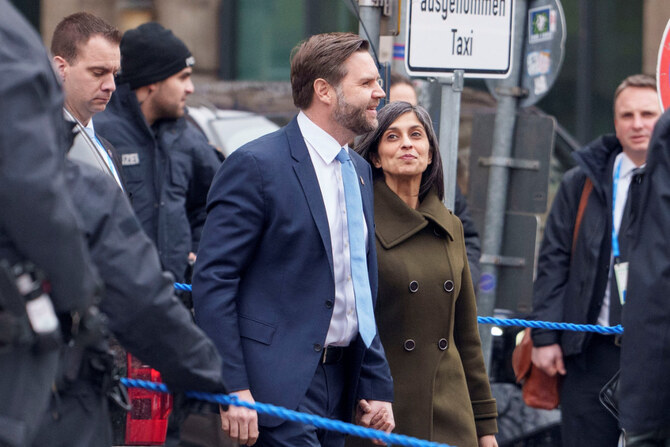

MUNICH: US Vice President JD Vance accused European leaders on Friday of censoring free speech and failing to control immigration, drawing a sharp rebuke from Germany’s defense minister and overshadowing discussions on the war in Ukraine.
The prospect of peace talks had been expected to dominate the annual Munich Security Conference after a call between US President Donald Trump and Russian leader Vladimir Putin this week but Vance barely mentioned Russia or Ukraine in his speech to the gathering.
He said the threat to Europe that worried him most was not Russia or China but what he called a retreat from fundamental values of protecting free speech — as well as immigration, which he said was “out of control” in Europe.
German Defense Minister Boris Pistorius hit back in his speech to the conference later in the day, calling Vance’s remarks “unacceptable.”
He said Vance had called into question democracy not only in Germany but in Europe as a whole.
The clash underlined the divergent worldviews of Trump’s new administration and European leaders, making it hard for longtime allies the United States and Europe to find common ground on issues including Ukraine.
Many conference delegates watched Vance’s speech in stunned silence. There was little applause as he delivered his remarks.
After his speech, Vance met with Alice Weidel, the leader of the far-right Alternative for Germany (AfD) party, a move likely to draw criticism as unwelcome interference ahead of German federal elections next week.
Trump’s call with Putin alarmed European governments, which have tried to isolate the Russian president since Moscow’s 2022 invasion of Ukraine and fear they could be cut out of peace talks that would have repercussions for their own security.
Vance, who met Ukrainian President Volodymyr Zelensky in Munich on Friday, told the Wall Street Journal in an interview before the conference that Trump could use several tools — economic and military — for leverage with Putin.
Vance’s spokesman, William Martin, later took issue with the newspaper’s interpretation that the vice president had been threatening Russia.
Peace talks
Zelensky said at the Munich conference that he would talk to Putin only once Ukraine had agreed on a common plan with Trump and European leaders.
Vance and Zelensky declined to give details of what they discussed in Munich but the Ukrainian president reiterated that his country needs “real security guarantees.”
German Foreign Minister Annalena Baerbock warned against any attempt to impose a peace deal on Ukraine.
“A sham peace — over the heads of Ukrainians and Europeans — would gain nothing,” she said. “A sham peace would not bring lasting security, neither for the people in Ukraine nor for us in Europe or the United States.”
Russia now holds about 20 percent of Ukraine nearly three years after launching a full-scale invasion, saying Kyiv’s pursuit of NATO membership posed an existential threat. Ukraine and the West call Russia’s action an imperialist land grab.
Vance also repeated Trump’s demand that Europe do more to safeguard its own defense so Washington can focus on other regions, particularly the Indo-Pacific.
“In the future, we think Europe is going to have to take a bigger role in its own security,” he said in a meeting with German President Frank-Walter Steinmeier.
NATO Secretary General Mark Rutte said Vance was “absolutely right” about the need for Europe “stepping up” and doing more for its own defense. “We have to grow up in that sense and spend much more,” Rutte said.
At the conference, several European leaders echoed his comments, saying Europe would step up its defense spending but also needed to discuss with Washington on a gradual phasing-out of its support.
Prior to meeting with the AfD leader, Vance suggested in his speech that the group is an eligible political partner, appearing to denounce a policy not to work with the AfD held by Germany’s major political parties.
The anti-immigration AfD is monitored by German security services on suspicion of being right-wing extremist. It is currently polling at around 20 percent ahead of the February 23 general election.
Billionaire US businessman Elon Musk, the biggest donor to Trump’s 2024 election effort and now head of Trump’s task force to slash US government spending, has also publicly backed the AfD.


