

Tunisian startup takes on e-waste challenge

1 / 3
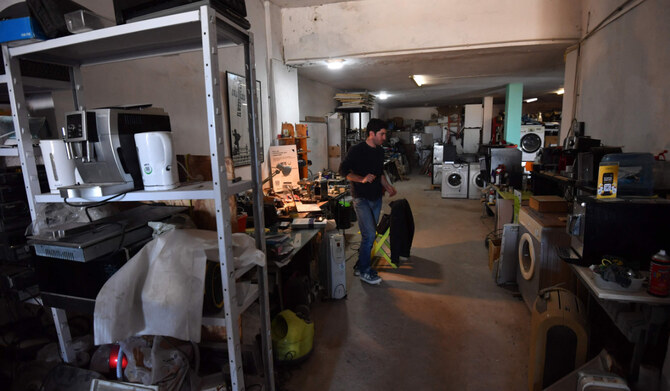
A technician works at Wefix, a startup business founded by Sabri Cheriha,a Tunisian engineer turned social entrepreneur, in Tunis, on January 24, 2025. (AFP)
2 / 3
Sabri Cheriha, a Tunisian engineer turned social entrepreneur, works at the depot that hosts Wefix, a startup business that he founded in Tunis, on January 24, 2025. (AFP)
3 / 3
Sabri Cheriha, a Tunisian engineer turned social entrepreneur, works at the depot that hosts Wefix, a startup business that he founded in Tunis, on January 24, 2025. (AFP)
Short Url
Updated 14 February 2025
Follow

Tunisian startup takes on e-waste challenge

  • The aim is to have “an environmental and social impact, but also an economic gain,” Cheriha said, adding that refurbished products can be up to 60 percent cheaper in a country where the average monthly salary is around 1,000 dinars ($310)

TUNIS: Engineer turned social entrepreneur Sabri Cheriha hunches over a washing machine at a small depot in a suburb of Tunisia’s capital, the unassuming home of a startup he launched to tackle the country’s mounting electronic waste problem.
Cheriha said there were about 8 million household appliances and 9 million cell phones in use across Tunisia, but once these devices break down or are replaced, “there’s no service to dispose of them properly.”
WeFix, the startup that won him a second-place regional social entrepreneur award last year, stands out by offering an “all-in-one service,” providing collection, repairs, and recycling to reduce e-waste.
The aim is to have “an environmental and social impact, but also an economic gain,” Cheriha said, adding that refurbished products can be up to 60 percent cheaper in a country where the average monthly salary is around 1,000 dinars ($310).
The startup “avoided” 20 tonnes of waste in 2023 and 80 tonnes last year, according to its founder, who anticipates handling another 120 tonnes this year.
“When we talk about ‘avoided waste,’ we’re also considering the resources needed to manufacture a single washing machine — 50 or 60 kg of finished product require over a tonne of raw materials,” he explained.


Syria Kurds chief says ‘all efforts’ being made to salvage deal with Damascus

Updated 25 December 2025
Follow

Syria Kurds chief says ‘all efforts’ being made to salvage deal with Damascus

  • Abdi said the Syrian Democratic Forces (SDF), the Kurds’ de facto army, remained committed to the deal
  • The two sides were working toward “mutual understanding” on military integration and counter-terrorism

DAMASCUS: Syrian Kurdish leader Mazloum Abdi said Thursday that “all efforts” were being made to prevent the collapse of talks on an agreement with Damascus to integrate his forces into the central government.
The remarks came days after Aleppo saw deadly clashes between the two sides before their respective leaders ordered a ceasefire.
In March, Abdi signed a deal with Syrian President Ahmed Al-Sharaa to merge the Kurds’ semi-autonomous administration into the government by year’s end, but differences have held up its implementation.
Abdi said the Syrian Democratic Forces (SDF), the Kurds’ de facto army, remained committed to the deal, adding in a statement that the two sides were working toward “mutual understanding” on military integration and counter-terrorism, and pledging further meetings with Damascus.
Downplaying the year-end deadline, he said the deal “did not specify a time limit for its ending or for the return to military solutions.”
He added that “all efforts are being made to prevent the collapse of this process” and that he considered failure unlikely.
Abdi also repeated the SDF’s demand for decentralization, which has been rejected by Syria’s Islamist authorities, who took power after ousting longtime ruler Bashar Assad last year.
Turkiye, an important ally of Syria’s new leaders, sees the presence of Kurdish forces on its border as a security threat.
In Damascus this week, Turkish Foreign Minister Hakan Fidan stressed the importance of the Kurds’ integration, having warned the week before that patience with the SDF “is running out.”
The SDF control large swathes of the country’s oil-rich north and northeast, and with the support of a US-led international coalition, were integral to the territorial defeat of the Daesh group in Syria in 2019.
Syria last month joined the anti-IS coalition and has announced operations against the jihadist group in recent days.