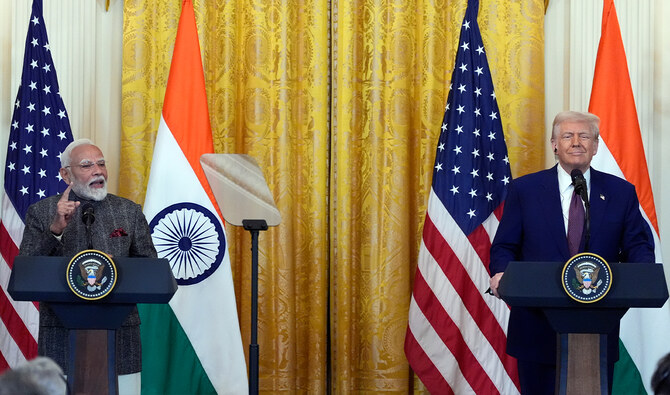
WASHINGTON: The US has approved the extradition of a suspect in the 2008 militant attacks in India’s financial capital Mumbai in which over 160 people were killed, President Donald Trump said on Thursday in a press conference with Indian Prime Minister Narendra Modi.
The three-day attacks on hotels, a train station and a Jewish center in which 166 people were killed began on November 26, 2008. India says Pakistan-based group Lashkar-e-Taiba orchestrated the attacks. Pakistan’s government denies being involved.
“I am pleased to announce that my administration has approved the extradition of one of the plotters and one of the very evil people of the world, having to do with the horrific 2008 Mumbai terrorist attack to face justice in India. So he is going to be going back to India to face justice,” Trump told reporters at the White House.
Trump did not name the individual but media reports identified him as Pakistani-origin Chicago businessman and Canadian citizen Tahawwur Rana.
Late last month, the US Supreme Court rejected Rana’s review petition against his extradition.
Rana was previously sentenced to US federal prison for providing support to the Lashkar-e-Taiba.
Trump was also asked in the press conference about Sikh separatists in the United States, whom India calls security threats. Sikh separatists demand an independent homeland known as Khalistan to be carved out of India.
Trump did not respond directly to the question but said India and the US worked together on crime.
Since 2023, India’s alleged targeting of Sikh separatists in the US and Canada has emerged as a wrinkle in US-India ties, with Washington charging an ex-Indian intelligence officer in a foiled US plot. India says it is probing US allegations.

Trump says US has approved extradition of suspect in 2008 Mumbai attacks
Short Url
https://arab.news/6225q
Trump says US has approved extradition of suspect in 2008 Mumbai attacks
- The three-day attacks on hotels, a train station and a Jewish center killed 166 people in November 2008
- India says Pakistan-based group Lashkar-e-Taiba orchestrated the attacks. Pakistan denies being involved
Afghan polio survivor’s sock factory provides hope by employing disabled workers
HERAT: In a tiny room in the center of Herat, Afghanistan’s westernmost city, Shahabuddin uses his hands to propel himself along the floor to a freshly-made pile of socks waiting to be sorted and packaged.
A double amputee since a roadside bomb took both his legs a decade ago, when Afghanistan was mired in conflict between US-led forces and Taliban insurgents, the 36-year-old father of four had struggled to find work. Unemployed for the last decade, he had been forced to rely on relatives for his family’s survival.
But a new sock production workshop in Herat employing only disabled workers has given him new hope.
“I became disabled due to the explosion. Both my legs were amputated,” Shahabuddin, who like many Afghans goes by only one name, said during a brief pause in his work in early December. “Now I work here in a sock factory, and I am very happy that I have been given a job here.”
The workshop is the brainchild of Mohammad Amiri, 35, a former grocery shop worker who started the business about a month ago. Amiri, himself disabled by childhood polio, wanted to create jobs and help provide income for other people with disabilities, particularly as many of them were injured during the conflict and have no other means of income.
He teamed up with another polio survivor to start the sock factory with a workforce of men disabled either through traumatic injuries or because of congenital issues or other reasons. They make four types of socks: long and short, for winter and summer.
“The factory, which is funded and supported by people with disabilities, began operations last month and currently employs around 50 people with disabilities,” Amiri said. “They are busy in the production, packaging and sale of socks in the city.”
A combination of decades of conflict, a weak health care system and struggling economy have contributed to high levels of disability in Afghanistan. Data from a 2019 Model Disability Survey conducted by The Asia Foundation nonprofit organization indicates that nearly 25 percent of adults live with a mild disability, while 40 percent have moderate and about 14 percent have severe disabilities.
“These figures compel us to act with greater urgency and commitment,” the UN Assistance Mission in Afghanistan said in a statement released on the International Day of Persons with Disabilities on Dec. 3, quoting the same figures. “Persons with disabilities must not be treated as an afterthought; they must be fully integrated into every stage of planning, decision-making, and service delivery.”
Meanwhile, Afghanistan is one of only two countries — along with neighboring Pakistan — where wild poliovirus remains endemic. The infectious disease can cause flu-like symptoms, but can also cause severe reactions, including paralysis, disability and death.
The Afghan Ministry of Martyrs and Disabled Affairs says 189,635 disabled people across the country are registered and receiving financial support from the government.
Amiri said his business faces serious competition from cheap imports of textiles, and expressed the hope that the government would stop imports from abroad. He has hopes of getting a contract to provide the Afghan security forces with socks, and wants to expand his workforce to 2,000 people.
His current employees include former refugees who have recently returned to Afghanistan after spending years abroad.
One such man is Mohammad Arif Jafari, 40, an economics graduate and polio survivor who lived in Iran for years. Returning to Afghanistan has been hard, he said.
“I suffered a lot due to unemployment. But fortunately, now I produce several types of socks,” he said while selling his wares from a stall on the streets of Herat. “I am happy that I am working here and earning an income.”
A double amputee since a roadside bomb took both his legs a decade ago, when Afghanistan was mired in conflict between US-led forces and Taliban insurgents, the 36-year-old father of four had struggled to find work. Unemployed for the last decade, he had been forced to rely on relatives for his family’s survival.
But a new sock production workshop in Herat employing only disabled workers has given him new hope.
“I became disabled due to the explosion. Both my legs were amputated,” Shahabuddin, who like many Afghans goes by only one name, said during a brief pause in his work in early December. “Now I work here in a sock factory, and I am very happy that I have been given a job here.”
The workshop is the brainchild of Mohammad Amiri, 35, a former grocery shop worker who started the business about a month ago. Amiri, himself disabled by childhood polio, wanted to create jobs and help provide income for other people with disabilities, particularly as many of them were injured during the conflict and have no other means of income.
He teamed up with another polio survivor to start the sock factory with a workforce of men disabled either through traumatic injuries or because of congenital issues or other reasons. They make four types of socks: long and short, for winter and summer.
“The factory, which is funded and supported by people with disabilities, began operations last month and currently employs around 50 people with disabilities,” Amiri said. “They are busy in the production, packaging and sale of socks in the city.”
A combination of decades of conflict, a weak health care system and struggling economy have contributed to high levels of disability in Afghanistan. Data from a 2019 Model Disability Survey conducted by The Asia Foundation nonprofit organization indicates that nearly 25 percent of adults live with a mild disability, while 40 percent have moderate and about 14 percent have severe disabilities.
“These figures compel us to act with greater urgency and commitment,” the UN Assistance Mission in Afghanistan said in a statement released on the International Day of Persons with Disabilities on Dec. 3, quoting the same figures. “Persons with disabilities must not be treated as an afterthought; they must be fully integrated into every stage of planning, decision-making, and service delivery.”
Meanwhile, Afghanistan is one of only two countries — along with neighboring Pakistan — where wild poliovirus remains endemic. The infectious disease can cause flu-like symptoms, but can also cause severe reactions, including paralysis, disability and death.
The Afghan Ministry of Martyrs and Disabled Affairs says 189,635 disabled people across the country are registered and receiving financial support from the government.
Amiri said his business faces serious competition from cheap imports of textiles, and expressed the hope that the government would stop imports from abroad. He has hopes of getting a contract to provide the Afghan security forces with socks, and wants to expand his workforce to 2,000 people.
His current employees include former refugees who have recently returned to Afghanistan after spending years abroad.
One such man is Mohammad Arif Jafari, 40, an economics graduate and polio survivor who lived in Iran for years. Returning to Afghanistan has been hard, he said.
“I suffered a lot due to unemployment. But fortunately, now I produce several types of socks,” he said while selling his wares from a stall on the streets of Herat. “I am happy that I am working here and earning an income.”
© 2025 SAUDI RESEARCH & PUBLISHING COMPANY, All Rights Reserved And subject to Terms of Use Agreement.


