WASHINGTON: US President Donald Trump on Thursday offered to sell state-of-the-art fighter jets to India as he and Prime Minister Narendra Modi vowed to ramp up trade, rekindling a bond that defies the new US administration’s punitive approach to much of the world.
Modi, only the fourth world leader to visit the White House since Trump’s return, described the fellow nationalist as a friend and told him he’s determined to “Make India Great Again,” or “MIGA,” a play on Trump’s “MAGA” or “Make America Great Again” catch phrase and movement.
Trump said that he found a “special bond” with Modi and India and, in an uncharacteristic if ironic show of humility, complimented Modi as being a “much tougher negotiator” than he is.
Successive US administrations have seen India as a key partner with like-minded interests in the face of a rising China, and Trump announced that the new administration was ready to sell one of the top US military prizes — F-35s.
“Starting this year, we’ll be increasing military sales to India by many billions of dollars,” Trump told a joint news conference with Modi.
“We’re also paving the way to ultimately provide India with the F-35 stealth fighters,” Trump said.
Trump, who has previously complained about Indian tariffs, agreed with Modi that the two countries would work together on a trade deal.
“In order to ensure India’s energy security, we will focus on trade in oil and gas,” Modi said, expecting a “mutually beneficial trade agreement” would come “very soon.”
Joining Trump’s meeting with Modi was SpaceX and Tesla tycoon Elon Musk, who has launched an aggressive effort as Trump’s right-hand man to overhaul the US bureaucracy.
Musk also held a one-on-one meeting with Modi earlier Thursday, in an encounter that drew questions over whether the world’s richest man was meeting the Indian premier in an official or a business capacity.
The Indian premier posted pictures of himself shaking hands with the beaming Musk, with several children on Musk’s side of the room, and Indian officials on the other.
Modi said later that he has known Musk since before he became prime minister.
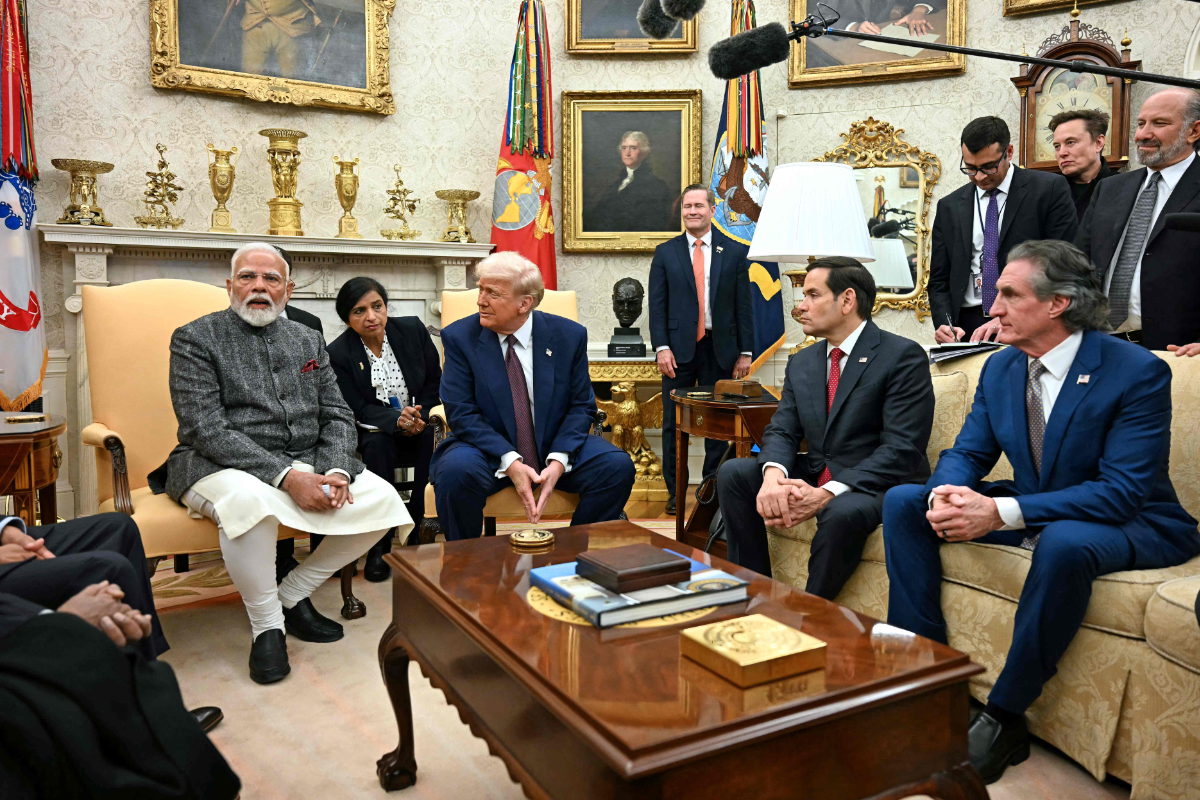
US President Donald Trump meets with Indian Prime Minister Narendra Modi at the White House in Washington, DC, on February 13, 2025. Also in the meeting were US Secretary of State Marco Rubio, billionaire Elon Musk, and US Secretary of the Interior Doug Burgum, among others. (AFP)
Trump had earlier put the leader of the world’s most populous nation on notice over possible tariffs.
The meeting came hours after the US president announced reciprocal tariffs on all countries, including India — but New Delhi is hoping to avoid further levies that Trump says are needed to counter the US trade deficit.
“India, traditionally, is the highest, just about the highest tariff country. They charge more tariffs than any other country. And I mean, we’ll be talking about that,” Trump earlier told reporters.
“India is a very hard place to do business because of the tariffs.”
US officials said there had been “early body language” from India but there was a “lot more work to do.”
Modi offered quick tariff concessions ahead of his visit, with New Delhi slashing duties on high-end motorcycles — a boost to Harley-Davidson, the iconic US manufacturer whose struggles in India have irked Trump.
Trump also said he’d back extraditing one of the plotters of the 2008 Mumbai attacks, appeared to be referencing Tahawwur Hussain Rana who was convicted in 2011 in the US for plotting an attack on a Danish newspaper.
“He’s going to be going back to India to face justice,” Trump said, latter adding that “we’re giving him back to India immediately.”
India has already accepted a US military flight carrying 100 shackled migrants last week as part of Trump’s immigration overhaul, and New Delhi has vowed its own “strong crackdown” on illegal migration.
Trump said more extraditions could be coming.
The Indian prime minister assiduously courted Trump during his first term.
The two share much in common, with both campaigning on promises to promote majority communities over minorities and both doggedly quashing dissent.
In 2020, Modi invited Trump before a cheering crowd of more than 100,000 people to inaugurate the world’s largest cricket stadium in his home state of Gujarat.
For the Trump administration, meanwhile, India is seen as integral to the US strategy of containing China in the Indo-Pacific. Modi’s country is hosting a summit of a group of countries known as the Quad — made up of the US, India, Japan and Australia — later this year.