WASHINGTON: President Donald Trump on Thursday rolled out his plan to increase US tariffs to match the tax rates that other countries charge on imports, possibly triggering a broader economic confrontation with allies and rivals alike as he hopes to eliminate any trade imbalances.
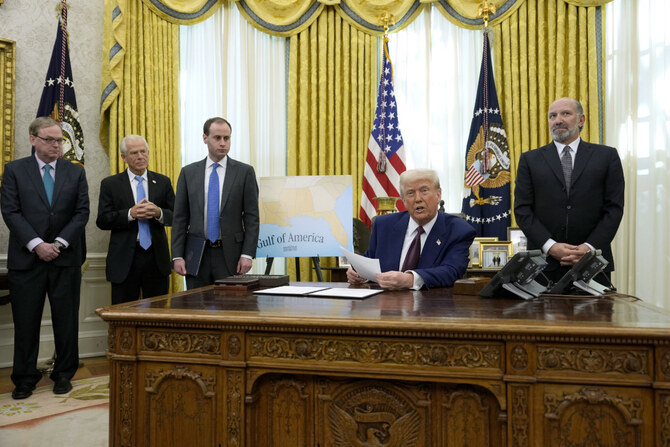
“I’ve decided for purposes of fairness that I will charge a reciprocal tariff,” Trump said in the Oval Office at the proclamation signing. “It’s fair to all. No other country can complain.”
Trump’s Republican administration has insisted that its new tariffs would equalize the ability of US and foreign manufacturers to compete, though under current law these new taxes would likely be paid by American consumers and businesses either directly or in the form of higher prices.
The politics of tariffs could easily backfire on Trump if his agenda pushes up inflation and grinds down growth, making this a high stakes wager for a president eager to declare his authority over the US economy.
The tariff increases would be customized for each country with the partial goal of starting new trade negotiations. But other nations might also feel the need to respond with their own tariff increases on American goods. As a result, Trump may need to find ways to reassure consumers and businesses to counteract any uncertainty caused by his tariffs.
The United States does have low average tariffs, but Trump’s proclamation as written would seem designed to jack up taxes on imports, rather than pursue fairness as the United States also has regulatory restrictions that limit foreign products, said Scott Lincicome, a trade expert at the Cato Institute, a libertarian think tank.
“It will inevitably mean higher tariffs, and thus higher taxes for American consumers and manufacturers,” he said. Trump’s tariffs plan “reflects a fundamental misunderstanding of how the global economy works.”
Trump’s proclamation identifies value-added taxes — which are similar to sales taxes and common in the European Union — as a trade barrier to be included in any reciprocal tariff calculations. Other nations’ tariff rates, subsidies to industries, regulations and possible undervaluing of currencies would be among the factors the Trump administration would use to assess tariffs.
A senior White House official, who insisted on anonymity to preview the details on a call with reporters, said that the expected tariff revenues would separately help to balance the expected $1.9 trillion budget deficit. The official also said the reviews needed for the tariffs could be completed within a matter of weeks or a few months.
The possible tax increases on imports and exports could be large compared to the comparatively modest tariffs that Trump imposed during his first term. Trade in goods between Europe and the United States nearly totaled $1.3 trillion last year, with the United States exporting $267 billion less than it imports, according to the Census Bureau.
The president has openly antagonized multiple US trading partners over the past several weeks, levying tariff threats and inviting them to retaliate with import taxes of their own that could send the economy hurtling into a trade war.
Trump has put an additional 10 percent tariff on Chinese imports due to that country’s role in the production of the opioid fentanyl. He also has readied tariffs on Canada and Mexico, America’s two largest trading partners, that could take effect in March after being suspended for 30 days. On top of that, on Monday, he removed the exemptions from his 2018 steel and aluminum tariffs. And he’s mused about new tariffs on computer chips and pharmaceutical drugs.
But by Trump’s own admission, his separate tariffs for national security and other reasons would be on top of the reciprocal tariffs, meaning that the playing field would not necessarily be level.
In the case of the 25 percent steel and aluminum tariffs, “that’s over and above this,” Trump said. Autos, computer chips and pharmaceuticals would also be tariffed at higher rates than what his reciprocal plan charges, he said.
The EU, Canada and Mexico have countermeasures ready to inflict economic pain on the United States in response to Trump’s actions, while China has already taken retaliatory steps with its own tariffs on US energy, agricultural machinery and large-engine autos as well as an antitrust investigation of Google.
The White House has argued that charging the same import taxes as other countries do would improve the fairness of trade, potentially raising revenues for the US government while also enabling negotiations that could eventually improve trade.
But Trump is also making a political wager that voters can tolerate higher inflation levels. Price spikes in 2021 and 2022 severely weakened the popularity of then-President Joe Biden, with voters so frustrated by inflation eroding their buying power that they chose last year to put Trump back in the White House to address the problem. Inflation has risen since November’s election, with the government reporting on Wednesday that the consumer price index is running at an annual rate of 3 percent.
The Trump team has decried criticism of its tariffs even as it has acknowledged the likelihood of some financial pain. It says that the tariffs have to be weighed against the possible extension and expansion of Trump’s 2017 tax cuts as well as efforts to curb regulations and force savings through the spending freezes and staff reductions in billionaire adviser Elon Musk’s Department of Government Efficiency initiative.
But an obstacle to this approach might be the sequencing of the various policies and the possibilities of a wider trade conflict stifling investment and hiring amid the greater inflationary pressures.
Analysts at the bank Wells Fargo said in a Thursday report that the tariffs would likely hurt growth this year, just as the possibility of extended and expanded tax cuts could help growth recover in 2026.
Trump tried to minimize the likelihood that his policies would trigger anything more than a brief bump in inflation. But when asked if he would ask agencies to analyze the possible impact on prices, the president declined.
“There’s nothing to study,” Trump said. “It’s going to go well.”


![]()

Trump signs a plan for reciprocal tariffs on US trading partners, ushering in economic uncertainty
Short Url
https://arab.news/4jb97
Trump signs a plan for reciprocal tariffs on US trading partners, ushering in economic uncertainty
- Says the reciprocal tariff is “fair to all. No other country can complain,” adding that the new tariffs would equalize the ability of US and foreign manufacturers to compete
- Analysts warned that the politics of tariffs could easily backfire on Trump if his agenda pushes up inflation and grinds down growth


Latest updates


Recommended


© 2026 SAUDI RESEARCH & PUBLISHING COMPANY, All Rights Reserved And subject to Terms of Use Agreement.