


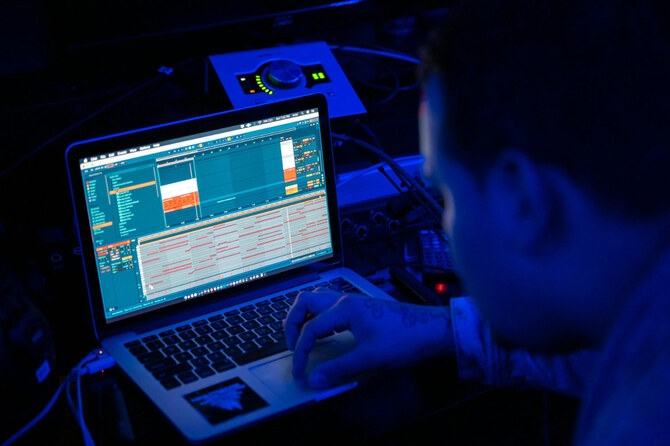

RIYADH: Artificial intelligence is redefining music, opening up new opportunities to create, innovate, and preserve cultural legacies. From composing new melodies to recreating the voices of late artists, AI sits at the intersection of technology and artistry.
According to Alice Eldridge, Thor Magnusson, and Chris Kiefer in their paper, “Artificial intelligence in music and performance: A subjective art-research inquiry,” AI leverages machine learning to analyze patterns in music, enabling it to compose, mimic, or adapt musical styles.
Technologies such as generative adversarial networks refine outputs to make them more lifelike, while natural language processing aids in creating lyrics and melodies. The researchers say these tools are integral to interactive music systems, where AI becomes a collaborative partner in the creative process.

Musician Atheer Al-Amoudi views AI’s creative potential as revolutionary. “AI is becoming unstoppable in various fields, and the outcomes are undeniably mind-blowing,” Al-Amoudi told Arab News.
“Its limitlessness makes the wildest thoughts of creativity easier to actually produce. If an artist wished to collaborate with another artist but they were unreachable, they can use AI to bring this to life.”
Although such technological leaps are transformative for the production of music, they do throw up concerns about plagiarism and copyright infringement. “There must be a form of consent or at least a disclaimer stating that the actual artist has been replicated,” Al-Amoudi said.
Opinion
This section contains relevant reference points, placed in (Opinion field)
Indeed, while AI can spark creativity, its potential for misuse is concerning. “AI could become a shortcut for lazy artists, where they sell their voice input and let editors produce whatever music they want,” Al-Amoudi said.
“It’s not as authentic, but the shortcut has its benefits for certain projects.”
One especially powerful application in AI-generated music is when it is used to recreate the voices of late singers by drawing upon their body of work.
“The only aspect where AI can create deep emotional music is when it uses the vocals of a deceased singer,” Al-Amoudi said. “It’s really moving, and you can’t help but wonder how that singer would feel about it, and if they would sing it the same way AI is doing it.”
AI in music depends on various advanced technologies, including machine learning, voice synthesis, and generative adversarial networks. These systems analyze and recreate everything from rhythm and harmony to unique vocal traits.

Voice synthesis and cloning, for example, involve training AI on recordings of an artist’s voice to replicate their tone, pitch, and intonation. (Supplied)
Voice synthesis and cloning, for example, involve training AI on recordings of an artist’s voice to replicate their tone, pitch, and intonation. Models like generative adversarial networks refine these replications, ensuring they sound natural and authentic.
This integration of AI technologies was recently used to recreate the voice of Saudi musician and composer Talal Maddah for his daughter Nagham’s wedding — a project that demonstrated the ability of AI to preserve and honor cultural heritage.
“Initially, when I met with the bride, she hadn’t even considered the idea of using one of her father’s songs for her wedding,” music designer Nasser Al-Ojan told Arab News.

How a generative adversarial network works. (Wikimedia Commons)
“She was only planning to walk down the aisle to instrumental music. I suggested that her father should somehow be present with her at this special moment. She asked, ‘How?’ That’s when the idea of using AI came to me.”
The process was both technical and deeply emotional. “Creating such a precise outcome is one of the most challenging tasks,” Al-Ojan said. “First, we used 59 songs by Talal Maddah to isolate his voice across all the vocal ranges he had sung in. This was necessary to replicate his vocal signature accurately.
“The process involved extracting his voice from these songs at various pitches, so when the software works on highs or lows, it mimics the way the artist’s voice naturally flows. This level of precision required a lot of effort and professionalism. The process takes exactly 48 hours to achieve this level of perfection.”

AI leverages machine learning to analyze patterns in music, enabling it to compose, mimic, or adapt musical styles. (Supplied)
The final result was a rendition of one of Maddah’s songs personalized with Nagham’s name, bringing his voice back to life for a deeply personal and moving moment.
Noor Al-Faraj, a data AI and automation expert at IBM and winner of the Saudi Authority for Data and Artificial Intelligence’s Enjaz Hackathon, sees AI as a tool that could push music beyond traditional boundaries.
“AI can help generate melodies, experiment with different sounds, or even mix genres in ways we might not think of,” Al-Faraj told Arab News. “It’s making music creation more accessible, too — you don’t have to be a professional to use these tools and make something amazing.”
However, Al-Faraj highlights the ethical concerns surrounding the technology. “Since AI is trained on existing music, there’s always a chance it could accidentally copy something too closely.

Noor Al-Faraj
“And then there’s the question of ownership — if an AI tool creates a song, who owns it? The person using the tool? The company that made the AI? It’s a gray area that we’re still figuring out.”
AI’s role should complement human creativity rather than replace it, she said. “The goal isn’t to replace what humans create but to complement it with something different, something we’ve never heard before.”
AI is revolutionizing the music industry, offering tools to preserve the legacy of artistic greats like Maddah and push the boundaries of creativity.
From Al-Amoudi’s enthusiasm for AI’s potential to Al-Ojan’s emotionally charged recreation of Maddah’s voice for his daughter, these stories illustrate the transformative power of AI in music.


