

Pakistani PM, Turkish president discuss Middle East crisis, express ‘unwavering solidarity’ with Palestinians

1 / 2
This handout photograph taken and released by Pakistan's Prime Minister Office on February 13, 2025 shows Turkey's President Recep Tayyip Erdogan (L) shaking hands with Pakistan's Prime Minister Shehbaz Sharif before inspecting a guard of honour during his ceremonial reception at the Prime Minister House in Islamabad. (AFP)
2 / 2
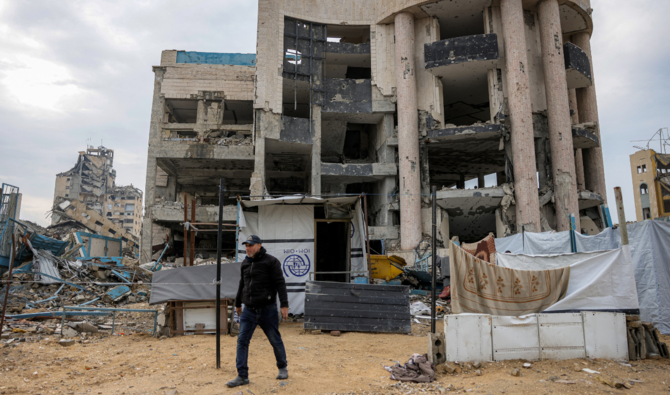
A man walks past the destroyed Sheikh Radwan Health Centre run by the United Nations Relief and Works Agency for Palestine Refugees (UNRWA) in the north of Gaza City on February 10, 2025. (AFP)
Short Url
Updated 13 February 2025
Follow

Pakistani PM, Turkish president discuss Middle East crisis, express ‘unwavering solidarity’ with Palestinians

  • Turkish President Erdogan meets Pakistan PM Shehbaz Sharif in Islamabad
  • Development takes place as life limps back to normalcy in war-ravaged Palestine

ISLAMABAD: Pakistani Prime Minister Shehbaz Sharif and Turkish President Recep Tayyip Erdoğan voiced “unwavering solidarity” with the Palestinian people, Sharif’s office said on Thursday, reiterating Palestinians’ right to self-determination under a two-state solution. 

The development takes place as life limps to normalcy in war-ravaged Gaza, where Israel killed at least 48,000 people during the 15-month war triggered by Hamas’ surprise attack on Oct. 7, 2023. Around 1,200 Israelis were killed and 251 were taken as hostages in Hamas’ lightening offensive. 

Israel and Hamas last month reached an uneasy truce that has halted 15 months of war between the two sides. Aid trucks continue to supply food and medicines to the Palestinian people in Gaza as the fragile truce holds. 

The recent interaction between Erdogan and Sharif follows the Turkish president’s bilateral meeting with Sharif. Erdogan arrived in Pakistan late Wednesday for a two-day visit to boost trade and investment ties between the countries. 

“Both leaders also discussed recent developments in the Middle East during the course of which they expressed unwavering solidarity with the Palestinian people,” the Prime Minister’s Office (PMO) said. 

He reiterated Pakistan’s call for a two-state solution with an independent and sovereign state of Palestine with pre-1967 borders and Al Quds Al Sharif as its capital, Sharif’s office said. 

The statement also comes in the wake of recent controversial remarks by American President Donald Trump to resettle Gaza’s Palestinian residents and redevelop the enclave.

Under Trump’s scheme, Gaza’s about 2.2 million Palestinians would be resettled in Egypt, Jordan and other countries, and the United States would take control and ownership of the coastal territory, redeveloping it into the “Riviera of the Middle East.”

On Wednesday, Pakistan’s Deputy Prime Minister Ishaq Dar and United Arab Emirates, Sheikh Abdullah bin Zayed Al Nahyan also expressed concern in a phone call about Trump’s proposal to displace Palestinians from Gaza.

Trump’s comments have been rejected by Egypt and Jordan, while Arab countries and Pakistan have strongly criticized it. 


Anti-fuel smuggling drive boosts Pakistan revenues 82%, PM office says

Updated 9 sec ago
Follow

Anti-fuel smuggling drive boosts Pakistan revenues 82%, PM office says

  • Crackdown targets illegal petroleum trade using GPS tracking and pump registration
  • July–November gains cited as government intensifies tax, customs enforcement

ISLAMABAD: The Pakistani prime minister’s office said on Friday revenues from petroleum products rose 82% between July and November 2025 after a nationwide crackdown on fuel smuggling, as the government steps up enforcement to curb tax evasion and losses that have long strained public finances.

The increase was cited during a weekly performance review of the Federal Board of Revenue (FBR), where Prime Minister Shehbaz Sharif directed authorities to accelerate action against smuggling and tax evasion, according to a statement issued by the PM’s Office.

Fuel smuggling has been a persistent problem in Pakistan, where subsidised or untaxed petroleum products are often trafficked across borders or sold through unregistered pumps, depriving the state of revenue and distorting domestic energy markets. Successive governments have blamed the practice for billions of rupees in annual losses, while international lenders have repeatedly urged tighter enforcement as part of broader fiscal reforms.

“Every year the nation loses billions due to smuggling,” Sharif was quoted as saying in a statement, praising customs authorities for successful operations and noting that revenues from petroleum products increased by 82% from July to November 2025 compared with the same period last year.

The PM said stricter enforcement had brought several goods back into the formal economy, adding that there would be “no leniency” toward those involved in tax evasion or illegal trade.

Officials briefed the prime minister that Pakistan Customs has rolled out a nationwide enforcement framework, including GPS tracking of petroleum product transportation, registration of fuel stations through a digital monitoring system, and legal action against illegal machinery under updated petroleum laws.

The government has also instructed provincial administrations to cooperate fully with federal authorities in shutting down illegal petrol pumps, the statement said.

Sharif said enforcement efforts would continue until smuggling networks were dismantled and tax compliance improved, as the government seeks to strengthen revenues amid ongoing economic reforms.

Pakistan has struggled for years with weak tax collection and a narrow revenue base, forcing repeated bailouts from the International Monetary Fund. Smuggling of fuel, cigarettes, electronics and consumer goods has been identified by policymakers as a major obstacle to improving revenues and stabilising the economy.

Independent research shows that Pakistan loses an estimated Rs750 billion (about $2.7 billion) annually in tax revenue due to illicit trade and smuggling across sectors such as petroleum, tobacco and pharmaceuticals. Broader analyzes suggest total tax revenue losses linked to the informal economy and smuggling may reach as high as Rs3.4 trillion (around $12.1 billion) a year, roughly a quarter of the government’s annual tax targets.

Smuggled petroleum products alone are thought to cost the state about Rs270 billion (around $960 million) a year in lost revenue, underscoring why authorities have focused recent enforcement efforts on fuel tracking and pump registration.