

‘Block that noise’: Ex-captain Sarfaraz advises Pakistan to hold nerves during India clash 

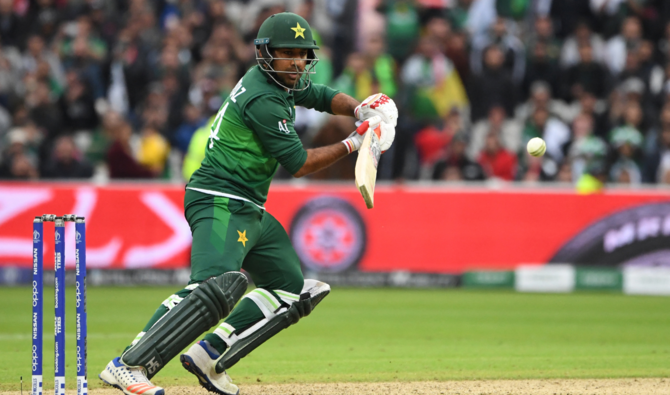
Pakistan's captain Sarfaraz Ahmed plays a shot during the 2019 Cricket World Cup group stage match between New Zealand and Pakistan at Edgbaston in Birmingham, central England, on June 26, 2019. (AFP/ File)
Short Url
Updated 13 February 2025
Follow

‘Block that noise’: Ex-captain Sarfaraz advises Pakistan to hold nerves during India clash 

  • Pakistan face India on Feb. 23 in Dubai for Champions Trophy 2025 Group A clash 
  • Under Sarfaraz Ahmed’s leadership in 2017, Pakistan beat India to win Champions Trophy

ISLAMABAD: Former Pakistan cricket captain Sarfaraz Ahmed advised the green shirts to head into their highly anticipated Champions Trophy clash against India by keeping their nerves in check and avoiding the added pressure, the International Cricket Council (ICC) reported on Thursday. 

India and Pakistan will take the field against each other in Dubai on Feb. 23 for their Champions Trophy Group A clash. One of the fiercest rivalries in sport, cricket matches between the two countries draw thousands to stadiums across the world, and millions to TV sets. 

Pakistan will begin their title defense against New Zealand on Feb. 19 in Karachi. Under Ahmed’s leadership in 2017, Pakistan beat India to lift the Champions Trophy that year in a one-sided clash. 

“Whenever we meet, it is a special occasion and there is so much hype and pressure around it,” Ahmed wrote in a column for the ICC.

“But as players, you need to stay calm, try and block that noise out, and just play with the same intensity as you would play Australia or any other team.”

Ahmed said Pakistan have a strong team and a really good chance of successfully defending the trophy. 

“Some of the boys from 2017 are still there and we’re talking about some of the best – especially Babar Azam,” he said, referring to Pakistan’s most prolific ODI batter. 

Ahmed noted that Azam was more mature and formidable than he was in 2017. 

“His batting will be so important for Pakistan and so will Fakhar Zaman’s,” he said, referring to Pakistan’s left-handed aggressive opening batter. 

He said left-armer Shaheen Shah Afridi and Haris Rauf are both “brilliant bowlers.”

“The captain, Mohammad Rizwan, is also a wicketkeeper-batter, which worked pretty well for me back in 2017!” he said. 

The green shirts will face New Zealand in the final of an ongoing tri-nation series involving South Africa on Friday in Karachi. 

The tri-nation series is a warm-up before the Champions Trophy kicks off next week. 


Chinese, Pakistani firms join Barrick in mining push as Reko Diq exports near

Updated 51 min 43 sec ago
Follow

Chinese, Pakistani firms join Barrick in mining push as Reko Diq exports near

  • Port operator says more than $5 billion in copper and gold exports planned from Reko Diq in phases
  • PIBT readies capacity upgrades as security and regional connectivity remain key logistical risks

KARACHI: After Canada’s Barrick Mining Corporation, Chinese firms and major Pakistani business groups have also secured mining leases for copper, gold and other minerals in Pakistan’s southwest, signaling a broader expansion of the sector, according to a senior port executive involved in export planning.

Sharique Azim Siddiqui, chief executive officer of Pakistan International Bulk Terminal Limited (PIBT), said the facility had been contracted to export more than $5 billion worth of minerals from the Reko Diq project in phases, with additional mining ventures emerging in the same mineral-rich belt in Balochistan.

“There are some Chinese involved in that, but otherwise there are Pakistani big business houses that have taken the mining leases,” he said in an interview with Arab News this week.

Last week, Reko Diq Mining Company (RDMC), a Barrick subsidiary, signed a port access agreement with PIBT to use Pakistan’s first dirty bulk cargo handling terminal at Port Qasim for large-scale exports of copper and gold concentrate starting from 2028.

Located in the remote Chagai district of Balochistan, Reko Diq is among the world’s largest undeveloped copper-gold deposits. Barrick holds a 50 percent stake in the project, while Pakistan’s federal and Balochistan governments each own 25 percent.

“They are working on their mine in Balochistan, and we hope that by 2028 or latest by 2029 they should be in operation,” Siddiqui said. “They should be sending about 800,000 to a million tons of copper and gold concentrate for which PIBT will be the export terminal at Port Qasim.”

He said exports from the first phase were estimated at $2.7 billion annually, rising to around $5 billion after expansion.

“$2.7 billion is just from Reko Diq,” Siddiqui said. “They would double in two phases. It could be around $5 billion in exports, which would be a significant chunk of Pakistan’s exports.”

Pakistan has struggled to lift exports, which rose 4.5 percent last fiscal year to $32 billion. In the current fiscal year through January, exports fell 7 percent to $18.2 billion, while imports rose 9 percent to $40.2 billion, official data show.

“One single project adding $5 billion to our bottom line would be very helpful,” Siddiqui said.

He added that other copper and gold projects in Balochistan remained at early stages.

“Reko Diq will come online before them, but I don’t have an agreement with them so I can’t comment on those projects,” he said.

CAPACITY EXPANSION
Under its agreement with PIBT, RDMC will invest $150 million to build dedicated storage and handling facilities at the terminal as part of the project’s broader $7.7 billion investment.

“Reko Diq is upgrading PIBT’s infrastructure and Reko Diq is building their own storage and handling facility inside PIBT,” Siddiqui said. “Our export line can handle their product. We have got an export handling crane, we have got a conveyor, several kilometers of conveyor belt built for that purpose, but they will upgrade it.”

Construction of the port-side facilities is expected to begin within two months.

PIBT, which began operations in 2017, was developed with $305 million in investment, including financing from the International Finance Corporation, and is listed on the Pakistan Stock Exchange with about 20,000 shareholders.

PIBT has an annual handling capacity of 12 million tons of imports and four million tons of exports. Reko Diq is expected to initially use about one million tons of export capacity, rising to two million tons in the second phase.

“We will still have ample capacity to fill up our 4 million tons of export capacity,” Siddiqui said.

Historically focused on coal imports, PIBT currently handles six to seven million tons annually. Reko Diq will make it a major export terminal for the first time.

Siddiqui said PIBT was also in discussions with exporters of barite, rock phosphate, iron ore and sand, adding that Reko Diq’s shipments would set the benchmark for future mineral exports.

He said the terminal was also open to partnerships with Gulf investors, particularly from the United Arab Emirates.

SECURITY RISKS
Siddiqui said Pakistan’s long-term ambition to serve as a transit hub for landlocked Central Asian states remained constrained by security and regional connectivity challenges.

Afghanistan, he said, remained a bottleneck, though he described it as temporary.

“We are well positioned to encash that opportunity and become a transit port for exporting or importing cargo for Central Asian states,” he said.

Security concerns persist, particularly in Balochistan, which has seen a resurgence of militant attacks. However, the PIBT official downplayed the situation.

“The government at the highest level is going to ensure that there is security for their cargo movement, because if there is no security for the cargo movement, then that’s going to hurt that project and hurt everyone,” Siddiqui said.

“I’m pretty confident that we would be able to provide that security for their cargo movement,” he added.