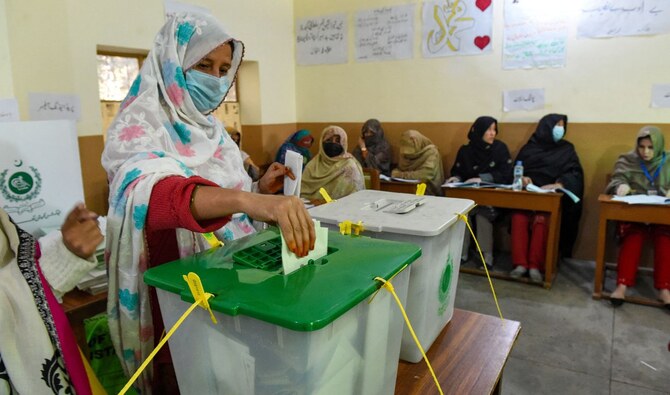
ISLAMABAD: Former Prime Minister Imran Khan’s Pakistan Tehreek-e-Insaf (PTI) party wrote to the International Monetary Fund (IMF) on Wednesday, urging it to take note of alleged election rigging and the manipulation of the democratic system in Pakistan.
The letter, penned by Leader of the Opposition in the National Assembly Omar Ayub, comes as a three-member IMF mission visits Pakistan for a Governance and Corruption Diagnostic Assessment (GCDA) under the country’s $7 billion loan program.
The assessment, running until Feb. 14, aims to evaluate vulnerabilities in six key state functions, including fiscal governance, central bank operations, financial sector oversight, market regulation, rule of law and anti-money laundering efforts.
PTI has consistently complained of widespread irregularities in last year’s national elections, claiming they were used to deprive the party of its mandate. It has also protested a systematic crackdown on its leaders and supporters, arguing that a recent constitutional amendment has weakened the judicial system, leaving them without legal recourse.
“I write to you at a crucial juncture when the IMF mission is assessing Pakistan’s economic and governance framework, with transparency and the rule of law being fundamental concerns,” Ayub said in the letter addressed to IMF country head Mahir Binici.
“In this context, enclosed is a dossier that has been submitted to the Honorable Chief Justice of Pakistan, detailing undeniable evidence of widespread electoral rigging in the 2024 General Elections,” he continued.
Ayub emphasized the importance of transparency for economic and political stability, asserting that his party’s concerns should be brought to the attention of international institutions monitoring governance in Pakistan.
“We trust that upholding the rule of law and democratic integrity will remain a priority in all engagements concerning Pakistan’s future,” he added, offering Binici the opportunity to meet PTI leaders for further details.
Ayub’s letter follows an unprecedented meeting between the IMF team and Chief Justice of Pakistan Yahya Afridi on Feb. 11, where they discussed judicial reforms, accountability and the recent controversial restructuring of a commission responsible for recommending judges to Pakistan’s superior courts.
This is not the first time PTI has reached out to the IMF with grievances following its removal from power in April 2022 through a no-confidence vote.
Last year, Imran Khan himself wrote to the global lender, urging it to carefully review the election results before approving new financial assistance for Islamabad. Despite PTI’s concerns, Pakistan secured a $7 billion loan from the IMF in September 2024.
In 2022, an audio leak featuring PTI’s former finance minister Shaukat Tarin also surfaced, in which he advised a provincial PTI leader in Khyber Pakhtunkhwa to inform the IMF that Pakistan’s government would not be able to fulfill its loan repayment commitments.
The party came under severe criticism, with its rivals accusing it of working against the economic interests of Pakistan.


![]()

Opposition party writes to IMF on ‘electoral rigging’ as mission in Pakistan to assess governance
Short Url
https://arab.news/y4j5e
Opposition party writes to IMF on ‘electoral rigging’ as mission in Pakistan to assess governance
- PTI’s Omar Ayub highlights the importance of transparency for economic and political stability in the note
- He expresses hope that rule of law and democratic integrity will be a priority in IMF’s dealings with Pakistan
Latest updates


© 2026 SAUDI RESEARCH & PUBLISHING COMPANY, All Rights Reserved And subject to Terms of Use Agreement.