KARACHI: Pakistani health authorities this week confirmed the country’s second polio case of 2025 in the country’s southern Sindh province, days after concluding a national immunization campaign against the infection.
Polio is a paralyzing disease with no cure and to ensure immunity, health experts say it is crucial that all children under five complete the oral polio vaccine series. The South Asian country last year reported 74 polio cases in 2024, a sharp increase from just six in 2023.
The second polio case of the year was reported from district Badin in Sindh, Pakistan’s Polio Eradication Program said in a statement on Wednesday. The first case of the infection was reported in the Dera Ismail Khan district in the northwestern Khyber Pakhtunkhwa (KP) province last month.
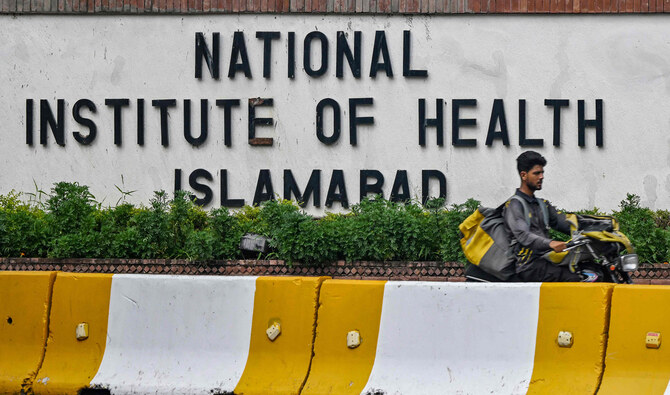
“The Regional Reference Laboratory for Polio Eradication at the National Institute of Health has confirmed the detection of the second wild poliovirus type 1 (WPV1) case of 2025,” Pakistan’s Polio Eradication Program said.
Of Pakistan’s 74 polio cases reported last year, 27 were from Balochistan, 22 from Khyber Pakhtunkhwa, 23 from Sindh, and one each from Punjab and Islamabad.
The Pakistan polio program runs several mass vaccination drives annually. This year’s first anti-polio drive was conducted from Feb. 3 to 9 during which over 45 million children were vaccinated.
Pakistan and Afghanistan are the last two countries where polio remains endemic. In the early 1990s, Pakistan reported around 20,000 cases annually but in 2018 the number dropped to eight cases.
Pakistan’s polio program began in 1994, but efforts to eradicate the virus have been hampered by vaccine misinformation, opposition from some religious hard-liners who view immunization as a foreign plot, and frequent attacks on polio vaccination teams by militant groups.


Pakistan reports second polio case of 2025 from southern Sindh province
https://arab.news/2ejqq
Pakistan reports second polio case of 2025 from southern Sindh province

- Latest polio case has been reported from country’s southern Badin district, Pakistani health authorities say
- Development takes place days after Pakistan conducted its first national anti-polio vaccination drive of 2025
Pakistan reports current account surplus in Jan. owing to improved trade, remittances
- Pakistan’s exports crossed the $3 billion mark in Jan. as the country received $3.5 billion in remittances
- Last month, IMF urged Pakistan to accelerate pace of structural reforms to strengthen economic growth
ISLAMABAD: Pakistan recorded a current account surplus of more than $120 million in January, the country’s finance adviser said on Tuesday, attributing it to improved trade balance and remittance inflows.
Pakistan’s exports rebounded in January 2026 after five months of weak performance, rising 3.73 percent year on year and surging 34.96 percent month on month, according to data released by the country’s statistics bureau.
Exports crossed the $3 billion mark for the first time in January to reach $3.061 billion, compared to $2.27 billion in Dec. 2025. The country received $3.5 billion in foreign remittances in Jan. 2026.
Khurram Schehzad, an adviser to the finance minister, said Pakistan reported a current account surplus of $121 million in Jan., compared to a current account deficit of $393 million in the same month last year.
“Improved trade balance in January 2026, strong remittance inflows, and sustained momentum in services exports (IT/Tech) continue to reinforce the country’s external account position,” he said on X.
Pakistan has undergone a difficult period of stabilization, marked by inflation, currency depreciation and financing gaps, and international rating agencies have acknowledged improvements after Islamabad began implementing reforms such as privatizing loss-making, state-owned enterprises (SOEs) and ending subsidies as part of a $7 billion International Monetary Fund (IMF) loan program.
Late last month, the IMF urged Pakistan to accelerate the pace of these structural reforms to strengthen economic growth.
Responding to questions from Arab News at a virtual media roundtable on emerging markets’ resilience, IMF’s director of the Middle East and Central Asia Jihad Azour said Islamabad’s implementation of the IMF requirements had been “strong” despite devastating floods that killed more than 1,000 people and devastated farmland, forcing the government to revise its 4.2 percent growth target to 3.9 percent.
“What is important going forward in order to strengthen growth and to maintain the level of macroeconomic stability is to accelerate the structural reforms,” he said at the meeting.
Azour underlined Pakistan’s plans to privatize some of the SOEs and improve financial management of important public entities, particularly power companies, as an important way for the country to boost its capacity to cater to the economy for additional exports.
“This comes in addition to the effort that the authorities have made in order to reform their tariffs, which will allow the private sector of Pakistan to become more competitive,” the IMF official said.


