Trump makes first big foray into Ukraine diplomacy, speaking to Putin, Zelensky

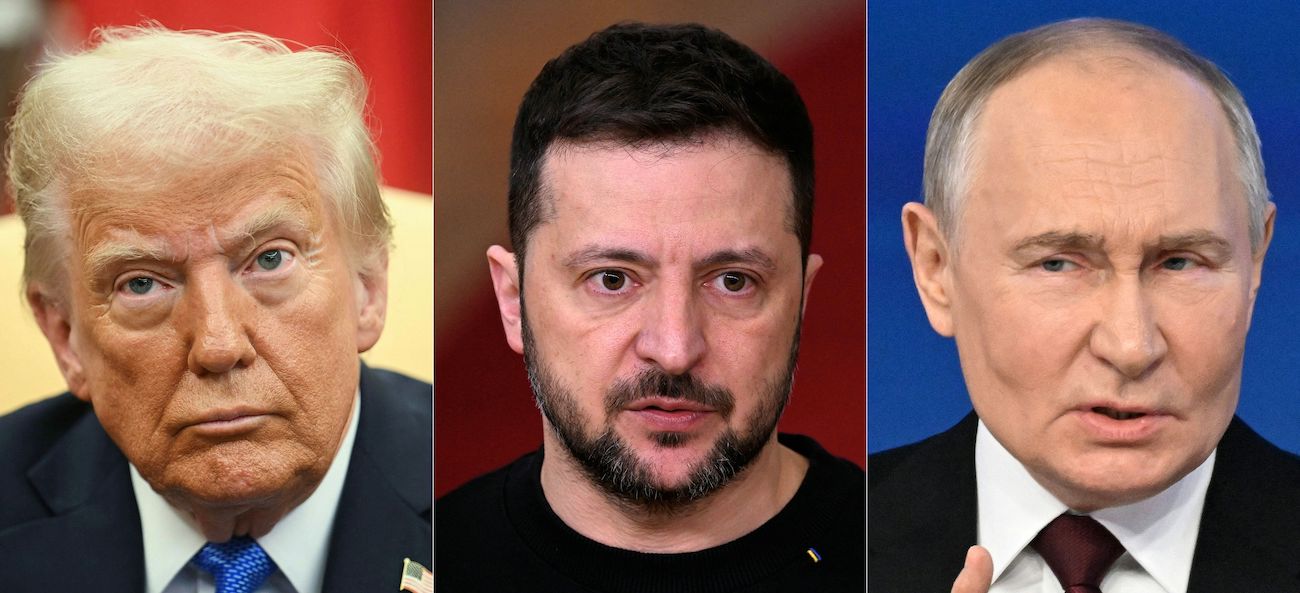
Donald Trump discussed war in Ukraine on Wednesday in phone calls with Russian President Vladimir Putin and Ukrainian President Volodymyr Zelensky. (File/AFP)
Short Url
Updated 13 February 2025
Follow

Trump makes first big foray into Ukraine diplomacy, speaking to Putin, Zelensky

  • Putin last spoke to a sitting US president in February 2022 when he had a call with Joe Biden shortly before ordering thousands of troops into Ukraine

WASHINGTON/MOSCOW/KYIV: Donald Trump discussed the war in Ukraine on Wednesday in phone calls with Russian President Vladimir Putin and Ukrainian President Volodymyr Zelensky, the new US president’s first big step toward diplomacy over a war he has promised to end.
In a post on his social media platform after speaking to Putin, Trump said they had “agreed to have our respective teams start negotiations immediately,” and that he would begin by phoning Zelensky.
After speaking to the Ukrainian leader, Trump said: “The conversation went very well. He, like President Putin, wants to make PEACE.”
Zelensky’s office said Trump and Zelensky had spoken by phone for about an hour, while the Kremlin said Putin’s call with Trump lasted nearly an hour and a half.
“I had a meaningful conversation with @POTUS. We... talked about opportunities to achieve peace, discussed our readiness to work together ...and Ukraine’s technological capabilities... including drones and other advanced industries,” Zelensky wrote on X.
The Kremlin said Putin and Trump had agreed to meet, and Putin had invited Trump to visit Moscow.
Trump has long said he would quickly end the war in Ukraine, without spelling out exactly how he would accomplish this.
Earlier on Wednesday, Trump’s Defense Secretary, Pete Hegseth, delivered the new administration’s bluntest statement so far on its approach to the war, saying recovering all of Ukraine’s territory occupied by Russia since 2014 was unrealistic, as was securing its membership in NATO.
“We want, like you, a sovereign and prosperous Ukraine. But we must start by recognizing that returning to Ukraine’s pre-2014 borders is an unrealistic objective,” Hegseth told a meeting of Ukraine and more than 40 allies at NATO headquarters in Brussels. “Chasing this illusionary goal will only prolong the war and cause more suffering.”
Hegseth said any durable peace must include “robust security guarantees to ensure that the war will not begin again.” But he said US troops would not be deployed to Ukraine as part of such guarantees.
“The United States does not believe that NATO membership for Ukraine is a realistic outcome of a negotiated settlement.”
France, Germany and Spain said Ukraine’s fate must not be decided without Kyiv’s active participation, with French Foreign Minister Jean-Noel Barrot saying Europe would play its role in offering security guarantees for Ukraine even if NATO membership were not immediate.

Zelensky offers minerals
Zelensky, hoping to keep Trump interested in continuing to support his country, has lately proposed a deal under which the United States would invest in minerals in Ukraine.
Trump’s Treasury Secretary Scott Bessent, in Kyiv on Wednesday on the first visit by a cabinet member in the new US administration, said such a mineral deal could serve as a “security shield” for Ukraine after the war.
No peace talks have been held since the early months of the conflict, now approaching its third anniversary. Trump’s predecessor Joe Biden and most Western leaders held no direct discussions with Putin after Russia launched its full-scale invasion of Ukraine in February 2022.
During the war’s first year, Ukraine succeeded in pushing Russian forces back from the outskirts of Kyiv and recapturing swathes of Russian-occupied territory.
But Moscow has mostly had the upper hand since a failed Ukrainian counteroffensive in 2023, making slow but steady gains in intense fighting that has killed or injured hundreds of thousands of troops on both sides and laid Ukrainian cities to waste.
Russia occupies around a fifth of Ukraine and has demanded Kyiv cede more territory and be rendered permanently neutral under any peace deal. Ukraine demands Russia withdraw from captured territory and says it must receive NATO membership or equivalent security guarantees to prevent Moscow from attacking again.
In recent discussions, Kyiv appears to have accepted that it will not be admitted to NATO soon but has emphasized its need for military support under a peace deal.
“If Ukraine is not in NATO, it means that Ukraine will build NATO on its territory. So we need an army as numerous as the Russians have today,” Zelensky said in an interview with The Economist published on Wednesday.
“And for all this, we need weapons and money. And we will ask the US for this,” Zelensky said, describing that as his “Plan B.”
India’s wealthy embrace a new luxury symbol: water

Updated 2 sec ago
Follow

India’s wealthy embrace a new luxury symbol: water

  • Tap water in India is not fit for human consumption
  • Wealthy opt for premium water as wellness craze boosts industry
NEW DELHI: At an Indian gourmet food store, Avanti Mehta is organizing a blind tasting of drinks sourced from France, Italy and India. No, ​this isn’t wine, it’s water.
Participants use tiny shot glasses to check the minerality, carbonation and salinity in samples of Evian from the French Alps, Perrier from southern France, San Pellegrino from Italy and India’s Aava from the foothills of the Aravalli mountains.
“They will all taste different ... you should be choosing a water that can give you some sort of nutritional value,” said Mehta, who is 32 and calls herself India’s youngest water sommelier, a term usually associated with premium wine. Her family owns the Aava mineral water brand. Premium water is a $400 million business in the world’s most populous nation and is growing bigger as its wealthy see it as a new status symbol that fits in with a spreading wellness craze.
Premium Indian mineral water costs around $1 for a one-liter bottle, while imported brands are upwards of $3, or 15 times the price of the country’s lowest-priced basic bottled water.
Clean water is a privilege in the country of 1.4 billion people where ‌researchers say 70 percent of ‌the groundwater is contaminated. Tap water remains unfit to drink, and 16 people died in Indore city ‌after ⁠consuming contaminated ​tap water ‌in December.
Many in India see bottled water as a necessity and standard 20 US-cent bottles are available widely at convenience stores, restaurants and hotels. The market is worth nearly $5 billion annually and is set to grow 24 percent a year — among the fastest in the world.
Bottled water demand in United States or China is driven by convenience, making it a $30 billion-plus market in each country which will grow just 4-5 percent each year, Euromonitor says.
In India, the premium water segment is leading the surge in demand, accounting for 8 percent of the bottled water market last year compared to just 1 percent in 2021, Euromonitor said.
“Distrust of municipal water in some areas has escalated the demand for bottled water. Now, people understand how mineral water has more health benefits. It’s expensive, but the category will boom,” said Amulya Pandit, a senior consultant at Euromonitor specializing in the drinks ⁠market.
Among its consumers are New Delhi-based real estate developer B.S. Batra, who says his family uses only premium water at home to get more minerals and safeguard health.
“You feel different, more energetic during the day,” ‌said Batra, 49, an avid badminton player.
“I consume mineral water even with whisky at home, and ‍kids use it for their smoothies.”

WATER LURES BOLLYWOOD STAR, WEALTHY
The popular 20-cent plastic ‍bottled water is mainly made by Pepsi, Coca-Cola and Indian market leader Bisleri. In addition, Indians who can afford it, install purifiers in their homes which ‍clean the water but also remove most minerals.
Imported and local premium waters are luring wealthy consumers and businesses alike.
Bollywood star Bhumi Pednekar and her sister have launched Backbay — selling 750 ml cartons of mineral water for $2.2; Indian conglomerate Tata is expanding its premium water portfolio, and retailers and businesses are reporting higher sales.
Tata Consumer Products, also Starbucks’ partner in India, sells 20-cent bottled water, but premium water is its priority as it sees affluent, health-focused consumers willing to spend on the drink without worrying about the price, CEO Sunil D’Souza said in ​an interview.
“I don’t have to push water uphill...I see a long, long, long runway for the business,” he said.
Tata’s premium “Himalayan” mineral water factory — which a Reuters photographer visited — is located in the foothills of the Himalayan range in Himachal Pradesh state. Workers there largely ⁠keep a hands-free watch on machines filling plastic and glass bottles with water sourced from a natural underground aquifer.

LOOKING FOR SPRINGS
Most Indians prefer still water, and the sparkling variant remains niche. Tata said it plans to launch a sparkling Himalayan water, and is also scouting for natural springs for expanding its other offerings. At three Foodstories Indian gourmet stores, sales of premium waters tripled in 2025. Customer demand prompted the chain to import “light and creamy” Saratoga Spring Water from New York, which costs 799 rupees ($9) for a 355-milliliter (12-fluid-ounce) bottle, and stocks sold out within days, said co-founder Avni Biyani.
Indian mineral water brand Aava’s sales touched a record 805 million rupees ($9 million) last year, growing 40 percent a year since 2021. Tata said its basic and premium water portfolio will grow 30 percent a year, after growing tenfold to $65 million in six years.
Imported waters, which attract an over 30 percent tax, are pricier than Indian brands. Nestle’s Perrier and San Pellegrino, and Danone’s Evian retail for over 300 rupees, or $3.20, for a 750 ml bottle.
Nestle declined to comment, while Danone said the Indian bottled water market was growing at a “robust” pace but imported waters “tend to be niche and boutique.”
“When you open your tap, you’re not getting an Aava, Evian ... And that is what you’re essentially paying for,” said water sommelier Mehta.
At the water tasting session, some participants said they enjoyed the experience ‌but many found the price hard to swallow.
“To be honest, it is kind of expensive,” said executive Hoshini Vallabhaneni, one of 14 people at the event. “For everyday use — it will burn a hole in the pocket.” (Reporting by Aditya Kalra in New Delhi and Rishika Sadam in Hyderabad; Additional reporting by Alexander Marrow in London and Anushree Fadnavis ‌in Himachal Pradesh; Editing by Raju Gopalakrishnan)