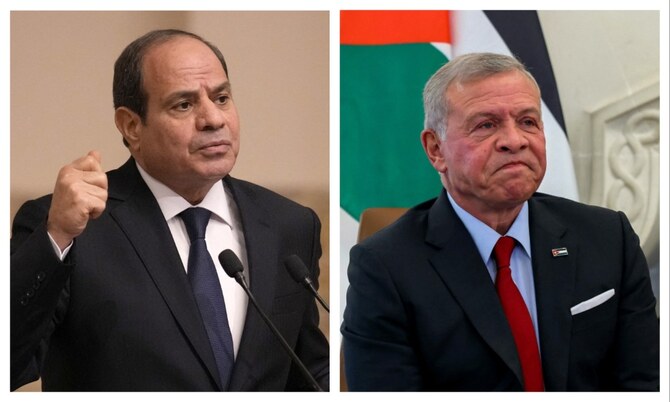
CAIRO: Egyptian President Abdel Fattah El-Sisi and Jordan’s King Abdullah II stressed Wednesday the “unity” of their countries’ positions on Gaza, a day after US President Donald Trump held talks with the Jordanian monarch in Washington.
“The two leaders affirmed the unity of the Egyptian and Jordanian positions,” on the reconstruction of the war-ravaged Gaza Strip, “without displacing the Palestinian people from their land,” a statement from the Egyptian presidency read.
Another statement from the Jordanian royal court said that the two leaders stressed their “shared position” rejecting the forced displacement of Palestinians.
Both statements also referred to their willingness to “cooperate” with Trump to achieve “just and lasting peace” in the Middle East.
Egypt and Jordan have been at the forefront of a fierce Arab pushback against a Trump plan to relocate Palestinians from Gaza to the two countries.
Trump’s remarks have been coupled with a suggestion that he could “conceivably” halt aid to both countries if they refuse to take in Palestinians.
After his talks with Trump in Washington on Tuesday, King Abdullah II said that his country remains “steadfast” in its position against the forced displacement of Palestinians in Gaza and the West Bank.
“This is the unified Arab position,” Abdullah wrote on social media.
Egypt announced this week that it would host a summit of Arab nations later this month. It also said it would present a “comprehensive vision” for Gaza’s reconstruction in a way that ensures Palestinians remain on their land.
Egypt and Jordan, both key US allies, are heavily reliant on foreign aid and the US is considered one of their top donors.


![]()

Egypt’s El-Sisi, Jordan king stress ‘unity’ of positions on Gaza: Egypt presidency
Short Url
https://arab.news/8khcs
Egypt’s El-Sisi, Jordan king stress ‘unity’ of positions on Gaza: Egypt presidency
- Leaders affirmed the “unity of the Egyptian and Jordanian positions,” on the reconstruction of Gaza Strip, “without displacing the Palestinian people”: Statement


Latest updates


© 2026 SAUDI RESEARCH & PUBLISHING COMPANY, All Rights Reserved And subject to Terms of Use Agreement.