

UK Muslim, Jewish leaders present reconciliation accord to King Charles after summit

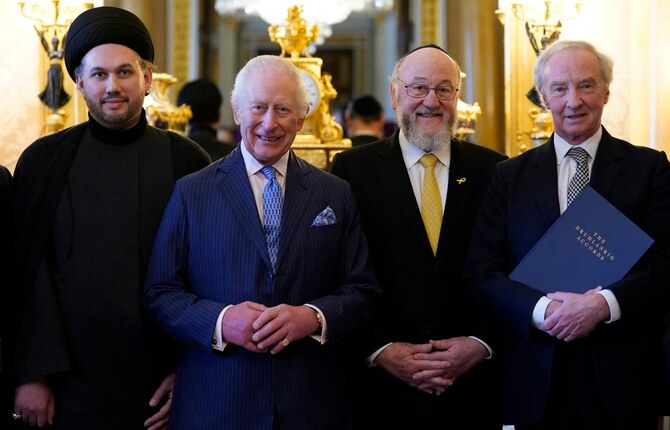
Britain's King Charles III (2nd L) poses for pictured with Chief Imam Dr Sayed Razawi (L), Chief Rabbi Sir Ephraim Mirvis (2nd R) and Richard Scott, 10th Duke of Buccleuch (R) at Buckingham Palace, in London, on February 11, 2025 after the signing of the Muslim-Jewish Reconciliation Accords. (AFP)
Short Url
Updated 12 February 2025
Follow

UK Muslim, Jewish leaders present reconciliation accord to King Charles after summit

  • Chief rabbi: Agreement represents ‘bold first step towards rebuilding meaningful trust’

LONDON: Senior Muslim and Jewish leaders from Britain held a secret summit that resulted in the signing of a historic reconciliation accord that was presented to King Charles III, The Times reported.

The summit was hosted last month at the 17th-century Drumlanrig Castle in Scotland and involved 11 religious leaders.

The resulting agreement, dubbed the Drumlanrig Accord, was presented to the king on Tuesday.

He hailed the “marvellous exercise” and said the “least he could do” was host the religious leaders.

The summit, held at the invitation of the duke of Buccleuch, aimed to repair ties between the UK’s Muslim and Jewish communities in the wake of the Gaza war.

“The leaders were honoured to be able to present a copy of the accord to his majesty the king at Buckingham Palace, underscoring its profound national and societal significance,” the group of faith leaders said.

“A new framework for engagement … built on mutual respect, dialogue and practical collaboration” between British Muslims and Jews was laid out in the accord. It highlights the shared spiritual heritage of the two faiths.

Both communities committed to working together on “practical initiatives that support the most vulnerable.”

Observers hope that the accord will lead to the establishment of a joint body that could monitor Islamophobic and antisemitic incidents in Britain.

The idea for the summit was put forward by the chief imam of the Scottish Ahlul Bayt Society, Sayed Razawi, who had been working for a year to bring Muslim and Jewish figures together for dinners and meetings.

Ephraim Mirvis, chief rabbi of the United Hebrew Congregations of the Commonwealth, also played a key role.

Sunni and Shiite sects of Islam were represented. Civil servants and community groups also attended.

Razawi said: “Initially people were slightly nervous as they were coming in and saw this huge castle that takes your breath away, but within an hour and a half people were best of friends, joking, talking about each other’s families, discussing issues and problems.”

After eight hours of discussion, the faith leaders agreed upon the accord. They met again on Tuesday at Spencer House in London to sign the document, before walking together to Buckingham Palace to present it to the king.

Mirvis said the accord represents “a bold first step towards rebuilding a meaningful trust between Muslim and Jewish communities over the long term.

“They do not gloss over our differences; they acknowledge them. But they also send out a powerful message that in times of division, when it is far easier to retreat into fear and suspicion, we are prepared to take the more challenging path to reconciliation.”


Venezuela to debate historic amnesty bill for political prisoners

Updated 3 sec ago
Follow

Venezuela to debate historic amnesty bill for political prisoners

  • Venezuela could pass a landmark bill on Thursday granting amnesty to political prisoners, marking an early milestone in the transition from the rule of toppled leader Nicolas Maduro
CARACAS:Venezuela could pass a landmark bill on Thursday granting amnesty to political prisoners, marking an early milestone in the transition from the rule of toppled leader Nicolas Maduro.
The legislation, which covers charges used to lock up dissidents under Maduro and his predecessor Hugo Chavez, aims to turn the page on nearly three decades of state repression.
It was spearheaded by interim president Delcy Rodriguez, who replaced Maduro after he was captured by US forces in Caracas last month and flown to New York to face trial.
Rodriguez took Maduro’s place with the consent of US President Donald Trump, provided she does Washington’s bidding on access to Venezuelan oil and expanding democratic freedoms.
She has already started releasing political prisoners ahead of the pending amnesty. More than 400 people have been released so far, according to rights group Foro Penal, but many more are still behind bars.
Rodriguez also ordered the closure of the notorious Helicoide prison in Caracas, which has been denounced as a torture center by the opposition and activists.
Lawmakers voted last week in favor of the amnesty bill in the first of two debates.
The second debate on Thursday coincides with Youth Day in Venezuela, which is traditionally marked by protests.
Students from the Central University of Venezuela, one of the country’s largest schools and home to criticism of Chavismo, called for a rally on campus.
Venezuela’s ruling party also announced a march in the capital Caracas.
’We deserve peace’
Venezuela’s attorney general said Wednesday that the amnesty — which is meant to clear the rap sheets of hundreds of people jailed for challenging the Maduro regime — must apply to both opposition and government figures.
He urged the United States to release Maduro and his wife, both in detention in New York.
“We deserve peace, and everything should be debated through dialogue,” Attorney General Tarek William Saab told AFP in an interview.
Delcy Rodriguez’s brother Jorge Rodriguez, who presides over the National Assembly, said last week that the law’s approval would trigger the release of all political prisoners.
“Once this law is approved, they will all be released the very same day,” he told prisoners’ families outside the notorious Zona 7 detention center in Caracas.
’We are all afraid’
Venezuelan opposition leader Juan Pablo Guanipa was one of the detainees granted early release.
But he was re-arrested less than 12 hours later and put under house arrest.
Authorities accused him of violating his parole after calling for elections during a visit to Helicoide prison, where he joined a demonstration with the families of political prisoners.
Guanipa is a close ally of Nobel Peace Prize laureate and opposition leader Maria Corina Machado, who was in hiding for over a year before she fled the country to travel to Oslo to receive the award.
“We are all afraid, but we have to keep fighting so we can speak and live in peace,” Guanipa’s son told reporters outside his home in Maracaibo.