Russia’s Medvedev calls Ukraine’s territory exchange proposals ‘nonsense’

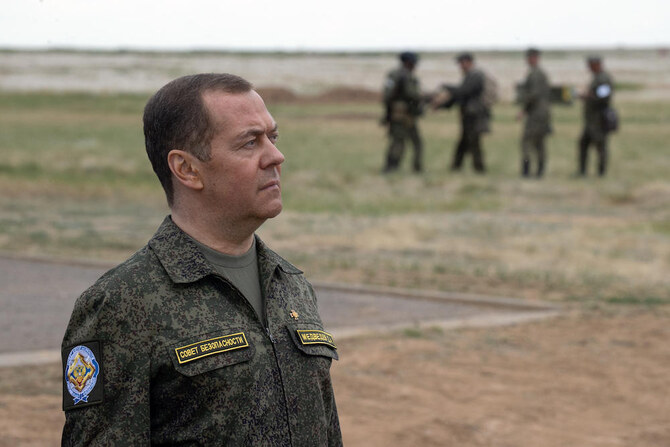
Dmitry Medvedev, who served as Russia’s president from 2008-2012, dismissed as ‘nonsense’ Kyiv’s proposal to trade pockets of territory. (AFP)
Short Url
Updated 12 February 2025
Follow

Russia’s Medvedev calls Ukraine’s territory exchange proposals ‘nonsense’

  • Dmitry Medvedev, who served as Russia’s president from 2008-2012, said Russia had shown that it can achieve ‘peace through strength’

MOSCOW: Dmitry Medvedev, deputy chairman of Russia’s powerful Security Council, on Wednesday dismissed as “nonsense” Kyiv’s proposal to trade pockets of Russian territory it holds in exchange for Moscow-controlled parts of Ukraine.
Ukrainian President Volodymyr Zelensky told the Guardian newspaper that he planned to offer Russia a straight territory exchange to help bring an end to the war.
Medvedev, who served as Russia’s president from 2008-2012, said Russia had shown that it can achieve “peace through strength,” including through drone and missile strikes which hit Kyiv on Wednesday.
Russia controls just under 20 percent of Ukraine, or more than 112,000 square kilometers, while Ukraine controls around 450 square kilometers of Russia’s western Kursk region, according to open source maps of the battlefield.


Moderate candidate wins emphatically over a populist in Portugal’s presidential runoff

Updated 5 sec ago
Follow

Moderate candidate wins emphatically over a populist in Portugal’s presidential runoff

LISBON: Center-left Socialist candidate António José Seguro recorded a thumping victory over hard-right populist André Ventura in Portugal’s runoff presidential election Sunday, according to official results with 99 percent of votes counted.
Seguro won a five-year term in Lisbon’s riverside “pink palace” with 66.7 percent of votes, compared with 33.3 percent for Ventura.
The ballot was an opportunity to test the depth of support for Ventura’s brash style, which has struck a chord with voters and helped make his Chega (Enough) party the second-biggest in the Portuguese parliament, as well as gauge the public appetite for Europe’s increasing shift to the right in recent years.
European Commission President Ursula von der Leyen congratulated Seguro and said on social media that “Portugal’s voice for our shared European values remains strong.”
Seguro, a longstanding Socialist politician, positioned himself as a moderate candidate who will cooperate with Portugal’s center-right minority government, repudiating Ventura’s anti-establishment and anti-immigrant tirades.
He won the backing of other mainstream politicians on the left and right who want to halt the rising populist tide.
In Portugal, the president is largely a figurehead with no executive power. Traditionally, the head of state stands above the political fray, mediating disputes and defusing tensions.
However, the president is an influential voice and possesses some powerful tools, being able to veto legislation from parliament, although the veto can be overturned. The head of state also possesses what in Portuguese political jargon is called an “atomic bomb,” the power to dissolve parliament and call early elections.
In May, Portugal held its third general election in three years in the country’s worst bout of political instability for decades, and steadying the ship is a key challenge for the next president.
Ventura, an eloquent and theatrical politician, rejected political accommodation in favor of a more combative stance.
Ventura said he will keep working to bring about a political “transformation” in Portugal.
“I tried to show there’s a different way … that we needed a different kind of president,” he told reporters.
Making it through to the runoff was already a milestone for Ventura and his party, which have recalibrated Portuguese politics.
One of Ventura’s main targets has been what he calls excessive immigration, as foreign workers have become more conspicuous in Portugal in recent years.
“Portugal is ours,” he said.
During the campaign, Ventura put up billboards across the country saying, “This isn’t Bangladesh” and “Immigrants shouldn’t be allowed to live on welfare.”
Although he founded his party less than seven years ago, its surge in public support made it the second-largest party in Portugal’s parliament in the May 18 general election.
Seguro will next month replace center-right President Marcelo Rebelo de Sousa, who has served the constitutional limit of two five-year terms.