BEIJING/TAIPEI: Two US Navy ships sailed through the sensitive Taiwan Strait this week in the first such mission since President Donald Trump took office last month, drawing an angry reaction from China, which said the mission increased security risks.
The US Navy, occasionally accompanied by ships from allied countries, transits the strait about once a month. China, which claims Taiwan as its own territory, says the strategic waterway belongs to it.
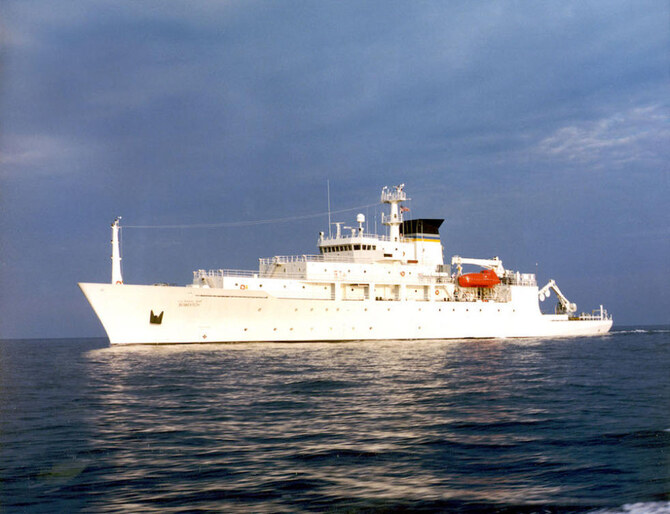
The US Navy said the vessels were the Arleigh Burke-class guided-missile destroyer USS Ralph Johnson and Pathfinder-class survey ship, USNS Bowditch. The ships carried out a north-to-south transit February 10-12, it said.
“The transit occurred through a corridor in the Taiwan Strait that is beyond any coastal state’s territorial seas,” said Navy Commander Matthew Comer, a spokesperson at the US military’s Indo-Pacific Command. “Within this corridor all nations enjoy high-seas freedom of navigation, overflight, and other internationally lawful uses of the sea related to these freedoms.”
China’s military said that Chinese forces had been dispatched to keep watch.
“The US action sends the wrong signals and increases security risks,” the Eastern Theatre Command of the People’s Liberation Army said in a statement early Wednesday.
China considers Taiwan its most important diplomatic issue and it is regularly a stumbling block in Sino-US relations.
China this week complained to Japan over “negative” references to China in a statement issued after a meeting between Trump and Japanese Prime Minister Shigeru Ishiba.
That statement called for “maintaining peace and stability across the Taiwan Strait,” and voiced support for “Taiwan’s meaningful participation in international organizations.”
Asked in Beijing on Wednesday about the US warships, Zhu Fenglian, spokesperson for China’s Taiwan Affairs Office, said that Taiwan was a “core interest” for the country and that the United States should act with caution.
“We are resolutely opposed to this and will never allow any outside interference, and have the firm will, full confidence and capability to uphold the country’s sovereignty and territorial integrity,” she said.
Taiwan’s defense ministry said its forces had also kept watch but noted the “situation was as normal.”
The last publicly acknowledged US Navy mission in the strait was in late November, when a P-8A Poseidon maritime patrol aircraft flew over the waterway.
The last time a US Navy ship was confirmed to have sailed through the strait was in October, a joint mission with a Canadian warship.
China’s military operates daily in the strait as part of what Taiwan’s government views as part of Beijing’s pressure campaign.
On Wednesday, Taiwan’s defense ministry said that it had detected 30 Chinese military aircraft and seven navy ships operating around the island in the previous 24 hour period.
“I really don’t need to explain further who is the so-called troublemaker around the Taiwan Strait. All other countries in the neighborhood have a deep appreciation of this,” ministry spokesperson Sun Li-fang told reporters in Taipei.
Taiwan President Lai Ching-te rejects Beijing’s sovereignty claims, saying only Taiwan’s people can decide their future.

First US Navy ships sail through Taiwan Strait since Trump inauguration
Short Url
https://arab.news/52egu
First US Navy ships sail through Taiwan Strait since Trump inauguration
- The US Navy, occasionally accompanied by ships from allied countries, transits the strait about once a month
- China, which claims Taiwan as its own territory, says the strategic waterway belongs to it
Greenland prepares next generation for mining future
SISIMIUT: At the Greenland School of Minerals and Petroleum, a dozen students in hi-viz vests and helmets are out for the day learning to operate bulldozers, dump trucks, excavators and other equipment.
The Greenlandic government is counting on this generation to help fulfill its dream of a lucrative mining future for the vast Arctic territory coveted by US President Donald Trump.
Founded in 2008, the school, based in El-Sisimiut in the southwest of the island, offers students from across Greenland a three-year post-secondary vocational training.
Apart from their practical classes, the students, aged 18 to 35, also learn the basics of geology, rock mechanics, maths and English.
Teacher Kim Heilmann keeps a watchful eye on his students as they learn to maneuver the heavy equipment.
“I want them to know it’s possible to mine in Greenland if you do it the right way,” he told AFP.
“But mostly the challenge is to make them motivated about mining,” he added.
The remote location of Greenland’s two operational mines, and the ensuing isolation, puts many people off, the school’s director Emilie Olsen Skjelsager said.
A Danish autonomous territory, Greenland gained control over its raw materials and minerals in 2009.
The local government relies heavily on Danish subsidies to complement its revenues from fishing, and is hoping that mining and tourism will bring it financial independence in the future so that it can someday cut ties with Denmark.
“The school was created because there is hope for more activities in mining, but also to have more skilled workers in Greenland for heavy machine operating and drilling and blasting, and exploration services,” Olsen Skjelsager said.
By the end of their studies, some of the students — “a small number, maybe up to five” — will go on to work in the mines.
The rest will work on construction sites.
- Lack of skills -
Greenland is home to 57,000 people, and has historically relied on foreign workers to develop mining projects due to a lack of local know-how.
“We have some good people that can go out mining and blasting and drilling and all that kind of stuff,” explained Deputy Minister of Minerals Resources, Jorgen T Hammeken-Holm.
“But if you have a production facility close to the mining facility, then you need some technical skills in these processing facilities,” he said.
“There is a lack of educated people to do that.”
Going forward, geologists, engineers and economists will be needed, especially as Greenland’s traditional livelihoods of hunting and fishing are expected to gradually die out as professions.
The students’ tuition is paid by the Greenland government, which also gives them a monthly stipend of around 5,000 kroner ($800).
Inside the school, a glass case displays some of the minerals that lie — or are believed to lie — under Greenland, including cryolite, anorthosite and eudialyte, which contains rare earth elements essential to the green and digital transitions.
“New mine sites have been searched (for) all over Greenland,” said Angerla Berthelsen, a 30-year-old student who hopes to find a job in the mining sector one day.
There are “lots of possibilities” in Greenland, he said, sounding an optimistic note.
- Doubts over deposits -
But questions remain about Greenland’s actual resources, with the existence and size of the deposits still to be confirmed.
According to the Geological Survey of Denmark and Greenland (GEUS), Greenland is home to 24 of the 34 critical raw materials identified by the EU as essential for the green and digital transitions.
“A large variety of geological terrains exists, which have been formed by many different processes. As a result, Greenland has several types of metals, minerals and gemstones,” it says in a document on its website.
“However, only in a few cases have the occurrences been thoroughly quantified, which is a prerequisite for classifying them as actual deposits,” it stressed.
Deputy minister Hammeken-Holm said it was “more or less a guess” for now.
“Nobody knows actually.”
In addition, the island — with its harsh Arctic climate and no roads connecting its towns — currently doesn’t have the infrastructure needed for large-scale mining.
There are currently only two operational mines on the island — one gold mine in the south, and one for anorthosite, a rock containing titanium, on the west coast.
The Greenlandic government is counting on this generation to help fulfill its dream of a lucrative mining future for the vast Arctic territory coveted by US President Donald Trump.
Founded in 2008, the school, based in El-Sisimiut in the southwest of the island, offers students from across Greenland a three-year post-secondary vocational training.
Apart from their practical classes, the students, aged 18 to 35, also learn the basics of geology, rock mechanics, maths and English.
Teacher Kim Heilmann keeps a watchful eye on his students as they learn to maneuver the heavy equipment.
“I want them to know it’s possible to mine in Greenland if you do it the right way,” he told AFP.
“But mostly the challenge is to make them motivated about mining,” he added.
The remote location of Greenland’s two operational mines, and the ensuing isolation, puts many people off, the school’s director Emilie Olsen Skjelsager said.
A Danish autonomous territory, Greenland gained control over its raw materials and minerals in 2009.
The local government relies heavily on Danish subsidies to complement its revenues from fishing, and is hoping that mining and tourism will bring it financial independence in the future so that it can someday cut ties with Denmark.
“The school was created because there is hope for more activities in mining, but also to have more skilled workers in Greenland for heavy machine operating and drilling and blasting, and exploration services,” Olsen Skjelsager said.
By the end of their studies, some of the students — “a small number, maybe up to five” — will go on to work in the mines.
The rest will work on construction sites.
- Lack of skills -
Greenland is home to 57,000 people, and has historically relied on foreign workers to develop mining projects due to a lack of local know-how.
“We have some good people that can go out mining and blasting and drilling and all that kind of stuff,” explained Deputy Minister of Minerals Resources, Jorgen T Hammeken-Holm.
“But if you have a production facility close to the mining facility, then you need some technical skills in these processing facilities,” he said.
“There is a lack of educated people to do that.”
Going forward, geologists, engineers and economists will be needed, especially as Greenland’s traditional livelihoods of hunting and fishing are expected to gradually die out as professions.
The students’ tuition is paid by the Greenland government, which also gives them a monthly stipend of around 5,000 kroner ($800).
Inside the school, a glass case displays some of the minerals that lie — or are believed to lie — under Greenland, including cryolite, anorthosite and eudialyte, which contains rare earth elements essential to the green and digital transitions.
“New mine sites have been searched (for) all over Greenland,” said Angerla Berthelsen, a 30-year-old student who hopes to find a job in the mining sector one day.
There are “lots of possibilities” in Greenland, he said, sounding an optimistic note.
- Doubts over deposits -
But questions remain about Greenland’s actual resources, with the existence and size of the deposits still to be confirmed.
According to the Geological Survey of Denmark and Greenland (GEUS), Greenland is home to 24 of the 34 critical raw materials identified by the EU as essential for the green and digital transitions.
“A large variety of geological terrains exists, which have been formed by many different processes. As a result, Greenland has several types of metals, minerals and gemstones,” it says in a document on its website.
“However, only in a few cases have the occurrences been thoroughly quantified, which is a prerequisite for classifying them as actual deposits,” it stressed.
Deputy minister Hammeken-Holm said it was “more or less a guess” for now.
“Nobody knows actually.”
In addition, the island — with its harsh Arctic climate and no roads connecting its towns — currently doesn’t have the infrastructure needed for large-scale mining.
There are currently only two operational mines on the island — one gold mine in the south, and one for anorthosite, a rock containing titanium, on the west coast.
© 2026 SAUDI RESEARCH & PUBLISHING COMPANY, All Rights Reserved And subject to Terms of Use Agreement.


