


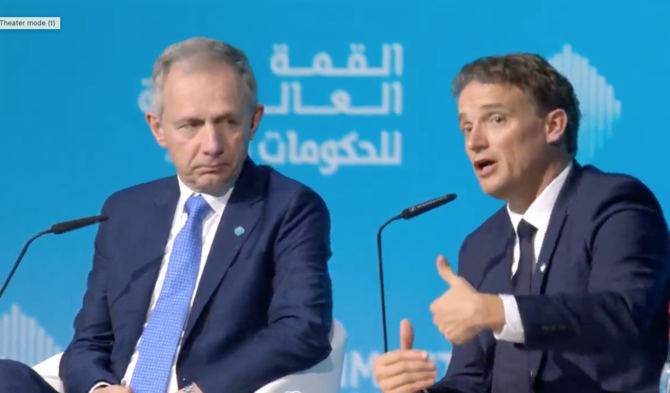


LONDON: Diversified supply chains and regional hubs will help protect technology companies against global trade uncertainty, chief executives told the World Governments Summit in Dubai on Tuesday.
The CEOs of IBM, HP, Blackberry and Europe’s biggest software company SAP, also discussed the global race for artificial intelligence technology and how it impacts their firms.
US President Donald Trump launched his latest protectionist salvo on Monday when he said that a 25 percent tariff on all steel and aluminum imports would take effect on March 12 “without exceptions or exemptions.”
America’s Consumer Technology Association warned last month that the trade war could lead to a 46 percent increase in laptop and tablet prices within the US alone.
Asked whether his company could absorb the hit of the tariffs, HP President and CEO Enrique Lores said: “The situation is very fluid, so it is hard to know exactly what that will be, so what is going to be very important is to be very agile responding, having flexibility, and our goal of course, would be to minimize the impact this will have on the consumer by being flexible and being able to adjust our production all over the world.”
He said the world has realized in recent years that supply chains need to be more diverse and that there is a need to build products in multiple parts of the world “to be more resilient, but also to respond to changes as tariffs could be.
“What we have now is a much more flexible model than what we had that will allow us to respond to the changes.”
IBM’s Chairman and CEO Arvind Krishna said that while supply chain diversification helps protect against all kinds of shocks, not just tariffs, he was more worried about deteriorating trade relations and their impact on economic growth.
“Every 10 percent increase in global trade is 1 percent increase on global GDP,” Krishna said. “The trade relations is what worries us, because GDP in the end and economic growth is what would drive consumption of technology and what'll allow everyone to grow.”
Lores of IBM said he did not see the challenge as just the “US versus China,” but as adapting to demand for manufacturing capabilities in many different countries.
“So, this is why the new way to look at globalization is by looking at regional centers, much more and whether the center is in the US or the center is in China.”
Canada was one of the countries threatened with 25 percent tariffs by Trump, something which BlackBerry CEO John Giamatteo said had “caught our attention,” given his company is based in Ontario.
“It’s particularly an acute issue (for) us, a Canadian company,” he said. “I’m hoping it’s a little bit of a bark and there’s not much bite into it at the end of the day, but we’ll see we’ll see where it all lands.
“I think managing our business on a global level, having regional centers that can help deliver the outcomes that our customers are expecting in the most economical way is really the only thing that we can do to be able to address it properly.”
The panel also discussed the global race to develop AI technology, which has been competing for headlines with Trump’s tariff threats.
The launch of a chatbot by Chinese-owned AI start-up DeepSeek last month wiped $1 trillion from US technology stocks. The competitor to ChatGPT appeared to match its performance at much lower cost, in what some described as a “Sputnik moment” for the AI technology race.
While the world is still digesting the fallout from DeepSeek, SAP CEO Christian Klein said the UAE and the Gulf region had also been leading in the AI digital transformation.
He said when he came to the UAE nine years ago “all the companies were already embracing it, no matter if it’s public or private sector, when in Europe we are still discussing is this technology secure enough? Can we apply it? Here it’s already happening.
“When we talk about inventory, asset management, about saving billions of dollars, by getting smarter on supply chain, here actually we find the use cases by the customers giving us the feedback.”
Lores added: “The work that has been done in these countries during the last 10 years has put them significantly ahead of many, many other countries of the world.”

Joumanna Bercetche, the Dubai-based host of Bloomberg’s “Horizons Middle East and Africa,” discusses AI adoption in emerging economies with Makhtar Diop, managing director of the International Finance Corporation at the World Governments Summit. (Screengrab)
In a separate panel at the summit, Makhtar Diop, managing director of the World Bank’s private investment arm, the International Finance Corp., said he already saw the application of AI widely in developing countries in areas like agriculture and health.
But he added these countries need more energy to power the data centers required to advance AI there.
“If the less advanced countries don’t have electricity, they will not be able to be part of these transformation that is happening right now,” Diop said.


