Pakistan’s UN ambassador calls for global action against militants operating from Afghanistan

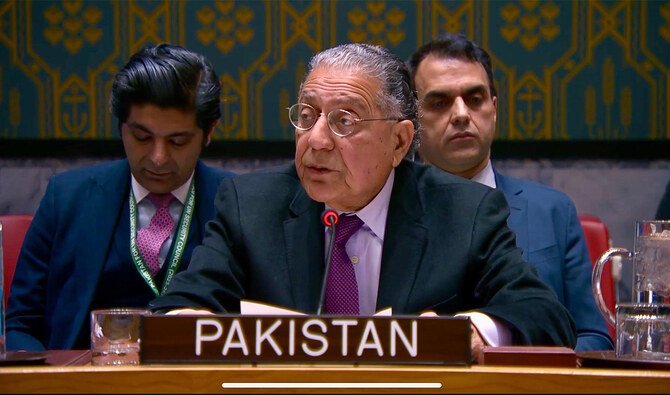
Pakistan’s UN Ambassador Munir Akram addresses UN Security Council briefing on “threats to international peace & security caused by terrorist acts” in New York, US, on February 10, 2025. (@PakistanUN_NY/X)
Short Url
Updated 11 February 2025
Follow

Pakistan’s UN ambassador calls for global action against militants operating from Afghanistan

  • Pakistan accuses Afghanistan of harboring safe havens for militants as it suffers from surge in attacks 
  • Munir Akram calls for eliminating root causes of militancy such as poverty, injustice and unresolved conflicts

ISLAMABAD: Pakistan’s UN Ambassador Munir Akram has called for global action against religiously motivated militants such as Daesh, the Tehreek-e-Taliban Pakistan (TTP) and the separatist Majeed Brigade outfits, alleging that over two dozen “terrorist groups” are operating from Afghanistan which are a threat to the entire region and beyond. 

Pakistan has suffered a surge in militant attacks in its western provinces bordering Afghanistan. The TTP or the Pakistani Taliban have carried out attacks against civilians and law enforcers in Pakistan’s northwestern Khyber Pakhtunkhwa (KP) provinces while the Majeed Brigade, a specialized unit of the Baloch Liberation Army, have scaled attacks in the southwestern Balochistan province. 

Islamabad has repeatedly urged Kabul to take action against militants that it says are using Afghan soil to launch attacks against Pakistan, a charge the Taliban-led government denies. Pakistan last year conducted cross-border strikes into Afghanistan against alleged militant targets, escalating tensions with its western neighbor. 

Akram made the comments during the UN Security Council briefings on “Threats to international peace & security caused by terrorist acts,” Pakistan’s Permanent Mission to the UN shared on social media platform X on Tuesday. 

“While strongly rejecting any imputation that an ISIL-K/Daesh recruitment is taking place inside the country, Pakistan has urged the international community to take greater cognizance of the renewed terrorist threat posed by the TTP, Majeed Brigade and Daesh,” the mission said. 

“He stated in unequivocal terms that over two dozen terrorist groups are operating inside Afghanistan, which is also the ‘main hub for ISIL-K’s recruitment and facilitation,’ as is confirmed by the UN Monitoring Team’s recent report.”

Akram pointed out that Pakistan had defeated Al-Qaeda and other militant networks within its borders, adding that the South Asian country continues to confront “terrorist threats” such as the TTP, Daesh and the Majeed Brigade operating from safe havens across the border.

He demanded addressing root causes of militancy such as poverty, injustice, prolonged unresolved conflicts, foreign occupation and denial of the right of self-determination to people. 

“Without addressing the root causes, we can hope for little success if our focus remains restricted to the consequences of such policies,” he maintained.

Akram pointed out that it was unfortunate how counter-terrorism policies have often equated Islam with extremism, adding that such misplaced notions fuel Islamophobia and further radicalization.

He condemned “terrorism” in all its forms, saying Pakistan was one of the countries worldwide leading the battle against militancy. 

“For more than four decades, we have remained at the forefront of global counter terrorism efforts and been a principle target of terrorist attacks, financed by our adversaries in the region and we have paid a heavy price in innocent human life; lost 80,000 casualties and enormous damage to our economy,” Akram said. 


Pakistan seeks operationalization of World Bank’s $20 billion framework to advance reform priorities

Updated 5 sec ago
Follow

Pakistan seeks operationalization of World Bank’s $20 billion framework to advance reform priorities

  • Pakistan’s finance chief meets World Bank Country Director Bolormaa Amgaabazar in the capital
  • The Bank’s 10-year Country Partnership Agreement for Pakistan was approved in January last year

ISLAMABAD: Pakistan’s Finance Minister Muhammad Aurangzeb on Wednesday called for the operationalization of the World Bank Country Partnership Framework (CPF) to advance the government’s key reform priorities during a meeting with the Bank’s country director, according to a statement.

The Bank’s Board of Directors approved a 10-year CPF deal with Pakistan, indicating $20 billion in financing for Pakistan under the framework. The amount will include public and private financing from the World Bank Group, with roughly half expected to come from private-sector operations led by the International Finance Corporation (IFC).

“The Finance Minister emphasized the importance of effective operationalization of the CPF, particularly in priority areas such as population management and climate change,” the finance ministry said in a statement after Aurangzeb’s meeting with the Bank’s Country Director Bolormaa Amgaabazar.

“He underscored the need for strong coordination between federal and provincial governments to ensure coherence in policy design and implementation.”

Discussions focused on population, human capital development, climate resilience, agricultural reform and energy sector sustainability, it added.

The ministry said both sides exchanged views on enhancing institutional coordination, improving transparency in project design and strengthening monitoring mechanisms to deliver intended outcomes. It highlighted that the World Bank expressed readiness to continue supporting agricultural transformation efforts in collaboration with the IFC.

“Both sides agreed to continue technical-level engagements to explore feasible solutions in line with Pakistan’s reform agenda and fiscal framework,” the finance ministry added.

Climate resilience and population control are major concerns for policymakers in Pakistan, a country whose population exceeds 241 million, making it the world’s sixth-most populous country. Limited infrastructure, health care, and educational opportunities place added strain on public services, contributing to unemployment and poverty.

The South Asian nation is also among the countries most affected by climate change. Unusually heavy monsoon rains in 2022 killed more than 1,700 people and caused over $30 billion in damages. Torrential rains and floods since late June last year have claimed more than 1,000 lives, as authorities continue surveys to assess the full extent of the destruction.