

Pakistan’s UN ambassador calls for global action against militants operating from Afghanistan

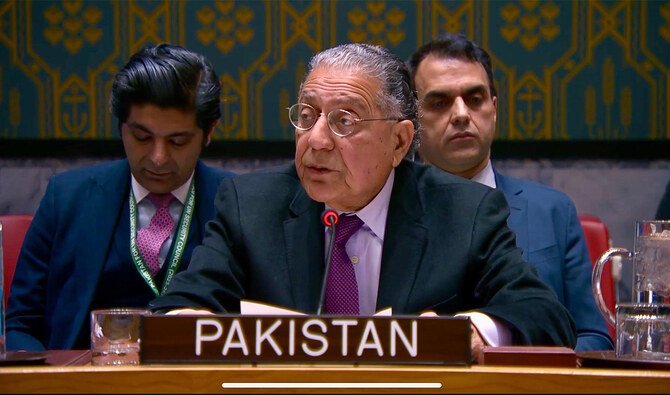
Pakistan’s UN Ambassador Munir Akram addresses UN Security Council briefing on “threats to international peace & security caused by terrorist acts” in New York, US, on February 10, 2025. (@PakistanUN_NY/X)
Short Url
Updated 11 February 2025
Follow

Pakistan’s UN ambassador calls for global action against militants operating from Afghanistan

  • Pakistan accuses Afghanistan of harboring safe havens for militants as it suffers from surge in attacks 
  • Munir Akram calls for eliminating root causes of militancy such as poverty, injustice and unresolved conflicts

ISLAMABAD: Pakistan’s UN Ambassador Munir Akram has called for global action against religiously motivated militants such as Daesh, the Tehreek-e-Taliban Pakistan (TTP) and the separatist Majeed Brigade outfits, alleging that over two dozen “terrorist groups” are operating from Afghanistan which are a threat to the entire region and beyond. 

Pakistan has suffered a surge in militant attacks in its western provinces bordering Afghanistan. The TTP or the Pakistani Taliban have carried out attacks against civilians and law enforcers in Pakistan’s northwestern Khyber Pakhtunkhwa (KP) provinces while the Majeed Brigade, a specialized unit of the Baloch Liberation Army, have scaled attacks in the southwestern Balochistan province. 

Islamabad has repeatedly urged Kabul to take action against militants that it says are using Afghan soil to launch attacks against Pakistan, a charge the Taliban-led government denies. Pakistan last year conducted cross-border strikes into Afghanistan against alleged militant targets, escalating tensions with its western neighbor. 

Akram made the comments during the UN Security Council briefings on “Threats to international peace & security caused by terrorist acts,” Pakistan’s Permanent Mission to the UN shared on social media platform X on Tuesday. 

“While strongly rejecting any imputation that an ISIL-K/Daesh recruitment is taking place inside the country, Pakistan has urged the international community to take greater cognizance of the renewed terrorist threat posed by the TTP, Majeed Brigade and Daesh,” the mission said. 

“He stated in unequivocal terms that over two dozen terrorist groups are operating inside Afghanistan, which is also the ‘main hub for ISIL-K’s recruitment and facilitation,’ as is confirmed by the UN Monitoring Team’s recent report.”

Akram pointed out that Pakistan had defeated Al-Qaeda and other militant networks within its borders, adding that the South Asian country continues to confront “terrorist threats” such as the TTP, Daesh and the Majeed Brigade operating from safe havens across the border.

He demanded addressing root causes of militancy such as poverty, injustice, prolonged unresolved conflicts, foreign occupation and denial of the right of self-determination to people. 

“Without addressing the root causes, we can hope for little success if our focus remains restricted to the consequences of such policies,” he maintained.

Akram pointed out that it was unfortunate how counter-terrorism policies have often equated Islam with extremism, adding that such misplaced notions fuel Islamophobia and further radicalization.

He condemned “terrorism” in all its forms, saying Pakistan was one of the countries worldwide leading the battle against militancy. 

“For more than four decades, we have remained at the forefront of global counter terrorism efforts and been a principle target of terrorist attacks, financed by our adversaries in the region and we have paid a heavy price in innocent human life; lost 80,000 casualties and enormous damage to our economy,” Akram said. 


Pakistan urges UN Security Council to sanction separatist BLA group after recent attacks

Updated 05 February 2026
Follow

Pakistan urges UN Security Council to sanction separatist BLA group after recent attacks

  • Separatist BLA launched attacks in multiple Balochistan cities last week, killing over 50 as per official figures
  • Pakistan envoy says since Taliban assumed control of Afghanistan, BLA, other militant groups have a “new lease of life“

ISLAMABAD: Pakistan’s UN Ambassador Iftikhar Ahmed this week urged the Security Council to impose sanctions against the separatist Baloch Liberation Army (BLA) militant group and designate it as a “terrorist” group, after its recent coordinated attacks in southwestern Balochistan province. 

Pakistan’s military said on Thursday it has concluded security operations in Balochistan against separatists that was launched since Jan. 29, killing 216 militants. The military launched counteroffensive operations in Balochistan after the BLA said it launched coordinated attacks in several parts of the province last Friday and Saturday. 

The attacks killed 36 civilians and 22 law enforcement and security forces personnel, Pakistan’s military said. Pakistan’s government has accused India of being involved in the attacks, charges that New Delhi has dismissed. 

“We hope the Council will act swiftly to designate BLA under the 1267 sanctions regime acceding to the listing request that is currently under consideration,” Iftikhar said on Wednesday during a UNSC briefing on the topic ‘Threats to International Peace and Security caused by Terrorist Acts.’

The 1267 sanctions regime is a UNSC program that seeks to impose sanctions on individuals and entities associated with “terrorism.”

The regime seeks to impose travel bans, freeze assets and impose an arms embargo on individuals and groups primarily associated with Al-Qaeda or the Taliban. 

Ahmad said that after the Taliban takeover of Afghanistan in 2021, “externally sponsored and foreign-funded proxy terrorist groups” such as the Tehreek-e-Taliban Pakistan and the BLA have got a “new lease of life.”

“Operating with virtual impunity from Afghan soil and with the active support of our eastern neighbor, these groups are responsible for heinous terrorist attacks inside Pakistan,” he said. 

The Pakistani envoy said it has become imperative to prevent billions of dollars of sophisticated weapons and equipment, which were left behind by foreign forces in Afghanistan, “from falling into the hands of terrorists.”

“There must be accountability of external destabilizing actors who support, finance and arm these groups, including their proxies in Afghanistan,” Ahmad said in a veiled reference to India. 

Pakistan’s largest and poorest province, mineral-rich Balochistan borders Iran and ‌Afghanistan and is home to China’s investment in the Gwadar deep-water ‍port and other projects.

Balochistan has been the site of a ‍decades-long insurgency led by ethnic Baloch separatists seeking greater autonomy and a larger share of its natural ‍resources. 

They accuse the state of denying locals a fair share of the province’s mineral wealth, charges that are denied by the Pakistani government.