

Saudi Arabia is already making strides in AI technology, says Abdullah Al-Swaha

1 / 2
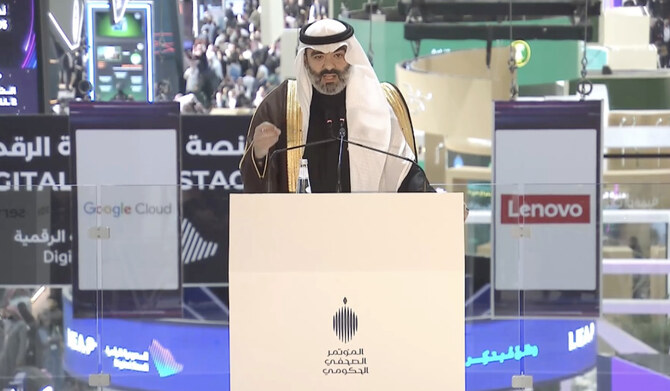
Abdullah Al-Swaha, Minister of Communications and Information Technology, speaks to the press during LEAP 2025. (Supplied)
2 / 2
Abdullah Al-Swaha, Minister of Communications and Information Technology, speaks to the press during LEAP 2025. (Supplied)
Short Url
Updated 10 February 2025
Follow

Saudi Arabia is already making strides in AI technology, says Abdullah Al-Swaha

  • Minister speaks about vision for future of AI
  • Kingdom’s notable achievements highlighted

RIYADH: Saudi Arabia is making strides in AI technology, said Abdullah Al-Swaha, the minister of communications and information technology, during the ministry’s flagship conference LEAP.

Responding to a question from Arab News, Al-Swaha told the press about his vision for the future of artificial intelligence in the Kingdom in the next five years, highlighting some of the country’s most notable achievements so far.

He spoke about the decision-making AI platform provider Intelmatix which he called “the No. 1 startup in the region, (with) $20 million of funding.”

Al-Swaha also highlighted the Saudi startup NanoPalm, which aims to tackle sickle cell disease by using nanoparticles, and Fathom.io, a platform that enables organizations to accelerate decision-making.

“When it comes to autonomous AI, we have Dr. Khaliel doing the first fully robotic heart transplant,” he said, referring to King Faisal Specialist Hospital and Research Center’s Dr. Feras Khaliel who, in 2024, used robotic technology to replace the heart of a 16-year-old.

“So, we are making strides and rest assured we are committed, with royal guidance and support and in partnership with all of the global innovators, and the Kingdom will continue to be the hub for generative AI, GenTech, and autonomous AI, powered by talent and technology.”

He also noted his admiration for the leadership skills of Crown Prince Mohammed bin Salman, adding: “I have the humble pleasure of learning from him; have the ability to anticipate market transitions; and be able to decisively allocate resources and have a wonderful opportunity to zoom in and zoom out. These are the three traits that I am learning from our royal highness.

“When we first pitched to him all of our ambitions in artificial intelligence, he said it’s not only about hardware, but it’s about applications and services.

“It’s not about models, as some of them might be commoditized; it is about the diffusion of these technologies across industries.”

He added: “Fast forward to today, and the DeepSeek moment, the ChatGPT moment, have shown us that it is hardware and software, applications and adoption, and the Kingdom is already making strides in generative AI, GenTech AI, and autonomous AI.”

Boasting the theme “Into New Worlds,” LEAP 2025 aims to expand business networking and investment opportunities in the tech sector.

The event, which runs until Feb. 12 in Riyadh, plays a critical role in Saudi Arabia’s ambition to become a global technology hub, aligning with its Vision 2030 plan to diversify the economy. As part of this initiative, the Kingdom has pledged $100 billion toward advancing its technology sector.

LEAP 2025 is co-organized by Tahaluf and the Ministry of Communications and Information Technology, in partnership with Informa PLC, the Saudi Federation for Cybersecurity, Programming and Drones, and the Events Investment Fund.

This year’s LEAP is expected to host more than 680 tech startups, 1,100 speakers, 1,800 technology brands, and over 170,000 visitors.


Kingdom key player in regional peace, EU official says

Updated 15 sec ago
Follow

Kingdom key player in regional peace, EU official says

  • Hana Jalloul Muro highlights Riyadh’s role in regional stability, economic growth and advancing EU-Saudi strategic ties

Riyadh: Hana Jalloul Muro, vice-chair of the European Parliament’s Foreign Affairs Committee, has praised Saudi Arabia’s role as a “reliable partner” to the EU.

Describing the Kingdom as a “key international actor,” she highlighted its pivotal role in regional stability, including brokering peace talks on Ukraine, promoting peace in Palestine, and supporting stable governments in Lebanon and the Syrian Arab Republic.

“Saudi is a reliable partner because it is a country that has demonstrated that with Vision 2030, only in the last five, six years, it has changed impressively. It has a major women’s labor force, a very low youth unemployment rate and is growing very fast,” Muro told Arab News.

Speaking on the sidelines of the Future Minerals Forum in Riyadh, she added: “Saudi Arabia is becoming a key major player in the international arena now — for peace conversations on Ukraine, supporting the Syrian government, paying Syria’s external debt, stabilizing the government in Lebanon, promoting peace in Gaza, in Palestine and pushing for a ceasefire, too.

“So, I think it is a very key international actor, very important in the region for stability,” Muro added.

Explaining why she considers the Kingdom a reliable partner, Muro said: “It’s a country that knows how to see to the East and to the West.”

Muro also serves as the European Parliament’s rapporteur for Saudi Arabia, and is responsible for drafting reports on legislative and budgetary proposals and other key bilateral issues.

In mid-December 2025, the European Parliament endorsed a road map to elevate EU-Saudi relations into a full-fledged strategic partnership, which Saudi Ambassador to the EU Haifa Al-Jedea described as “an important milestone” in bilateral ties.

The report highlighted the possibility of Saudi-EU visa-free travel, reaffirming the EU’s commitment to advancing a safe, mutually beneficial visa-free arrangement with the five GCC countries to ensure equal treatment under the new EU visa strategy.

“One of the key hot topics is the visa waiver to Saudi Arabia, which I always support,” Muro said. “Saudi Arabia has, as you are aware, been in cascade for five years, and I think we need to work toward a visa waiver.”

The report also highlighted the economic significance of Saudi tourists to EU member states, particularly for the hospitality, retail and cultural sectors, while emphasizing that Saudi citizens do not pose a source of irregular migration pressure.

When asked about the status of the visa waiver, Muro said: “The approval, it is the recommendation to the commission to take into account its importance. We need to advance on that because we are in the framework of this strategic partnership agreement that covers many topics, so this is why the visa waiver is a central key issue.”

She added: “I think by now we recognize the international role of Saudi Arabia and how important it is to us as a neighbor — not only for security, counter-terrorism and energy, but for everything. We need to get closer to partners like the GCC, Saudi specifically.

“And I think that we need to take Saudi Arabia as a very big ally of ours,” Muro said.

During her time in Riyadh, Muro took part in a panel at the forum focused on the EU-KSA business and investment dialogue, and advancing the critical raw materials value chain.

On the sidelines, she met Saudi Vice Foreign Minister Waleed Elkhereiji to discuss ways to further strengthen Saudi-EU relations.

She also met Hala Al-Tuwaijri, chairwoman of the Saudi Human Rights Commission, saying: “I have to congratulate you and the government, your country, on doing a great job.”