France in advanced talks to buy Indian rocket launcher system, Indian official says

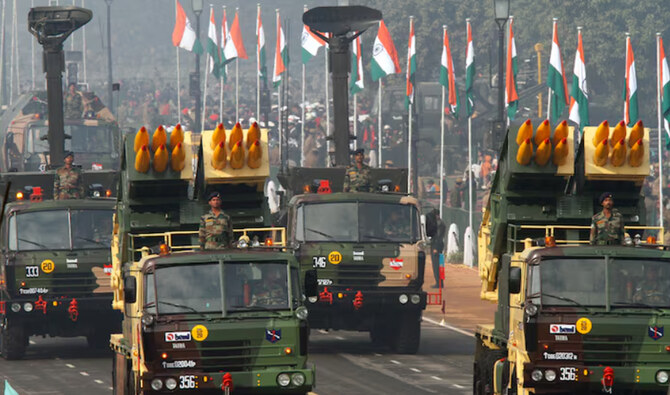
The Indian Army’s Pinaka multi barrel rocket launcher systems are displayed during the full dress rehearsal for the Republic Day parade in New Delhi on January 23, 2011. (REUTERS/File)
Short Url
Updated 10 February 2025
Follow

France in advanced talks to buy Indian rocket launcher system, Indian official says

  • India is the world’s biggest arms importer, but has been trying to boost local production to meet its defense requirements
  • The Pinaka rocket system with a range of up to 90km was demonstrated to a French delegation in India around three months ago

BENGALURU: France is in advanced talks with India to buy a multi-barrel rocket launcher system, a top Indian official said on Monday, a potential deal that would be the first time India’s second-largest arms supplier buys weapons from New Delhi.
India is the world’s biggest arms importer, but has been trying to boost local production to meet its defense requirements and has been steadily raising its defense exports.
The domestically made Pinaka rocket system with a range of up to 90 km (56 miles) was demonstrated to a French delegation in India around three months ago and was found to be satisfactory, a second official said, speaking on condition of anonymity.
“France is in active talks for Pinaka,” Ummalaneni Raja Babu, the director general of missiles and strategic systems at India’s Defense Research and Development Organization, said on the sidelines of the Aero India aerospace exhibition in the southern city of Bengaluru.
“A deal has not been reached yet, but the talks are continuing,” said Babu.
Indian Prime Minister Narendra Modi embarked on a visit to France on Monday to co-chair an artificial intelligence summit in Paris with French President Emmanuel Macron and both leaders are scheduled to hold bilateral talks on Tuesday.
It was not immediately clear if the rocket system will feature in the talks, and India’s foreign ministry did not immediately respond to a request for comment.
France’s embassy in India did not immediately respond to a request for comment outside of business hours.
France was India’s second-largest arms supplier after Russia between 2019 and 2023, according to the Stockholm International Peace Research Institute.
The Pinaka rocket launcher system, used by the Indian Army and deployed in the 1999 war between India and Pakistan, is also being enhanced with longer ranges, Babu said.


Youth voters take center stage in Bangladesh election after student-led regime change

Updated 38 min 40 sec ago
Follow

Youth voters take center stage in Bangladesh election after student-led regime change

  • About 45% of Bangladeshis eligible to vote in Thursday’s election are aged 18-33
  • Election follows 18 months of reforms after the end of Sheikh Hasina’s 15-year rule

DHAKA: When he goes to the polls on Thursday, Atikur Rahman Toha will vote for the first time, believing that this election can bring democratic change to Bangladesh.

A philosophy student at Dhaka University, Toha was already eligible to vote in the 2024 poll but, like many others, he opted out.

“I didn’t feel motivated to even go to vote,” he said. “That was a truly one-sided election. The election system was fully corrupted. That’s why I felt demotivated. But this time I am truly excited to exercise my voting rights for the first time.”

The January 2024 vote was widely criticized by both domestic and international observers and marred by a crackdown on the opposition and allegations of voter fraud.

But the victory of the Awami League of ex-Prime Minister Sheikh Hasina was short-lived, as a few months later the government was ousted by a student-led uprising, which ended the 15-year rule of Bangladesh’s longest-serving leader.

The interim administration, led by Nobel laureate Muhammad Yunus, took control in August 2024 and prepared a series of reforms to restructure the country’s political and institutional framework and organize the upcoming vote.

About 127.7 million Bangladeshis are eligible to cast their ballots, according to Election Commission data, with nearly a third of them, or 40.4 million, aged 18-29. Another 16.9 million are 30-33, making it a youth–dominated poll, with the voters hopeful the outcome will help continue the momentum of the 2024 student-led uprising.

“We haven’t yet fully transitioned into a democratic process. And there is no fully stable situation in the country,” Toha said. “After the election we truly hope that the situation will change.”

For Rawnak Jahan Rakamoni, also a Dhaka University student, who is graduating in information science, voting this time meant that her voice would count.

“We are feeling that we are heard, we will be heard, our opinion will matter,” she said.

“I think it is a very important moment for our country, because after many years of controversial elections, people are finally getting a chance to exercise their voting rights and people are hoping that this election will be more meaningful and credible. This should be a fair election.”

But despite the much wider representation than before, the upcoming vote will not be entirely inclusive in the absence of the Awami League, which still retains a significant foothold.

The Election Commission last year barred Hasina’s party from contesting the next national elections, after the government banned Awami League’s activities citing national security threats and a war crimes investigation against the party’s top leadership.

The UN Human Rights Office has estimated that between July 15 and Aug. 5, 2024 the former government and its security and intelligence apparatus, together with “violent elements” linked to the Awami League, “engaged systematically in serious human rights violations and abuses in a coordinated effort to suppress the protest movement.”

It estimated that at least 1,400 people were killed during the protests, with the majority shot dead from military rifles.

Rezwan Ahmed Rifat, a law student, wanted the new government to “ensure justice for the victims of the July (uprising), enforced disappearances, and other forms of torture” carried out by the previous regime.

The two main parties out of the 51 contesting Thursday’s vote are the Bangladesh Nationalist Party and Jamaat-e-Islami. Jamaat, which in 2013 was banned from political participation by Hasina’s government, heads an 11-party alliance, including the National Citizen Party formed by student leaders from the 2024 movement.

“I see this election as a turning point of our country’s democratic journey … It’s not just a normal election,” said Falguni Ahmed, a psychology student who will head to the polls convinced that no matter who wins, it will result in the “democratic accountability” of the next government.

Ahmed added: “People are not voting only for their leaders; they are also voting for the restoration of democratic credibility. That’s why this election is very different.”