

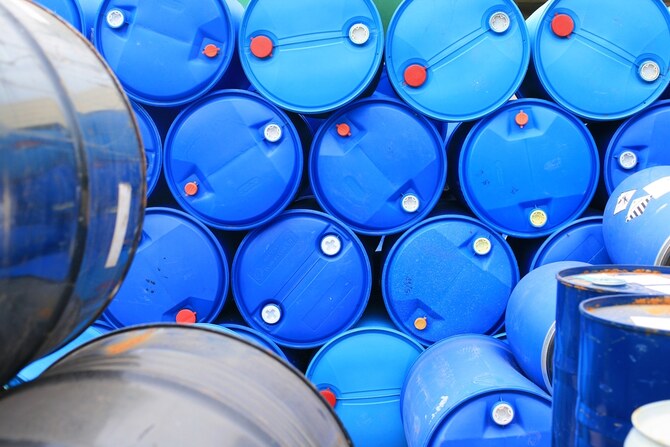
Oil Updates — crude climbs as investors weigh new US tariffs

Brent crude futures climbed 54 cents, or 0.7 percent, to $75.20 a barrel by 10:34 a.m. Saudi time. Shutterstock
Short Url
Updated 10 February 2025
Follow

Oil Updates — crude climbs as investors weigh new US tariffs

  • Trump said he will announce 25% tariffs on all steel and aluminum imports into the US
  • China’s retaliatory tariffs on some US exports are due to take effect on Monday

SINGAPORE: Oil prices ticked higher on Monday even as investors weighed US President Donald Trump’s latest tariff threat, this time on all steel and aluminum imports, which could dampen global economic growth and energy demand.

Brent crude futures climbed 54 cents, or 0.7 percent, to $75.20 a barrel by 10:34 a.m. Saudi time while US West Texas Intermediate crude was at $71.50 a barrel, up 50 cents, or 0.7 percent. The market posted its third consecutive weekly decline last week on concerns about a global trade war.

Trump said he will announce on Monday 25 percent tariffs on all steel and aluminum imports into the US, in another major escalation of his trade policy overhaul.

Just a week ago, the president announced tariffs on Canada, Mexico and China, but suspended those for the neighboring countries the next day.

In light of Trump’s temporary backdown last week, investors appeared to be shrugging off the steel and aluminum tariff threat for now, Tony Sycamore, a Sydney-based analyst at IG said.

“The market has realized tariff headlines are likely to continue in the weeks and months ahead,” he said, adding that there was an equal chance they could be walked back or even increased at some point in the near future.

“So perhaps investors are coming to the conclusion it’s not the best course of action to react to every headline negatively.”

China’s retaliatory tariffs on some US exports are due to take effect on Monday, with no sign as yet of progress between Beijing and Washington.

Oil and gas traders are seeking waivers from Beijing for US crude and liquefied natural gas imports.

Trump said on Sunday that the US is making progress with Russia to end the Ukraine war, but declined to provide details about any communications he had with Russian President Vladimir Putin.

Sanctions imposed on Russian oil trade on January 10 disrupted Moscow’s supplies to its top clients China and India.

Washington also stepped up pressure on Iran last week, with the US Treasury imposing new sanctions on a few individuals and tankers that help to ship millions of barrels of Iranian crude oil per year to China.

Sanctions on Iran and failure to reach a nuclear deal are upside risks to oil prices even though Trump’s policies are aimed at driving energy prices lower, Citi analysts said in a note.

“We see oil likely trading sideways to down over the next month or so, with the fundamental downward pressure building on crude in our base case throughout the year,” they said.

Brent is forecast to average $60 to $65 a barrel in the second half of 2025 as Trump will be persistent in his desire to lower energy prices, and he will ultimately prove to be a bearish influence on the oil market, Citi said.


Saudi minister at Davos urges collaboration on minerals

Global collaboration on minerals essential to ease geopolitical tensions and secure supply, WEF hears. (Supplied)
Updated 20 January 2026
Follow

Saudi minister at Davos urges collaboration on minerals

  • The reason of the tension of geopolitics is actually the criticality of the minerals

LONDON: Countries need to collaborate on mining and resources to help avoid geopolitical tensions, Saudi Arabia’s minister of industry and mineral resources told the World Economic Forum on Tuesday.

“The reason of the tension of geopolitics is actually the criticality of the minerals, the concentration in different areas of the world,” Bandar Alkhorayef told a panel discussion on the geopolitics of materials.

“The rational thing to do is to collaborate, and that’s what we are doing,” he added. “We are creating a platform of collaboration in Saudi Arabia.”

Bandar Alkhorayef, Saudi Minister of Industry and Mineral Resources 

The Kingdom last week hosted the Future Minerals Forum in Riyadh. Alkhorayef said the platform was launched by the government in 2022 as a contribution to the global community. “It’s very important to have a global movement, and that’s why we launched the Future Minerals Forum,” he said. “It is the most important platform of global mining leaders.”

The Kingdom has made mining one of the key pillars of its economy, rapidly expanding the sector under the Vision 2030 reform program with an eye on diversification. Saudi Arabia has an estimated $2.5 trillion in mineral wealth and the ramping up of extraction comes at a time of intense global competition for resources to drive technological development in areas like AI and renewables.

“We realized that unlocking the value that we have in our natural resources, of the different minerals that we have, will definitely help our economy to grow to diversify,” Alkhorayef said. The Kingdom has worked to reduce the timelines required to set up mines while also protecting local communities, he added. Obtaining mining permits in Saudi Arabia has been reduced to just 30 to 90 days compared to the many years required in other countries, Alkhorayef said.

“We learned very, very early that permitting is a bottleneck in the system,” he added. “We all know, and we have to be very, very frank about this, that mining doesn’t have a good reputation globally.

“We are trying to change this and cutting down the licensing process doesn’t only solve it. You need also to show the communities the impact of the mining on their lives.”

Saudi Arabia’s new mining investment laws have placed great emphasis on the development of society and local communities, along with protecting the environment and incorporating new technologies, Alkhorayef said. “We want to build the future mines; we don’t want to build old mines.”