

Baltic states switch to European power grid, ending Russia ties

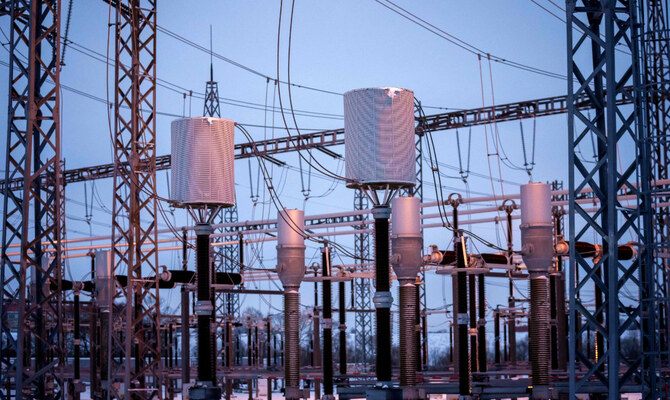
A photo taken on February 8, 2025 shows the power substation in Rezekne, Latvia before the disconnection of the major power line between Latvia and Russia. The three Baltic states on February 8 cut ties with Russia's power grid to join the European Union's network, the culmination of a years-long process that gained urgency with Moscow's invasion of Ukraine. (AFP)
Short Url
Updated 10 February 2025
Follow

Baltic states switch to European power grid, ending Russia ties

  • It is designed to integrate the three Baltic nations more closely with the European Union and to boost the region’s energy security

VILNIUS: The Baltic states of Estonia, Latvia and Lithuania completed a switch from Russia’s electricity grid to the EU’s system on Sunday, severing Soviet-era ties amid heightened security after the suspected sabotage of several subsea cables and pipelines.
European Commission President Ursula von der Leyen hailed the move, years in the planning, as marking a new era of freedom for the region, in a speech at a ceremony in Vilnius alongside the leaders of the three countries and the Polish president.
“These chains of power lines linking you to hostile neighbors will be a thing of the past,” von der Leyen said.
Debated for many years, the complex switch away from the grid of their former Soviet imperial overlord gained momentum following Moscow’s annexation of Crimea in 2014 and its invasion of Ukraine in 2022.
It is designed to integrate the three Baltic nations more closely with the European Union and to boost the region’s energy security.
“This is freedom, freedom from threats, freedom from blackmail,” von der Leyen said, adding that the wider European continent was also liberating itself from the use of Russian natural gas.
Ukrainian President Volodymyr Zelensky said in his nightly video address that Kyiv had taken the same step in 2022 “and the Baltic states are also ridding themselves of this dependence.
“Moscow will no longer be able to use energy as a weapon against the Baltic states.”
After disconnecting on Saturday from the IPS/UPS network, established by the Soviet Union in the 1950s and now run by Russia, the Baltic nations cut cross-border high-voltage transmission lines in eastern Latvia, some 100 meters from the Russian border, handing out pieces of chopped wire to enthusiastic bystanders as keepsakes.

HIGH ALERT
The Baltic Sea region is on high alert following power cable, telecom and gas pipeline outages between the Baltics and Sweden or Finland. All were believed to have been caused by ships dragging anchors along the seabed following Russia’s invasion of Ukraine.
Russia has denied any involvement.
Poland and the Baltics deployed navy assets, elite police units and helicopters to monitor the area after an undersea power link from Finland to Estonia was damaged in December, while Lithuania’s military began drills to protect the overland connection to Poland.
Analysts say any further damage to links could push power prices in the Baltics to levels not seen since the invasion of Ukraine, when energy prices soared.
The IPS/UPS grid was the final remaining link to Russia for the three countries, which re-emerged as independent nations in the early 1990s at the fall of the Soviet Union, and joined the European Union and NATO in 2004.
The three staunch supporters of Kyiv stopped purchases of power from Russia following Moscow’s invasion of Ukraine, but have relied on the Russian grid to control frequencies and stabilize networks to avoid outages.
Analysts say that maintaining a constant power supply requires a stable grid frequency, which can more easily be obtained over time in a large synchronized area such as Russia or continental Europe, compared to what the Baltics can do on their own.
For Russia, the decoupling means its Kaliningrad exclave, located between Lithuania, Poland and the Baltic Sea, is cut off from Russia’s main grid, leaving it to maintain its power system alone.
The Kremlin said it has taken all necessary measures to ensure uninterrupted, reliable operation in its electricity system, including the construction of several gas-fired power plants in Kaliningrad.


Zelensky says Ukrainian air force needs to improve as Russian drone barrages take a toll

Updated 06 February 2026
Follow

Zelensky says Ukrainian air force needs to improve as Russian drone barrages take a toll

  • Zelensky said Friday he had discussed with his defense minister and the air force commander what new air defense measures Ukraine needs to counter the Russian barrages
  • Russia fired 328 drones and seven missiles at Ukraine overnight and in the early morning

KYIV: Ukrainian President Volodymyr Zelensky on Friday described the performance of the air force in parts of the country as “unsatisfactory,” and said that steps are being taken to improve the response to large-scale Russian drone barrages of civilian areas.
The repeated Russian aerial assaults have in recent months focused on Ukraine’s power grid, causing blackouts and disrupting the heating and water supply for families during a bitterly cold winter.
With the war about to enter its fifth year later this month following Russia’s all-out invasion of its neighbor, there is no sign of a breakthrough in US-led peace efforts following the latest talks this week.
Further US-brokered meetings between Russian and Ukrainian delegations are planned “in the near future, likely in the United States,” Zelensky said.
Zelensky said Friday he had discussed with his defense minister and the air force commander what new air defense measures Ukraine needs to counter the Russian barrages. He didn’t elaborate on what would be done.
Russia fired 328 drones and seven missiles at Ukraine overnight and in the early morning, the air force said, claiming that air defenses shot down 297 drones.
One person was killed and two others were injured in an overnight Russian attack using drones and powerful glide bombs on the central Dnipropetrovsk region, according to the head of the regional military administration, Oleksandr Hanzha.
A Russian aerial attack on the southern Zaporizhzhia region during early daylight hours injured eight people and damaged 18 apartment blocks, according to regional military administration head Ivan Fedorov.
A dog shelter in the regional capital was also struck, killing 13 dogs, Zaporizhzhia City Council Secretary Rehina Kharchenko said.
Some dogs were rushed to a veterinary clinic, but they could not be saved, she said. Seven other animals were injured and are receiving treatment.
Amid icy conditions in Kyiv, more than 1,200 residential buildings in multiple districts of the capital have had no heating for days due to the Russian bombardment of the power grid, according to Zelensky.
The UK defense ministry said Friday that Ukraine’s electricity network “is experiencing its most acute crisis of the winter.”
Mykola Tromza, an 81-year-old pensioner in Kyiv, said he has had his power restored, but recently went without heating and water at home for a week.
“I touched my nose and by God, it was like an icicle,” Tromza said. He said he ran up and down to keep warm.
Russia’s Defense Ministry said that air defenses downed 38 Ukrainian drones overnight, including 26 over the Bryansk region.
Bryansk Gov. Alexander Bogomaz said the attack briefly cut power to several villages in the region.
Another Ukrainian nighttime strike damaged power facilities in the Russian city of Belgorod, disrupting electricity distribution, Gov. Vyacheslav Gladkov said.
Local reports said that Ukrainian missiles hit a power plant and an electrical substation, cutting power to parts of the city.
Fierce fighting has also continued on the front line despite the frigid temperatures.
Ukraine’s Commander in Chief, Col. Gen. Oleksandr Syrskyi, said the front line now measures about 1,200 kilometers (750 miles) in length along eastern and southern parts of Ukraine.
The increasing technological improvements to drones on both sides mean that the so-called “kill zone” where troops are in greatest danger is now up to 20 kilometers (12 miles) deep, he told reporters on Thursday in comments embargoed until Friday.