

Niger’s military to hold ‘national convention’ on transition charter

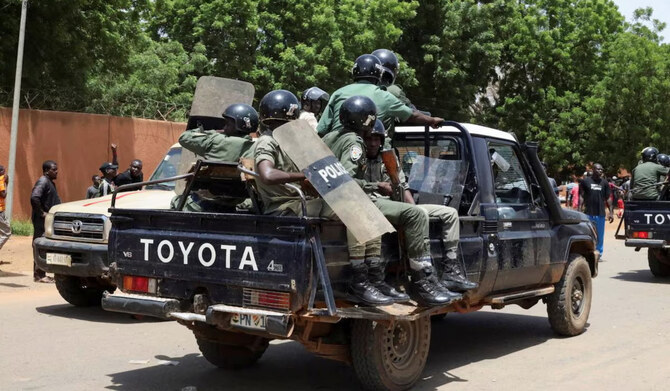
Niger, along with its neighbors Burkina Faso and Mali, has for over a decade battled an insurgency fought by militant groups. (Reuters)
Short Url
Updated 09 February 2025
Follow

Niger’s military to hold ‘national convention’ on transition charter

  • Sahel country is one of several nations in the region where army has seized power

NIAMEY: Niger’s military regime will organize a “national convention” from Feb. 15 to 19, notably intended to set the duration of the transition period that began with the 2023 overthrow of civilian President Mohamed Bazoum, the Interior Ministry said.

The ministry unveiled the dates in a press release broadcast on state television, adding that the gathering would take place in the capital Niamey.
In August 2023, shortly after taking power in a coup, General Abdourahamane Tiani announced the organization of an “inclusive national dialogue” to outline the priority areas of governance and lay down the duration of the transition.
At the time, he mentioned a maximum duration of three years, but he has not addressed the issue since.
Early last year consultations were held across the country’s eight regions to lay out a working basis for next week’s meetings, with a national commission also created by presidential decree to oversee the work of the four-day conference set to produce a “preliminary draft of the transition charter.”
Following the gathering there will be a three-week period in which to draft a “final report” to General Tiani.
The commission, headed by Mamoudou Harouna Djingareye, a traditional leader, also comprises former ministers, academics, lawyers, soldiers, advisers to General Tiani, religious leaders and figures drawn from civil society.
It is made up of five sub-committees whose themes are “peace, security, national reconciliation and social cohesion,” “political and institutional overhaul” and “justice and human rights.”
Niger is one of several countries in Africa’s Sahel region where the military has seized power in coups in recent years, amid persistent attacks by insurgencies.
A few days earlier, armed assailants in the country killed at least 10 soldiers in an ambush on a military unit that had been sent to hunt cattle rustlers in a border region near Burkina Faso.
The military unit was deployed to catch criminals who had been stealing the cattle in the western village of Takzat, the military said in a statement broadcast Wednesday night.
“It was during the operation that a group of criminals ambushed the detachment of the internal security forces which resulted in the loss of 10 of our soldiers,” the statement said. It did not identify the attackers.
The attackers managed to flee, but the military caught and neutralized 15 “terrorists” on Tuesday, the statement added.
Niger, along with its neighbors Burkina Faso and Mali, has for over a decade battled an insurgency fought by militant groups, including some allied with Al-Qaeda and Daesh.
Following military coups in all three nations in recent years, the ruling juntas have expelled French forces and turned to Russia’s mercenary units for security assistance. The three countries have vowed to strengthen their cooperation by establishing a new security alliance, the Alliance of Sahel States.
But the security situation in the Sahel, a vast region on the fringes of the Sahara Desert, has significantly worsened since the juntas took power, analysts say, with a record number of attacks and civilians killed both by militants and government forces.


China foreign minister blasts Middle East war, urges US to manage ties

Updated 4 sec ago
Follow

China foreign minister blasts Middle East war, urges US to manage ties

  • Wang Yi: ‘A strong fist does not mean strong reason. The world cannot return to the law of the jungle’
BEIJING: China’s top diplomat condemned on Sunday the war in the Middle East and urged the United States to iron out its differences with Beijing.
Foreign Minister Wang Yi told a press conference in the Chinese capital that the war, which was sparked by US and Israeli strikes on Iran, “should never have happened.”
“A strong fist does not mean strong reason. The world cannot return to the law of the jungle,” he told reporters.
He was speaking during China’s annual political gathering, which began this week, known as the “Two Sessions.”
The parallel meetings of China’s parliament and political consultative body are closely watched for clues as to the priorities of top leaders, in the face of a precarious geopolitical landscape
Wang addressed a range of issues, including a trade war with the United States, regional tensions in the South China Sea, as well as wars in the Middle East and Ukraine.
“This year is indeed a big year for Sino-US relations,” Wang said.
‘Manage differences’
Ties between China and the United States have been strained since US President Donald Trump returned to the White House last year, followed by a trade war that saw the two countries impose tit-for-tat tariffs on each other’s products.
“We observe certain country erecting tariff barriers and pursuing decoupling and supply chain disruption,” Wang said on Sunday.
“These actions are akin to trying to extinguish a fire with fuel. Ultimately, they will backfire and harm itself.”
While China and the United States “cannot change each other,” he said, “we can change the way we interact with each other.”
Wang urged both sides to “create a suitable environment, manage existing differences, and eliminate unnecessary interference.”
But a wide range of disagreements remain.
Beijing has blasted US and Israeli military strikes on Iran, with which it has diplomatic and trade ties.
It has in particular condemned the killing of the country’s supreme leader Ayatollah Ali Khamenei.
Wang also maintained that China’s relations with Moscow, which have been criticized by Western countries for sustaining the war in Ukraine, remained “steadfast and unshakeable.”
China ‘gym’
China has sought to profit off Trump’s volatile foreign policies, positioning itself as a reliable alternative to once traditional US allies.
Leaders from France, Canada, Finland and the United Kingdom, among others, have flocked to Beijing, recoiling from Trump’s bid to seize Greenland and tariff threats against fellow NATO members.
Wang welcomed the visits on Sunday, saying “we have noticed that more and more insightful Europeans agree that China is not a competitor, but a global partner.”
“We welcome our European friends to step out of the ‘small attic’ of protectionism and come to the ‘gym’ of the Chinese market, where they can strengthen their muscles and enhance their competitiveness,” he said.
In the spirit of warming relations, China has doled out visa-free travel agreements to around 50 countries including France, Germany, and the United Kingdom.
Beijing has also agreed to reduced tariffs with Ottawa and London in their exports to China.
Wang also addressed relations between China and Japan, which have been locked in a spat after comments by Prime Minister Sanae Takaichi in November that Tokyo could intervene militarily in any attack on self-ruled Taiwan.
Takaichi’s comments enraged Beijing, which views Taiwan as its territory and has not ruled out taking by force.
Wang emphasized on Sunday that Beijing “will never allow anyone or any force to separate Taiwan … from China once again.”
He warned Japan against “repeating the same disastrous mistakes,” adding that China “will never allow anyone to stand up for colonialism,” in an apparent reference to Tokyo’s actions during World War II.
The issue of Taiwan, he insisted, is “at the heart of China’s core interests” and “a red line that must not be crossed or trampled on.”