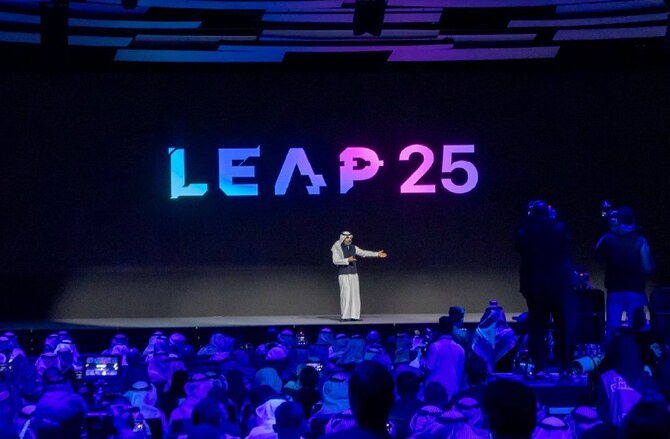

RIYADH: Saudi Arabia has announced investments worth $14.9 billion in the technological sector on the first day of the LEAP 2025 Tech Conference as the Kingdom continues to spearhead its economic diversification efforts.
During the event’s opening ceremony, the Kingdom’s Minister of Communications and Information Technology Abdullah Al-Swaha said Saudi Arabia is witnessing significant growth in the industry, with the number of jobs jumping from 150,000 in 2021 to 381,000 in 2024.
LEAP 2025 is a flagship event in the Kingdom, as the nation eyes to become a global and regional tech hub, aligned with the goals outlined in the Vision 2030 program.
“Under the leadership of His Royal Highness (Crown Prince Mohammed bin Salman), and in partnership with you, our global innovators and thinkers of the world — yet again, you keep making history in this dividing moment and announcing $14.9 billion worth of investments and announcements in this LEAP alone,” said Al-Swaha.
“The numbers speak for themselves. As a digital economy collectively, we (MENA region) have grown by 73 percent to $260 billion in the region from 2021 to 2024. The Kingdom represents 50 percent of it. As a tech force, as His Royal Highness said this region is the new Europe,” he added.
“In terms of growth, we jumped from 150,000 tech force to 381,000 in Saudi, and as a result, the region grows,” Al-Swaha said.
Highlighting Saudi Arabia’s progress in the technological sector, the minister said his country currently has seven unicorns, while the region has 15.
“If you look at the Kingdom alone, if you put it in the EU zone, we will be the fifth largest tech hub in Europe. If you use unicorns and startups as a proxy for growth, the region grew to 15 unicorns, and the Kingdom grew from two unicorns to seven,” said Al-Swaha.
Major investment deals
During the event, Groq, a US-based artificial intelligence firm, announced investing $1.5 billion in its project developed in association with Saudi Aramco to launch the world’s largest AI inferencing data center in the Kingdom, following a memorandum of understanding signed in September.
The inferencing data center is expected to play a crucial role in Aramco Digital’s vision to leverage advanced technologies that drive operational excellence and support Vision 2030.
The event witnessed Alat, owned by Saudi Arabia’s Public Investment Fund, and Chinese tech giant Lenovo joining hands to establish an advanced manufacturing and technology center based on AI and robotics.
Lenovo also announced the decision to establish its regional headquarters in the Kingdom.
China-based retail and e-commerce company Alibaba said it will launch an AI empowerment program in cooperation with Tuwaiq Academy — the training arm of the Saudi Federation for Cybersecurity.
US-based Databricks also pledged to invest $300 million over the next five years to upskill Saudi citizens, build the company’s business in the Kingdom, and contribute to the local digital economy.
SambaNova, another US software firm, agreed to invest $140 million to build advanced AI infrastructure in Saudi Arabia.
Gulf Data Hub, in cooperation with London-based investment firm KKR, announced it will develop data centers with a capacity of 300 megawatts to strengthen the Kingdom’s leadership as a global destination for AI.
American cloud-based software company Salesforce said it will invest $500 million in the region and establish its regional headquarters in the Kingdom.
Chinese cloud computing service Tencent Cloud has committed to investing $150 million in local infrastructure, resources, and partnerships within the technology sector over the coming years to support Vision 2030.
The President of Google for the Europe, Middle East, and Africa region, Tara Brady, said the tech giant will contribute $70 billion to the Kingdom’s economy over the next 10 years.
“Google is committed to the region and the Kingdom. We believe this is the future. Google is doubling down, we believe, over the next 10 years, we could be contributing $70 billion to the economy,” said Brady.
He added: “We are going to be skilling Saudi nationals, over the next 10 years, one million. We will also scale up the Kingdom to become the number one AI provider for the world.”
Google Cloud announced investments in digital infrastructure for AI by launching a global hub in Saudi Arabia to serve regional and global demand.
LEAP 2025 also attracted strategic investments in infrastructure and AI, along with startup funding rounds valued at over $10.9 billion.
Steering ahead in the intelligent age
Al-Swaha said Saudi Arabia is trying to avoid division and polarization as innovation takes center stage globally.
“In the analog and digital world, we were talking about the Global North and the Global South. For every dollar made in the Global South, somebody makes three times to five times in the Global North, and that is not acceptable.
“For the intelligent age, this will even go bigger, where it is projected that only a billion to two will join this exclusive club called the intelligent age, and 6.5 billion by 2030 will be left behind,” said Al-Swaha.
He added: “I would argue that leaving anyone behind in the intelligent age is as devastating as depriving an individual from getting access to oxygen, water and food.”
The Saudi minister said the Kingdom is trying to ensure inclusivity in the technological sector, therefore ensuring prosperity for all in the future.
The minister also said the digital economy is currently valued at $16 trillion. However, 2.6 billion people remain excluded, including 100 million in the Global North and 2.5 billion in the Global South.
“Crown Prince Mohammed bin Salman has bet on closing down the divide of the digital age by fueling cloud, entrepreneurship, tech, for the region and the world, and this is why we are laser-focused on continuing to be the biggest success story in closing down the skills divide, digital divide, and governance divide in partnership with you,” he said.
Al-Swaha underscored the growth of the reduction of the gender gap in the technological sector and added that women’s empowerment in Saudi Arabia’s tech industry has already surpassed the EU, G20, and Silicon Valley.
Highlighting the necessity to avoid polarization, the minister said: “We have to celebrate the chat GPT moment of 2022, but we also have to appreciate the DeepSeek moment. The world does not need polarization in the intelligent age. We need to work collectively to celebrate these advancements, where DeepSeek so far is beating all AI models.”