

Pakistan condemns Israeli PM’s ‘irresponsible’ statement on establishing Palestinian state in Saudi Arabia

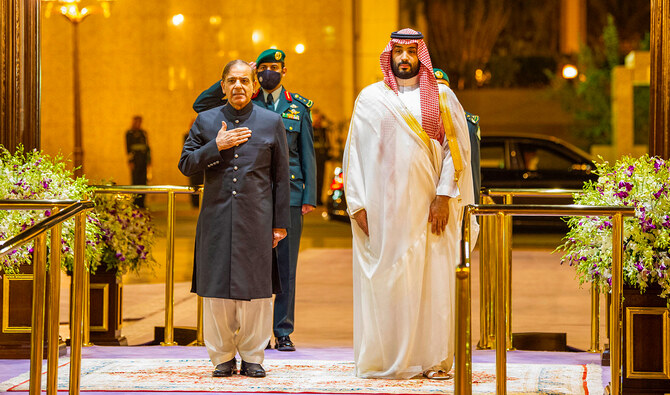
A handout picture provided by the Saudi Royal Palace shows Saudi Arabia's Crown Prince Mohammed Bin Salman (R) welcoming Pakistani Prime Minister Shehbaz Sharif in Jeddah on April 30, 2022. (AFP/File)
Short Url
Updated 09 February 2025
Follow

Pakistan condemns Israeli PM’s ‘irresponsible’ statement on establishing Palestinian state in Saudi Arabia

  • Pakistan says Netanyahu’s remarks “deeply offensive,” undermine legitimate rights of Palestinian people
  • Pakistan stands in solidarity with Saudi Arabia, commends its steadfast support for Palestinians, says Deputy PM Dar

ISLAMABAD: Pakistan’s Deputy Prime Minister and Foreign Minister Ishaq Dar on Sunday strongly condemned Israeli PM Benjamin Netanyahu’s statement calling for the establishment of a Palestinian state in Saudi Arabia, describing it as “irresponsible, provocative and thoughtless.”

Saudi Arabia’s Foreign Ministry on Sunday responded sharply to Netanyahu’s remarks, saying that it rejected “such statements that aim to divert attention from the continuous crimes committed by the Israeli occupation against the Palestinian brothers in Gaza.”

“Deputy Prime Minister/Foreign Minister Senator Mohammad Ishaq Dar stated that the Israeli remark is irresponsible, provocative and thoughtless, which is not only deeply offensive but also undermines and disregards the legitimate rights of the Palestinian people to self-determination and an independent State on their own historical and legitimate territory,” Pakistan’s foreign ministry said. 

Dar said Pakistan stands in solidarity with Saudi Arabia and commends its steadfast support for Palestinians and their cause. 

“Any attempt to undermine Saudi Arabia’s unwavering position and misrepresentation of its commitment to the Palestinian cause are deeply regrettable,” he was quoted as saying by the foreign ministry. 

The deputy prime minister said Pakistan supports the right of Palestinians to establish an independent and sovereign state based on the pre-1967 borders, with Al Quds Al Sharif as its capital. 

“Any proposal that seeks to displace or relocate the Palestinian people from their ancestral homeland is unacceptable and constitutes a blatant violation of international law, United Nations resolutions and the principles of justice and fairness,” the statement said. 

Dar said Pakistan reiterates its “unflinching support” for the Palestinian cause and will continue to work closely with Saudi Arabia and other members of the international community to advocate for the rights of the Palestinian people. 

He called for a “just, comprehensive and lasting solution to the Palestinian issue.”

“Pakistan urges the international community to denounce this provocative remark and hold Israel accountable for its continued attempts to undermine the peace process,” the statement said. 

Netanyahu’s remarks come amid an uneasy six-week truce reached between Hamas and Israel last month which ended 15 months of war.

The truce included the gradual withdrawal of Israeli forces from central Gaza and the return of displaced Palestinians to northern Gaza.

Netanyahu’s comments follow US President Donald Trump’s suggestion earlier this month that Palestinians residing in Gaza should be resettled in Egypt, Jordan or other countries.

The proposal was rejected by both Egypt and Jordan and countries including Pakistan, prompting condemnation from various international rights groups as well.


Sindh assembly passes resolution rejecting move to separate Karachi

Updated 21 February 2026
Follow

Sindh assembly passes resolution rejecting move to separate Karachi

  • Chief Minister Shah cites constitutional safeguards against altering provincial boundaries
  • Calls to separate Karachi intensified amid governance concerns after a mall fire last month

ISLAMABAD: The provincial assembly of Pakistan’s southern Sindh province on Saturday passed a resolution rejecting any move to separate Karachi, declaring its territorial integrity “non-negotiable” amid political calls to carve the city out as a separate administrative unit.

The resolution comes after fresh demands by the Muttahida Qaumi Movement (MQM) and other voices to grant Karachi provincial or federal status following governance challenges highlighted by the deadly Gul Plaza fire earlier this year that killed 80 people.

Karachi, Pakistan’s largest and most densely populated city, is the country’s main commercial hub and contributes a significant share to the national economy.

Chief Minister Syed Murad Ali Shah tabled the resolution in the assembly, condemning what he described as “divisive statements” about breaking up Sindh or detaching Karachi.

“The province that played a foundational role in the creation of Pakistan cannot allow the fragmentation of its own historic homeland,” Shah told lawmakers, adding that any attempt to divide Sindh or separate Karachi was contrary to the constitution and democratic norms.

Citing Article 239 of Pakistan’s 1973 Constitution, which requires the consent of not less than two-thirds of a provincial assembly to alter provincial boundaries, Shah said any such move could not proceed without the assembly’s approval.

“If any such move is attempted, it is this Assembly — by a two-thirds majority — that will decide,” he said.

The resolution reaffirmed that Karachi would “forever remain” an integral part of Sindh and directed the provincial government to forward the motion to the president, prime minister and parliamentary leadership for record.

Shah said the resolution was not aimed at anyone but referred to the shifting stance of MQM in the debate while warning that opposing the resolution would amount to supporting the division of Sindh.

The party has been a major political force in Karachi with a significant vote bank in the city and has frequently criticized Shah’s provincial administration over its governance of Pakistan’s largest metropolis.

Taha Ahmed Khan, a senior MQM leader, acknowledged that his party had “presented its demand openly on television channels with clear and logical arguments” to separate Karachi from Sindh.

“It is a purely constitutional debate,” he told Arab News by phone. “We are aware that the Pakistan Peoples Party, which rules the province, holds a two-thirds majority and that a new province cannot be created at this stage. But that does not mean new provinces can never be formed.”

Calls to alter Karachi’s status have periodically surfaced amid longstanding complaints over governance, infrastructure and administrative control in the megacity, though no formal proposal to redraw provincial boundaries has been introduced at the federal level.