- The fourth edition of the LEAP conference aims to expand business networking and investment opportunities in the global tech sector
- IT minister says Pakistan, which recorded $348 million IT exports in Dec., offers ‘world-class’ digital services, investment opportunities
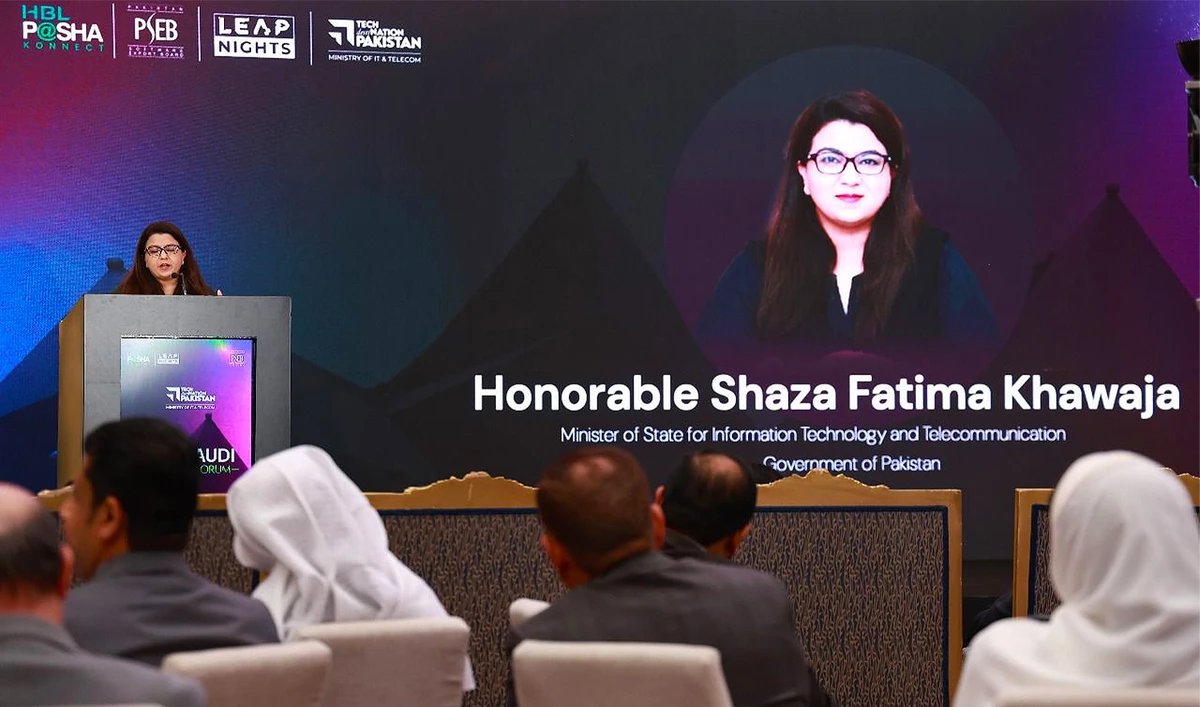
ISLAMABAD: State Minister for Information Technology (IT) Shaza Fatima Khawaja on Sunday invited Saudi businessmen to invest in Pakistan’s tech sector, highlighting the participation of over 100 Pakistani firms in the LEAP 2025 tech conference in Riyadh.
The minister expressed these views while addressing the Pakistan-Saudi Business Forum in Riyadh, a networking event jointly organized by the Pakistan Software Houses Association (P@SHA) and the Pakistan Software Export Board (PSEB), ahead of the four-day LEAP tech conference being held on Feb. 9-12.
This is the fourth edition of LEAP, recognized as Saudi Arabia’s award-winning global technology event for which entrepreneurs, investors and startups have converged in Riyadh to present their products to an anticipated audience of over 170,000 visitors. The latest edition follows last year’s record-breaking LEAP 2024, which saw $13.4 billion in investments and project commitments. Under the theme “Into New Worlds,” LEAP 2025 aims to expand business networking and investment opportunities in the tech sector.
Pakistan recorded the highest-ever monthly IT exports of $348 million in Dec. 2024, up by 15 percent year-on-year and 12 percent month-on-month, according to official data. The LEAP event offers Pakistani firms a platform to collaborate with stakeholders, explore business opportunities and showcase Pakistan’s diverse IT exports, including software development, artificial intelligence (AI), blockchain, fintech, gaming and robotics.
“Pakistan seeks strong partnerships in advanced technology under Saudi Vision 2030 and we invite Saudi investors to invest in Pakistan’s fintech, cybersecurity, and cloud computing sectors,” Khawaja said.
“Pakistan is making its largest participation in LEAP 2025, with over 100 tech companies and more than 1,000 participants.”
LEAP 2025 will debut Tech Arena, a platform for emerging innovations, featuring a ‘Live TV’ stage hosted by BBC Click’s Lara Lewington and Spencer Kelly. It is one of two new segments at LEAP 2025, alongside the SportsTech stage, supporting Saudi Arabia’s Vision 2030 for innovation and technological growth.
Visitors will explore AI, mixed reality, fashion tech, and brain-computer interfaces. Key highlights include Anouk Wipprecht’s Tech Couture exhibit, Adobe’s ‘Project Primrose’ digital dress technology, and Aramco-backed Terra Drone’s long-range medical delivery system. Saudi oil giant Aramco will also showcase SARA, an AI-driven assistant for decision-making. Engine VR will present its Golden Gloves VR boxing platform with live demos by UFC fighter Andrew Sanchez, while Alwaleed Philanthropies will showcase its Atlai AI program to support global deforestation monitoring. XPANCEO will introduce smart contact lenses with integrated computing.
Pakistan is providing world-class digital services and offering excellent opportunities for investors, according to Khawaja.
“We are not just participating [in LEAP 2025] but signing memorandums of understandings and making agreements for real economic growth through cooperation,” she said, adding that the Digital Cooperation Organization (DCO) was a key partner in the South Asian country’s digital growth.
The 16-member DCO, the world’s first standalone international intergovernmental organization, focuses on the acceleration of growth of an inclusive and sustainable digital economy. Pakistan is a key member of the organization.
Khawaja said the Digital Nation Act 2025 marked a new era in the Pakistani digital realm and provided a golden opportunity for digital investment and technological collaboration between Pakistan and Saudi Arabia. The act aims to align Pakistan’s economy, governance and services with global digital standards.
“The Digital Foreign Direct Investment (DFDI) Forum will soon be held in Islamabad, bringing together global investors, including from Saudi Arabia,” she added.