MUGHRAQA, Gaza Strip: Israeli forces withdrew from a key corridor in Gaza on Sunday, Israeli officials and Hamas said, the latest commitment under a tenuous ceasefire that faces a major test over whether the sides can negotiate its planned extension.
Israelis’ shock at the sight of three emaciated hostages released Saturday has added pressure on Prime Minister Benjamin Netanyahu to extend the truce instead of returning to fighting when the ceasefire’s first phase ends in early March.
Israel and Hamas appear to have made little progress on negotiating the deal’s second phase, which is meant to extend the ceasefire and lead to the release of more Israeli hostages held by Hamas. Talks had been due to start on Feb. 3.
Netanyahu was sending a delegation to Qatar, a key mediator, but it included low-level officials, sparking speculation that it won’t lead to a breakthrough. Netanyahu is also expected to convene key Cabinet ministers this week.
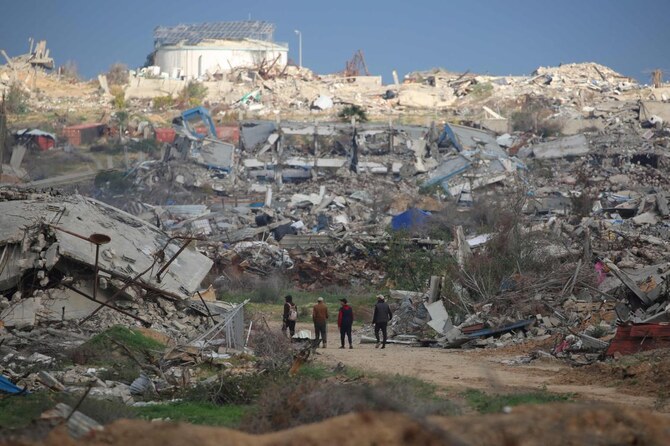
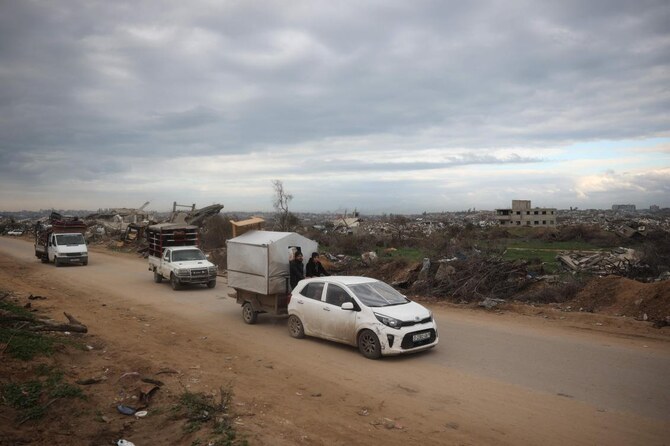
The 4-mile (6-kilometer) Netzarim corridor separating northern and southern Gaza had been used by Israel as a military zone during the 16-month war, but no troops were seen in the vicinity Sunday. As the ceasefire began last month, Israel began allowing hundreds of thousands of displaced Palestinians to cross Netzarim and return to the north.
Separately on Sunday, the Palestinian Health Ministry said two women, one of them eight months pregnant, were killed by Israeli gunfire in the occupied West Bank, where Israeli troops have been carrying out an operation.
The ceasefire’s extension is not guaranteed
The ceasefire that began on Jan. 19 has held, raising hopes that the war that led to seismic shifts in the Middle East may be headed toward an end.
But it remains fragile. On Sunday, civil defense first responders in Gaza said three people were killed by Israeli fire east of Gaza City. Israel’s military noted “several hits” after warning shots were fired and again warned Palestinians from approaching its forces.
Cars heaped with belongings headed north through a road that crosses Netzarim. Under the deal, Israel should allow cars to cross uninspected.
The Israeli officials, who spoke on condition of anonymity because they weren’t authorized to discuss troop movement with the media, did not say how many soldiers withdrew or to where. Troops remain along Gaza’s borders with Israel and Egypt.
Hamas spokesperson Abdel Latif Al-Qanoua said the troops’ withdrawal showed the militant group had “forced the enemy to submit to our demands” and that it thwarted “Netanyahu’s illusion of achieving total victory.”
Israel has said it won’t agree to a complete withdrawal from Gaza until Hamas’ military and political capabilities are eliminated. Hamas says it won’t hand over the last hostages until Israel removes all troops from the territory.
During the 42-day first phase of the ceasefire, Hamas is gradually releasing 33 Israeli hostages captured during its Oct. 7, 2023, attack that sparked the war in exchange for the release of nearly 2,000 Palestinian prisoners and a flood of humanitarian aid to Gaza. The deal also stipulates that Israeli troops will pull back from populated areas.
In the second phase, all remaining living hostages would be released in return for a complete Israeli withdrawal from Gaza and “sustainable calm.” But details beyond that are unclear.
Trump’s Gaza proposal poses a challenge
Families of hostages gathered Sunday in Tel Aviv to again urge Netanyahu to extend the ceasefire. “We know that for a year, that they are dying there, so we need to finish this deal in a hurry,” said Ayala Metzger, the daughter-in-law of hostage Yoram Metzger, who died in captivity.
But Netanyahu is also under pressure from far-right political allies to resume the war after the first phase so that Hamas, which carried out the deadliest attack on Israelis in their history, can be defeated.
Complicating things further is a proposal by US President Donald Trump to relocate the population of Gaza and take ownership of the Palestinian territory. Israel has expressed openness to the idea while Hamas, the Palestinians and much of the world have rejected it outright.
The suggested plan has moral, legal and practical obstacles. It may have been proposed as a negotiation tactic by Trump to pressure Hamas or make an opening gambit in discussions aimed at securing a normalization deal between Israel and Saudi Arabia.
That deal appeared to be rattled on Sunday as Saudi Arabia condemned remarks by Netanyahu who said Palestinians could create their state there.
Saudi Arabia said his remarks “aim to divert attention from the successive crimes committed by the Israeli occupation against our Palestinian brothers in Gaza, including the ethnic cleansing they are being subjected to.”
Qatar on Sunday called Netanyahu’s comments “provocative” and a blatant violation of international law.
The war in Gaza, sparked by Hamas’ attack that killed 1,200 people and took 250 hostage, has killed more than 47,000 Palestinians, according to local health authorities, who do not differentiate between fighters and noncombatants in their count. Vast parts of the territory have been obliterated.
Violence in the occupied West Bank
Violence has surged in the West Bank throughout the war and has intensified in recent days with an Israeli military operation in the territory’s north.
The shooting of the pregnant woman, Sundus Shalabi, happened in the Nur Shams urban refugee camp, a focal point of Israeli operations against Palestinian militants. The Palestinian Health Ministry said another woman, Rahaf Al-Ashqar, 21, was also killed.
Israel’s military said its police had opened an investigation.
Israel’s Defense Minister Israel Katz announced on Sunday the expansion of the operation, which started in Jenin several weeks ago. He said it was meant to prevent Iran from establishing a foothold in the West Bank.


![]()
![]()
![]()
![]()

Israeli forces withdraw from key Gaza corridor as concerns mount over extending ceasefire


Short Url
https://arab.news/whaea
Israeli forces withdraw from key Gaza corridor as concerns mount over extending ceasefire


Latest updates


© 2026 SAUDI RESEARCH & PUBLISHING COMPANY, All Rights Reserved And subject to Terms of Use Agreement.