

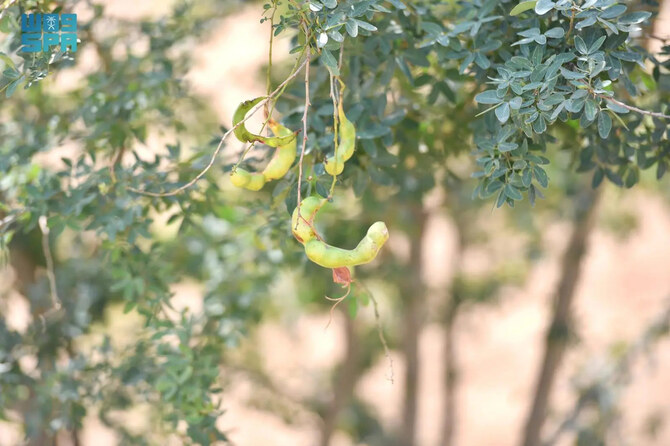
Indian almonds in Jazan: Tropical fruits at their best season

1 / 3
Indian almonds play a significant role in Jazan’s agricultural identity, thriving in the region’s warm environment and tropical climate, which foster their growth and bloom. (SPA)
2 / 3
Indian almonds play a significant role in Jazan’s agricultural identity, thriving in the region’s warm environment and tropical climate, which foster their growth and bloom. (SPA)
3 / 3
Indian almonds play a significant role in Jazan’s agricultural identity, thriving in the region’s warm environment and tropical climate, which foster their growth and bloom. (SPA)
Short Url
Updated 09 February 2025
Follow

Indian almonds in Jazan: Tropical fruits at their best season

  • Indian almonds play a significant role in Jazan’s agricultural identity
  • Heavy rains and relatively high temperatures in Jazan enhance production quality

JAZAN: In the heart of Jazan, the Indian almond has become a distinctive seasonal agricultural product for which the region in southwest Saudi Arabia is well known.

The almond tree is characterized by its dense foliage, abundant shade, and delectable fruit with a rich flavor.

Indian almonds play a significant role in Jazan’s agricultural identity, thriving in the region’s warm environment and tropical climate, the Saudi Press Agency reported. The fruit are highly sought after, whether enjoyed as a snack or valued for their natural oils.

The almond season in Jazan begins in February, marked by the blooming of white and yellow flowers that attract bees, which, along with the wind, aid in pollination.

Between May and July, the fruit gradually ripen, changing from green to yellow or red, signaling full maturity.

Peak production occurs in June and July, when the fruit are harvested and sold in local markets in substantial quantities and varying sizes, with each fruit weighing between 15 and 30 grams.


Indian almonds play a significant role in Jazan’s agricultural identity, thriving in the region’s warm environment and tropical climate, which foster their growth and bloom. (SPA)

Ripe almonds are prized for their soft texture and the ease with which the edible core can be extracted, reaching peak sweetness and exhibiting a more pronounced almond flavor.

Indian almonds are available in several markets, including the central Jazan market, as well as in the governorates of Sabia, Bish, Abu Arish, Samtah, and others throughout the region.

In Jazan, the combination of heavy rains and relatively high temperatures enhances production quality, increasing investment opportunities for cultivating the product.


Ripe almonds are prized for their soft texture and the ease with which the edible core can be extracted. (SPA)

This includes the development of packaging and marketing operations, locally and internationally, the establishment of factories for extracting Indian almond oil, and the expansion of organic agriculture to meet the rising demand for natural and healthy products.

These initiatives contribute significantly to the region’s agricultural and economic development.


Ramadan brings local communities together to engage in volunteering activities

Updated 8 sec ago
Follow

Ramadan brings local communities together to engage in volunteering activities

  • For the Jeddah Volunteer group, local volunteers head out to lower-income neighborhoods to distribute meals
  • Supervisor Ahmed Al-Hamdan told Arab News that the iftar project is among the group’s most significant Ramadan initiatives

JEDDAH: Since the start of Ramadan, charities, mosques, restaurants, generous individuals and young volunteers across Saudi Arabia are coming together to make a tangible difference to the lives of those in need.

Volunteering activities usually peak in the weeks preceding Ramadan, with several initiatives taking place across the country.

“Every Ramadan, we are proud to see citizens and residents step up as volunteers across the Kingdom of Saudi Arabia, in Riyadh, Jeddah, Damam, Tabuk, Hail, Najran, Qassim and the rest of cities, embodying the spirit of giving and solidarity during this holy month. The people’s dedication and compassion have been a true reflection of Saudi Arabia’s values,” Sheikh Mansour Al-Shareef, imam of Al-Tawheed Mosque in Jeddah, told Arab News.

Al-Shareef underscored the spiritual essence of volunteerism, saying: “Volunteerism in Ramadan is not only about helping the needy but also about showing unity within communities.”

He noted the remarkable rise in community engagement in recent years. “Volunteering is on the rise with individuals from all walks of life contributing their time and resources to foster social solidarity, particularly during Ramadan.”

For the Jeddah Volunteer group, local volunteers head out to lower-income neighborhoods to distribute meals.

Supervisor Ahmed Al-Hamdan told Arab News that the iftar project is among the group’s most significant Ramadan initiatives.

He noted that the program aims to strengthen social solidarity and ease the burden on needy families, adding that every day during Ramadan, more than 100 volunteers arrive at the various iftar sites by the afternoon Asr prayer.

They work together to prepare special meals which include water, dates and rice, and later they distribute meals by hand. For many, the reward of helping those in need is what drives them to participate in volunteer campaigns.

It is becoming an act of duty for volunteer Noura Abdulaziz, who has been involved in such initiatives for the last two years.

She said: “I dedicate myself to this cause because it is the month of giving and it is our duty to give a hand in this special month. I really enjoy every minute of it.”

She pointed out that she sacrificed her time spent with her family to hand out meals to those who are in need.

“The number of iftars I have with my family is minimal, but they have no complaints as they understand the greater purpose,” she said.

Under the slogan “Ramadan Kareem,” fulfilling its annual commitment to community service, Kayani Event Management launched its annual “Iftar for the Fasting” campaign in the heart of Al-Balad district (historic Jeddah) for the fifth consecutive year, creating a scene of social solidarity within the ancient city.

The aim was to deliver Iftar meals to needy families and charitable organizations in the area, reinforcing the spirit of compassion embodied by the holy month.

Rana Bajouda, CEO of Kayani, told Arab News: “Our continuation for the fifth year is a confirmation of our commitment to our neighbors and our people in Jeddah, and our belief that giving is the true engine of success for any organization.”

From individual acts to organized government efforts, the General Directorate of Education in the Makkah Region launched a broad community initiative to provide Iftar meals for fasting visitors to the Holy Mosque, aiming to distribute 5,000 meals daily throughout the holy month of Ramadan.

Behind this initiative stands a team of 500 volunteers from the education sector, who work side by side, in a scene of faith that embodies the spirit of cohesion and clearly reflects the leading community role of the education sector in serving those who visit the Grand Mosque.