

Senior UN official slams inadequate global support for Pakistan’s climate efforts

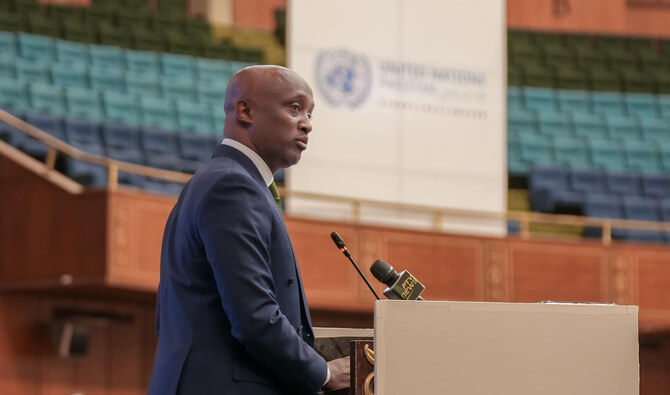
United Nations Resident and Humanitarian Coordinator Mohamed Yahya speaks during a climate change conference, “Breathe Pakistan,” in Islamabad on February 6, 2025. (Photo courtesy: UN Pakistan)
Short Url
Updated 08 February 2025
Follow

Senior UN official slams inadequate global support for Pakistan’s climate efforts

  • Mohamed Yahya urges polluting countries to show ‘stronger solidarity’ to rebuild destroyed homes in Pakistan
  • The country faced devastating floods in 2022 that killed 1,739 people, resulting in $14.9 billion in damages

ISLAMABAD: United Nations Resident and Humanitarian Coordinator Mohamed Yahya criticized the lack of global support for Pakistan in combating climate change this week, urging “stronger solidarity” with the South Asian nation to aid in the reconstruction of homes following the floods over two years ago.
In 2022, floods inundated one-third of Pakistan especially affecting the southeastern Sindh and southwestern Balochistan provinces, impacting 33 million people, causing 1,739 deaths and resulting in $14.9 billion (Rs4.1 trillion) in damage and $15.2 billion (Rs4.2 trillion) in economic losses, according to Pakistan’s National Disaster Management Authority.
The Global Climate Risk Index says Pakistan is among the countries most at risk from climate change. Extreme weather events like floods, droughts, cyclones, torrential rainstorms and heatwaves have been occurring more frequently and with greater intensity across Pakistan in recent years.
“One other things we are concerned about is the lack of stronger solidarity for Pakistan around the reconstruction after the 2022 floods,” Yahya told Arab News on the sidelines of the Breathe Pakistan Climate Conference in Islamabad on Friday.

He noted this was despite the fact that “Pakistan contributes even less than one percent of global emission and is in the top five countries impacted by climate change.”
Yahya described it as “unjust” for Pakistan to be asked to take loans for rebuilding homes destroyed in floods and mitigating a crisis caused by other countries, noting that 20 countries were responsible for 80 percent of global emissions.
According to the UN, the 20 countries contributing to the global greenhouse gas emissions include China, the United States, India, Russia, Japan, Germany and Iran etc.
“We obviously welcome the loans Pakistan has received but Pakistan should not be using or taking loans to rebuild things that it had very little to do with and that we think is not just,” he added.
The UN official maintained the world body consistently urged polluting countries, which have contributed to the climate change disaster, to do more and show solidarity and support to the countries bearing the brunt of the climate change impact.
International donors in January 2023 committed over $9 billion (Rs2.5 trillion) to help Pakistan recover from ruinous floods a year earlier, exceeding its external financing goals.
Officials from some 40 countries as well as private donors and international financial institutions gathered at a meeting in Geneva as Islamabad sought funds to cover around half of a recovery bill amounting to $16.3 billion (Rs 4.5 trillion).
Prime Minister Shehbaz Sharif also called for a grants-based and flexible financial assistance for climate resilience for developing nations like Pakistan this week.
He told the Breathe Pakistan Climate Conference that without global empathy and support, “the path to climate adaptation and green transformation will remain elusive.”


Pakistan forces killed 145 militants after Balochistan attacks— chief minister

Updated 9 sec ago
Follow

Pakistan forces killed 145 militants after Balochistan attacks— chief minister

  • Militants carried out coordinated attacks across Balochistan’s Quetta, Gwadar, Panjgur and other areas on Friday and Saturday
  • Chief Minister Sarfraz Bugti says 31 civilians, 17 law enforcement personnel killed in attacks, vows not to surrender to militants 

ISLAMABAD: The chief minister of Pakistan’s southwestern Balochistan province announced on Sunday that security forces had killed 145 militants in 40 hours after militant attacks in many parts of Balochistan this week, vowing that the government will continue fighting militancy. 

Separatist militants launched attacks in various areas of Balochistan province on Friday and Saturday, Pakistan’s military said in an earlier statement, prompting security forces to respond. The Inter-Services Public Relations (ISPR) said Pakistani forces carried out operations in Panjgur and Harnai areas on Friday to kill 41 militants. 

On Saturday, it said 92 more militants were killed in Quetta, Gwadar, Mastung, Nushki, Dalbandin, Kharan, Panjgur, Tump and Pasni areas as security forces repelled coordinated attacks on civilians and law enforcers. 

Pakistan’s military said the attacks were launched by “Indian-sponsored Fitna al Hindustan,” a reference the military frequently uses for the separatist Balochistan Liberation Army (BLA) militant group. The BLA also issued a statement on Saturday, saying it had launched what it called “Operation Herof 2.0,” claiming responsibility for attacks in multiple locations across Balochistan.

Interior Minister Mohsin Naqvi accused India of being behind the attacks, blaming New Delhi for planning the militant attacks in the province. India has always refuted Pakistan’s allegations of backing militant outfits in the country. 

“We managed to kill 145 terrorists in 40 hours,” Balochistan Chief Minister Sarfraz Bugti told reporters during a news conference. 

He said 17 law enforcement personnel, which included policemen, Frontier Corps personnel and a navy serviceman, were killed in the attacks. Civilian casualties totaled 31, he added.

The chief minister praised security forces for killing over 1,500 militants last year and conducting over 58,000 intelligence-based operations across Balochistan.

Bugti vowed that the government would not surrender to militants and would continue to fight them until they are eliminated. 

“We will fight this war for 1,000 years,” he said. “This country is ours. This is our motherland. We will fight for it.”

Balochistan, which borders Iran and Afghanistan, has faced a decades-long insurgency by separatist militant groups, with Pakistani authorities frequently accusing foreign actors of backing the violence. India has repeatedly denied such allegations.

Islamabad says separatist elements hide in sanctuaries in neighboring Afghanistan, along with the Pakistani Taliban militant group, and launch attacks against Pakistan. Afghanistan denies the allegations. 

Ethnic Baloch militant groups such as the BLA demand independence from Pakistan. They blame Islamabad for denying the local Baloch population a share in the province’s mineral wealth. 

Pakistan’s federal government and the military deny the allegations and point to several social and economic projects undertaken by the government for the benefit of the masses in Balochistan.