

Pakistan’s Imran Khan writes another letter to army chief as party stages protest

Supporters of former Prime Minister Imran Khan’s Pakistan Tehreek-e-Insaf party protest in Karachi on February 8, 2025, to mark the first anniversary of last year’s election. (AN Photo)
Short Url
Updated 08 February 2025
Follow

Pakistan’s Imran Khan writes another letter to army chief as party stages protest

  • The opposition party’s ‘Black Day’ protest is to mark the first anniversary of last year’s election
  • The ex-PM warns in his letter of a rift between the army and the people due to crackdown on PTI

KARACHI: Pakistan’s jailed former Prime Minister Imran Khan said on Saturday he has written another open letter to Chief of Army Staff General Asim Munir, complaining about the allegedly shrinking democratic space in the country since what he called “pre-poll rigging” in last year’s general elections, as his party marks a “Black Day” on the first anniversary of the electoral contest.
The letter is Khan’s second to the country’s powerful army chief this month. In the previous one, he had called for a reevaluation of current political policies while alleging that his party, Pakistan Tehreek-e-Insaf (PTI), was being targeted by the state.
Khan’s PTI and another opposition faction, Jamaat-e-Islami (JI), decided to stage protests today on the first anniversary of the last general elections. The PTI initially planned to hold a rally in Lahore but, after being denied permission by the local administration, relocated it to Swabi in Khyber Pakhtunkhwa, where the party is in power.
As protests continued in different cities, Khan warned in his letter of a widening rift between the army and the people.
“Using agencies for pre-poll rigging and manipulating election results to establish an orderly government, forcing a constitutional amendment through parliament under duress to subjugate the judiciary, recruiting handpicked judges, enforcing draconian laws like PECA [Prevention of Electronic Crimes Act] to suppress dissent, and involving state institutions in political engineering rather than their constitutional duties is not only hurting public sentiment but also deepening the divide between the people and the army,” he wrote.
“The army is a crucial institution of the country, but a few black sheep within it are harming the entire institution,” he added.
Khan also criticized state policies, saying that “Internet censorship and social media restrictions” was creating problems for the country.
He blamed “a handful of individuals” for undermining the public mandate, leading to economic instability that has pushed investors and skilled professionals to leave Pakistan.
“Economic instability is at its peak,” he said. “The growth rate is at zero, and investment in Pakistan is nearly nonexistent. Poverty and unemployment are soaring.”
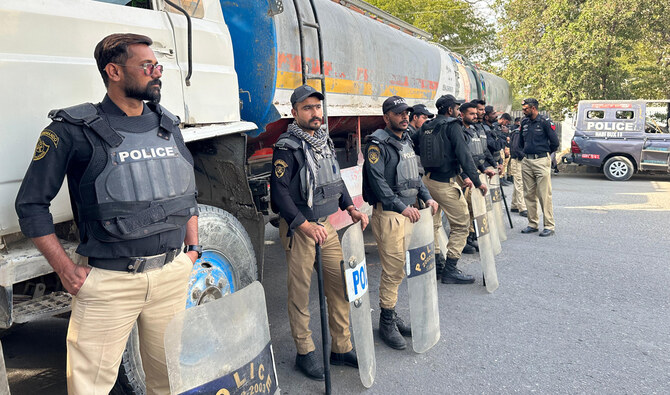


Pakistan police stand guard near a red zone in Karachi on February 8, 2025, as opposition parties protest to mark anniversary of Pakistan national polls, which they say were rigged to benefit their opponents. (AN Photo)

Khan also accused the authorities of damaging the military’s reputation among the public, arguing that national security depended on a strong bond between the people and the armed forces.
“Our soldiers are sacrificing their lives for Pakistan,” he continued. “To succeed in the fight against terrorism, the nation must stand behind the army. But the establishment’s policies and illegal actions have only worsened the army’s reputation among the people.”
There has been no official response from the army or the government to Khan’s letter yet.
Meanwhile, in Karachi, a PTI protest at the Press Club failed to draw large crowds, with party leaders blaming heavy security restrictions.
“How can anyone come to the protest?” asked Khair-un-Nisa, PTI’s Women District Manager in Karachi. “All the roads leading to [the protest venue] have been blocked. Troops have been deployed. They have started the arrests. What kind of law is this?“
Another PTI office bearer described the situation as “very unfortunate.”
“Freedom of association is a basic and fundamental right ensured by the Constitution of Pakistan,” said Advocate Maqsood Alam, Vice President of PTI’s Karachi Division. “But look here. You can see that the people of Pakistan, the citizens of Pakistan, cannot raise their voice independently. They cannot protest according to the constitution.”
Arrests of Opposition Workers
Earlier, police arrested multiple opposition members ahead of planned protests by PTI and JI to observe February 8 as a “Black Day” to highlight alleged election irregularities.
Pakistan’s general election was marred by a mobile Internet shutdown and unusually delayed results. The elections resulted in a hung National Assembly, followed by weeks of opposition protests alleging vote fraud. The caretaker government and the Election Commission of Pakistan (ECP) have denied the charges, but the US House of Representatives and several European countries have called for an independent probe— an initiative Pakistan has so far rejected.
PTI candidates contested the elections as independents after the party was barred from running under its symbol. While they won the most seats, they fell short of a majority, allowing a coalition of rival parties, led by Prime Minister Shehbaz Sharif, to form the government.

Pakistan puts border districts on high alert amid Iran protests — official

Updated 6 sec ago
Follow

Pakistan puts border districts on high alert amid Iran protests — official

  • The development comes as Iranian authorities try to suppress protests over faltering economy, with over 2,600 killed
  • Militancy in Balochistan has declined following the return of nearly 1 million Afghans, the additional chief secretary says

QUETTA: Pakistan has heightened security along districts bordering Iran as violent protests continue to engulf several Iranian cities, a top official in Pakistan’s southwestern Balochistan province said on Thursday, with authorities stepping up vigilance to guard against potential spillover.

The development comes as Iranian authorities try to suppress protests, which began late last month over the country’s faltering economy and the collapse of its currency, with more than 2,600 killed in weeks of violence in the Islamic republic.

The clampdown on demonstrations, the worst since the country’s 1979 Islamic revolution, has drawn threats from the United States (US) of a military intervention on behalf of the protesters, raising fears of further tensions in an already volatile region.

Pakistan, which shares a 909-kilometer-long border with Iran in its southwest, has said that it is closely monitoring the situation in the neighboring country and advised its citizens to keep essential travel documents with them amid the unrest.

“The federal government is monitoring the situation regarding what is happening in Iran and the provincial government is in touch with the federal government,” Hamza Shafqaat, an additional chief secretary at the Balochistan Home Department, told

Arab News in an exclusive interview on Thursday.

“As far as the law and order is concerned in all bordering districts with Iran, we are on high alert and as of now, the situation is very normal and peaceful at the border.”

Asked whether Islamabad had suspended cross-border movement and trade with Iran, Shafqaat said trade was ongoing, but movement of tourists and pilgrims had been stopped.

“There were few students stuck in Iran, they were evacuated, and they reached Gwadar,” he said. “Around 200 students are being shifted to their home districts.”

SITUATION ON PAKISTAN-AFGHANISTAN BORDER

Pakistan’s Balochistan province has long been the site of an insurgency by ethnic Baloch separatists and religiously motivated groups like the Tehreek e Taliban Pakistan (TTP). Besides Iran, the province shares more around 1,000-kilometer porous border with Afghanistan.

Islamabad has frequently accused Afghanistan of allowing its soil for attacks against Pakistan, an allegation denied by Kabul. In Oct., Pakistan and Afghanistan engaged in worst border clashes in decades over a surge in militancy in Pakistan. While the neighbors agreed to a ceasefire in Doha that month, relations between them remain tensed.

Asked about the government’s measures to secure the border with Afghanistan, Shafqaat said militancy in the region had declined following the return of nearly 1 million Afghan nationals as part of a repatriation drive Islamabad announced in late 2023.

“There is news that some of them keep on coming back from one border post or some other areas because we share a porous border and it is very difficult to man every inch of this border,” he said.

“On any intervention from the Afghanistan side, our security agencies which are deputed at the border are taking daily actions.”

LAW AND ORDER CHALLENGE

Balochistan witnessed 167 bomb blasts among over 900 militant attacks in 2025, which killed more than 400 people, according to the provincial government’s annual law and order report. But officials say the law-and-order situation had improved as compared to the previous year.

“More than 720 terrorists were killed in 2025 which is a higher number of operations against terrorists in many decades, while over a hundred terrorists were detained by law enforcement agencies in 90,000-plus security operations in Balochistan,” Shafqaat said.

The provincial government often suspended mobile Internet service in the southwestern province on various occasions last year, aimed at ensuring security in Balochistan.

“With that step, I am sure we were able to secure hundreds of lives,” Shafqaat said, adding it was only suspended in certain areas for less than 25 days last year.

“The Internet service through wireless routers remained open for the people in the entire year, we closed mobile Internet only for people on the roads because the government understands the difficulties of students and business community hence we are trying to reduce the closure of mobile Internet.”