

South Korean tech giant to display Saudi-tailored AI models at LEAP 2025

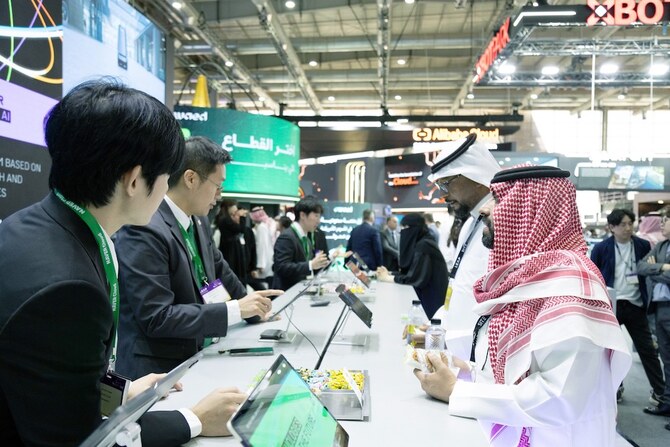
Naver’s booth at the LEAP 2024 conference in Riyadh, March 2024. (Naver)
Short Url
Updated 08 February 2025
Follow

South Korean tech giant to display Saudi-tailored AI models at LEAP 2025

  • Naver is South Korea’s largest search engine and internet portal provider
  • Company is one of few globally with a comprehensive AI value chain

SEOUL: South Korea’s tech giant Naver is going to present special Saudi-tailored artificial intelligence technologies at the LEAP 2025 conference, which will start in Riyadh on Sunday.

Organized by Saudi Arabia’s Ministry of Communications and Information Technology, LEAP is the largest tech event in the Middle East. This year, the four-day event is expected to draw nearly 700 startups, more than 1,000 expert speakers, 1,800 tech brands and 170,000 visitors.

Naver is among the few companies globally that has a comprehensive AI value chain, spanning data centers, cloud infrastructure and AI technologies. Its LEAP 2025 exhibition is themed “AI for Saudi Arabia, Powered by Naver” and will feature services currently provided in South Korea, with a focus on their potential adaptation for the Kingdom’s market.

These include an AI-powered tutor, an AI-driven electronic medical records service that converts conversations with patients to text-based documentation, and Naver Works, a tool that can summarize, translate, and generate emails.

The Korean company will present the potential localization of these technologies in Saudi Arabia’s education, healthcare, media and labor sectors.

“We aim to present AI models tailored specifically for Saudi Arabia, ensuring that the Kingdom maintains its own sovereign AI capabilities,” Han Dong-geun, Naver’s public relations officer, told Arab News.

“We already have two data centers and have cloud business know-how. And we also have AI experience in the form of LLMs (large language models). And so we want to introduce this value chain at LEAP 2025. AI development needs all three of these components, and we have all these capabilities.”

Naver has consistently emphasized the importance of sovereign AI, warning that the expansion of generative AI — driven primarily by US and Chinese tech companies — could threaten the technological independence of other countries.

The company believes its HyperCLOVA X — a Korean-based LLM, which is a type of AI program that can generate and understand text — is an example of a self-sufficient AI ecosystem that could serve as a model for Saudi Arabia’s own AI development.

“South Korea is the third country in the world to develop its own LLM ... We want to collaborate with Saudi Arabia and share our know-how and experiences to develop a custom AI model that preserves Saudi Arabia’s AI sovereignty,” Han said.

Saudi Arabia is emerging as the key Middle East market for the Korean tech giant, which is accelerating its foray into the region.

In 2023, the company won a $100 million contract to develop a digital twin platform — a software system that creates and manages a virtual replica, or “digital twin,” of a physical asset, process, or system, enabling users to monitor its real-time behavior and simulate various scenarios.

Last year, it also signed a memorandum of understanding with Aramco Digital and the Saudi Data and AI Authority to collaborate on the first Arabic LLM project, and partnered with Saudi Arabia’s National Housing Company to advance smart city projects and urban planning.

Naver is South Korea’s largest search engine and internet portal provider. Its business portfolio includes cloud services, AI, e-commerce, fintech, and digital content. The company logged a net income of $1.3 billion in 2024, according to regulatory filings.


Ugandan voters face soldiers in the street and an Internet shutdown before presidential election

Updated 9 sec ago
Follow

Ugandan voters face soldiers in the street and an Internet shutdown before presidential election

KAMPALA: Ugandans are set to vote Thursday in an election that is likely to extend the rule of the long-term president while raising concerns about transparency, hereditary rule, military interference and an opposition strategy to prevent vote tampering at polling stations.
President Yoweri Museveni, who has held power since 1986, seeks a seventh term that would bring him closer to five decades in power. But he faces a strong challenge from the musician-turned-politician best known as Bobi Wine, a 43-year-old who represents those yearning for political change.
Six other candidates are running for president in the East African nation of roughly 45 million people. Electoral authorities say there are 21.6 million registered voters.
Analysts say Museveni will almost certainly retain power, but at 81 he has become even more reliant on the nation’s security forces to enforce his authority. His son and presumptive heir, Gen. Muhoozi Kainerugaba, is the top commander of the military, which Wine accuses of interfering in the electoral process.
Here is what to know about the issues dominating the election.
Internet shutdown is a blow to activists
On Tuesday, less than 48 hours before the start of voting, the Uganda Communications Commission directed Internet service providers to temporarily suspend the general public’s access to the Internet, as well as the sale and registration of new SIM cards.
The government agency said the measure was “necessary to mitigate the rapid spread of online misinformation, disinformation, electoral fraud, and related risks.” It also cited a risk to national security stemming from possible violence.
The Internet shutdown was a blow to pro-democracy activists and others who use the Internet to share information about alleged electoral malpractices including ballot stuffing and other offenses that routinely plague Uganda’s elections.
‘Protecting the vote’ strategy
Wine’s party, the National Unity Platform, has urged followers to stay near polling stations and remain watchful after voting as part of an effort to prevent rigging.
Ugandan law allows voters to gather 20 meters (65 feet) from polling stations. Electoral officials are urging Ugandans to cast a ballot and then go home, perhaps returning later to witness vote counting.
The argument over whether voters should stay at polling stations as witnesses has animated public commentary and raised fears that the election could turn violent if security forces choose to enforce the electoral body’s guidance.
“The first step is for all of us to stay at the polling stations (while observing the 20-meter distance) and ensure that nothing criminal happens,” Wine wrote Tuesday on X. “We implore everyone to use their cameras and record anything irregular.”
Soldiers deployed in the streets
In a New Year’s Eve address, the president said he recommended security forces use tear gas to break up crowds of what he called “the criminal opposition.”
Wine faced similar setbacks when he first ran for president in 2021. He often was roughed up by the police, clothes ripped from his body, and dozens of his supporters were jailed.
Wine told The Associated Press in a recent interview that at least three of his supporters have been killed in violent campaign events, claiming “the military has largely taken over the election.”
The Office of the United Nations High Commissioner for Human Rights in Geneva has cited “widespread repression,” including the abduction and disappearance of opposition supporters.
Ugandan authorities say the presidential campaigns have been mostly peaceful. Ugandan authorities began deploying troops on Saturday in parts of the capital, Kampala, with armored trucks spreading into different parts of the city and soldiers patrolling the streets.
Military spokesman Col. Chris Magezi said the deployment was meant to deter violence, rejecting concerns that the mobilization was anti-democratic.
Son’s ambition raises hereditary rule concerns
Museveni has ruled Uganda for nearly 40 years by repeatedly rewriting the rules to stay in power. Term and age limits have been scrapped and rivals jailed or sidelined. But he has no recognizable successor in the upper ranks of the ruling party, the National Resistance Movement.
Kainerugaba, the president’s son, has asserted a wish to succeed his father, raising fears of hereditary rule.
Kainerugaba is a four-star general who sparked controversy by writing social media messages widely seen as offensive including comments about beheading Wine. He also wrote about hanging Kizza Besigye, an opposition figure who has been jailed over treason charges that he says are politically motivated.