ISLAMABAD: Bangladesh’s Chief of the Naval Staff Admiral Mohammad Nazmul Hassan has met with his counterpart Pakistan Navy Chief Admiral Naveed Ashraf in Islamabad, Pakistan Navy said on Friday, adding that the two naval chiefs discussed avenues for bilateral cooperation and regional maritime security.
The Bangladeshi naval chief is visiting Pakistan to attend the AMAN-25 multinational naval exercise and dialogue. Pakistan Navy has conducted the AMAN maritime exercise every two years since 2007 under the theme “Together For Peace,” involving ships, aircraft and special operations forces.
This year’s special feature is the inaugural AMAN Dialogue, themed “Secure Seas, Prosperous Future,” with a focus on security challenges in the Indian Ocean. These include strategic competition, piracy, narco-trafficking, non-state actors, resource exploitation, climate change, emerging technologies such as AI and unmanned systems, the blue economy and the need for global collaboration to ensure stability and prosperity.
Upon arrival at Pakistan Navy headquarters, Admiral Hassan was presented a Guard of Honour by a smartly turned-out Pakistan Navy contingent and introduced with principal staff officers, followed by a meeting with Admiral Ashraf, according to Pakistan Navy’s Directorate General of Public Relations (DGPR).
“During the meeting, matters of mutual interest, the regional maritime security environment, and prospects for enhanced bilateral naval collaboration between the two countries were discussed,” the DGPR said in a statement.
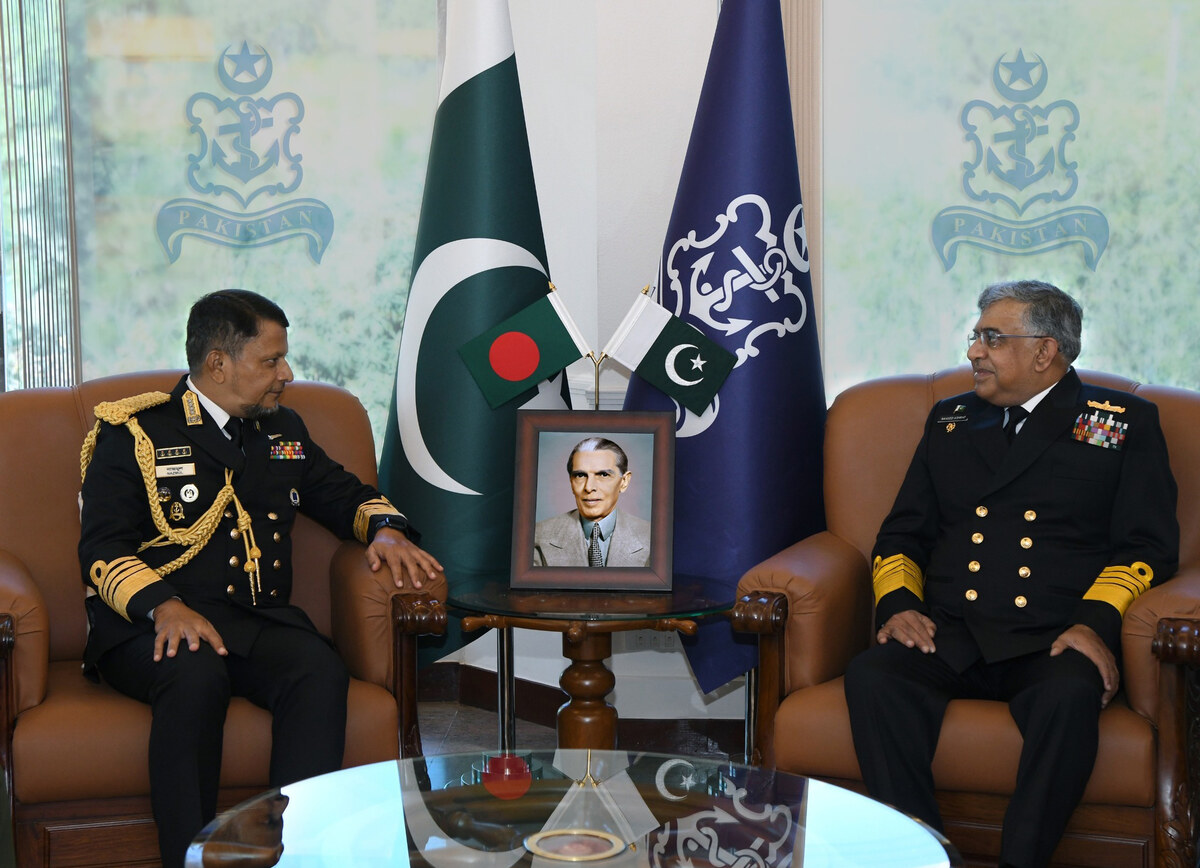
In this handout photograph, taken and released by the Director General Public Relations of Pakistan Navy on February 7, 2025, Bangladesh Chief of the Naval Staff Admiral M Nazmul Hassan gestures during a meeting with his Pakistani counterpart, Admiral Naveed Ashraf, at the Naval Headquarters in Islamabad. (Handout/Pakistan Navy)
“Various avenues of cooperation, including training, exchange of visits, and bilateral naval exercises between the navies of Pakistan and Bangladesh, were also highlighted.”
Pakistan and Bangladesh were once one nation, but they split in 1971 as a result of a bloody civil war, which saw the part previously referred to as East Pakistan seceding to form the independent nation of Bangladesh.
In the years since, Bangladeshi leaders, particularly former prime minister Hasina, chose to maintain close ties with India. Ties between Pakistan and Bangladesh have warmed up since Hasina’s ouster as a result of a student-led uprising in August, witnessing a marked improvement.
The head of Bangladesh’s interim government, Nobel laureate Muhammad Yunus, has met with Pakistani Prime Minister Shehbaz Sharif twice since taking office on Aug. 8. Last month, Lt. Gen. S.M. Kamr-ul-Hassan, principal staff officer of the Bangladesh armed forces division, was on a visit to Pakistan, while there have been widespread reports in regional media that the Pakistan army will be training Bangladeshi soldiers.
During their meeting, Admiral Ashraf emphasized Pakistan Navy’s initiatives to ensure maritime security and regional peace through Regional Maritime Security Patrols, according to the DGPR.
Admiral Ashraf “expressed gratitude” for the participation of the Bangladeshi chief of the naval staff in the AMAN Dialogue. The visiting dignitary appreciated Pakistan’s role and contributions in promoting collaborative maritime security in the region.
“The visit of the Chief of the Naval Staff of Bangladesh is expected to further strengthen and expand defense ties between the two brotherly countries, fostering greater collaboration and robust relations between their naval forces,” the DGPR added.