

US State Department lays out plans for $7 billion-plus arms sale to Israel as Netanyahu visits DC

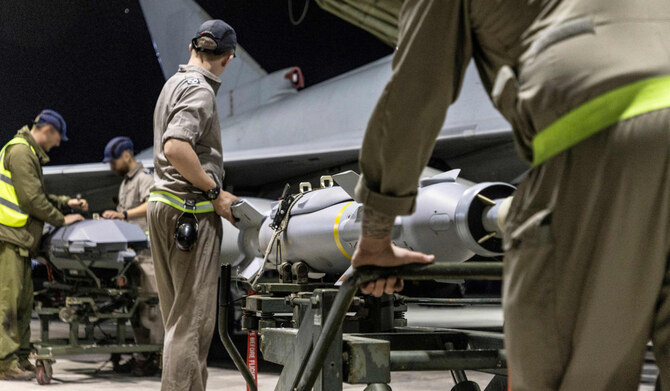
A Royal Air Force Typhoon FGR4 having Paveway IV weapons loaded by Weapon Technicians at RAF Akrotiri in Cyprus, in preparation for a strike on military targets in Yemen, on February 22, 2024. (AFP)
Short Url
Updated 08 February 2025
Follow

US State Department lays out plans for $7 billion-plus arms sale to Israel as Netanyahu visits DC

  • In late January, soon after he took office, he lifted the hold on sending 2,000-pound bombs to Israel

WASHINGTON: The State Department has formally told Congress that it plans to sell more than $7 billion in weapons to Israel, including thousands of bombs and missiles, just two days after President Donald Trump met with Israeli Prime Minister Benjamin Netanyahu at the White House.
The massive arms sale comes as a fragile ceasefire agreement between Israel and Hamas holds, even as Trump continues to tout his widely criticized proposal to move all Palestinians from Gaza and redevelop it as an international travel destination.
The sale is another step in Trump’s effort to bolster Israel’s weapons stocks. In late January, soon after he took office, he lifted the hold on sending 2,000-pound bombs to Israel. The Biden administration had paused a shipment of the bombs over concerns about civilian casualties, particularly during an assault on the southern Gaza city of Rafah.
Trump told reporters that he released them to Israel, “because they bought them.”
According to the State Department, two separate sales were sent to Congress on Friday. One is for $6.75 billion in an array of munitions, guidance kits and other related equipment. It includes 166 small diameter bombs, 2,800 500-pound bombs, and thousands of guidance kits, fuzes and other bomb components and support equipment. Those deliveries would begin this year.
The other arms package is for 3,000 Hellfire missiles and related equipment for an estimated cost of $660 million. Deliveries of the missiles are expected to begin in 2028.


Syria welcomes Canada’s decision to amend sanctions

Syria’s Central Bank governor, Abdulkader Husarieh. (SANA)
Updated 4 sec ago
Follow

Syria welcomes Canada’s decision to amend sanctions

  • Husarieh said the decision could pave the way for Canadian participation in Syria’s reconstruction and infrastructure development

DAMSCUS: Syria’s Central Bank governor, Abdulkader Husarieh, commended the Canadian government’s decision to amend the sanctions imposed on Damascus under the Special Economic Measures Regulations, including the lifting of the comprehensive economic embargo in place since May 2011.
In a post published on his personal Facebook page, Husarieh described the move as an important milestone that reinforces the implementation of understandings reached during his recent visit to Canada.
He added that the amendment provides an opportunity to boost economic relations and activate cooperation between Canadian and Syrian banks and financial institutions.
Husarieh said the decision could pave the way for Canadian participation in Syria’s reconstruction and infrastructure development.
Meanwhile, the Syrian Arab Red Crescent and the Turkish Red Crescent signed cooperation agreements on Friday to strengthen humanitarian efforts in Syria amid ongoing crises and economic hardship.
Syrian Arab Red Crescent President Hazem Bakleh met in Damascus with Alper Kucuk, the Turkish Red Crescent’s director general for international affairs and migration services, to discuss rising humanitarian needs and ways to enhance coordination in support of vulnerable communities.
According to a statement released by the Syrian organization, the agreement provides for expanding relief and service activities.
It includes support for the construction of a new Red Crescent branch headquarters in Idlib province and the launch of a project to distribute hot meals and bread in Damascus and Aleppo during the holy month of Ramadan.
The Syrian Arab Red Crescent has sought to broaden partnerships with regional and international organizations in recent years to strengthen its operational capacity across multiple provinces, as the country continues to face economic strain and humanitarian challenges affecting large segments of the population.