

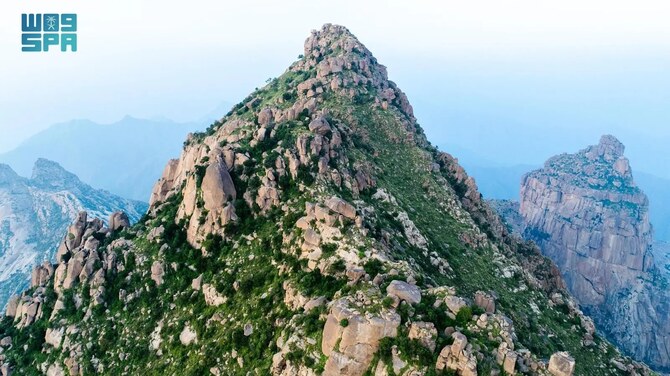
Shada Al-Ala Mountain: Historic gem draws visitors to Al-Baha

1 / 2
The region is also celebrated as the area where Shadawi coffee is cultivated.(SPA)
2 / 2
The region is also celebrated as the area where Shadawi coffee is cultivated.(SPA)
Short Url
Updated 07 February 2025
Follow

Shada Al-Ala Mountain: Historic gem draws visitors to Al-Baha

  • The oratory of Shada Al-Ala Mountain is atop Jabal Shada in Al-Makhwah Governorate, occupying an area of about 9 sq. meters

RIYADH: The Al-Baha region in southwest Saudi Arabia features a rich tapestry of archaeological sites and historic structures that span various eras, highlighting the area’s deep cultural heritage. 

These landmarks not only preserve the region’s historical legacy but also serve as enduring symbols of its vibrant past. 

Among the most notable are Al-Qara Hill and the oratory of Shada Al-Ala Mountain.

The oratory of Shada Al-Ala Mountain is atop Jabal Shada in Al-Makhwah Governorate, occupying an area of about 9 sq. meters, the Saudi Press Agency reported. 

Built along the entire perimeter of the mountain’s peak, it rises more than 2,200 meters above sea level, requiring an arduous four-hour trek from the nearest village to reach it. 

Despite its isolation, the oratory has remarkably preserved its four walls, although its roof has collapsed and remains unrestorable due to the site’s extreme inaccessibility and the rugged terrain leading to it.

During a visit to Shada Al-Ala Mountain, an SPA correspondent met with researcher Saeed Al-Shadwi, who elaborated on the historical significance of Mount Shada and Shadwan as prominent geographical landmarks. 

He highlighted their presence in numerous glossaries, historical records and poetic works dating back to the sixth century.

Al-Shadwi noted that the white rock situated beneath the mountain to the northwest is a triangular formation commonly known as “Al-Marwa” and the summit is named “Qimmat Al-Marwa” after it, as referred to by the villagers. 

The Shada Al-Ala and Al-Asfal mountains are home to a wealth of historical sites and landmarks that date back thousands of years. Among them are ancient caves, rock inscriptions, the Shada Mountain Reserve, and the oratory. 

The region is also celebrated as the area where Shadawi coffee is cultivated.


Royal reserve intensifies efforts for environmental conservation

Updated 05 December 2025
Follow

Royal reserve intensifies efforts for environmental conservation

  • Protection contributes toward sustainability to align with Saudi Vision 2030

RIYADH: The King Salman bin Abdulaziz Royal Reserve Development Authority is intensifying efforts to protect the vegetation, wildlife, and public property within its reserve, the largest in the Kingdom at 130,700 sq. km.

Distinguished by its nature, terrain and archaeological sites (some dating back to 8000 B.C.), its protection contributes to environmental sustainability and aligns with Saudi Vision 2030’s goal of making the Kingdom a global environmental tourist destination, the Saudi Press Agency reported.

The authority’s efforts include enforcing regulations against violators, in partnership with the Special Forces for Environmental Security; rehabilitating damaged lands affected by overgrazing and desertification; planting nearly 4 million seedlings; rehabilitating 750,000 hectares of degraded land to restore plant life; and distributing tonnes of native wild seeds.

The authority has urged adherence to regulations, stressing continuous monitoring and enforcement against violations.

The royal reserve, a vast ecological haven across the Northern Borders, Jouf, Tabuk and Hail regions, is a vital hub for migratory birds. It is home to more than 290 bird species, with 88 percent being migratory and 12 percent resident.

This accounts for 58 percent of all bird species recorded in the Kingdom. The reserve also protects 26 bird species listed as threatened on the International Union for Conservation of Nature Red List.

The reserve serves as the Kingdom’s first stop for flocks arriving from Asia and Europe in the autumn, and their last station before departing in spring.

With its rich biodiversity, balanced environment and varied landscapes, the reserve also stands as a natural sanctuary, hosting remarkable species such as the steppe eagle, the eastern imperial eagle, and the houbara bustard.