

Pakistani finance minister to attend funeral of Aga Khan IV in Lisbon tomorrow

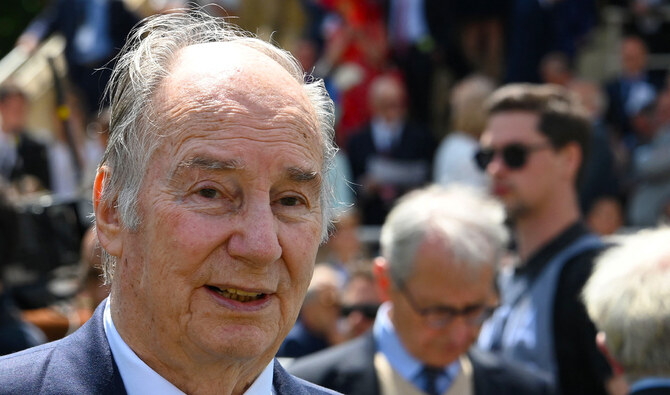
Prince Karim Aga Khan IV attends the 170th Prix de Diane horse racing on June 16, 2019 in Chantilly, northern Paris. (AFP/File)
Short Url
Updated 07 February 2025
Follow

Pakistani finance minister to attend funeral of Aga Khan IV in Lisbon tomorrow

  • Prince Karim died on Tuesday after nearly seven decades as the spiritual leader of the global Ismaili Muslim community
  • After a funeral ceremony in Lisbon on Saturday, Aga Khan IV will be laid to rest at a private burial ceremony in Aswan, Egypt 

ISLAMABAD: Finance Minister Muhammad Aurangzeb will represent Pakistan at the funeral tomorrow, Saturday, of the late Prince Karim Al-Hussaini Aga Khan IV who died this week after nearly seven decades as the spiritual leader of the global Ismaili Muslim community, state-owned Pakistan Television reported on Friday.

After a funeral ceremony at the Ismaili Center in the Portuguese capital on Saturday — to be attended by leaders of the community, Portuguese government members and foreign dignitaries — Aga Khan IV will be laid to rest at a private burial ceremony in Aswan, Egypt on Sunday, according to the Ismaili Imamat.

Prince Rahim Al-Hussaini was named the 50th hereditary Imam, or spiritual leader, of Ismaili Muslims on Wednesday after the will of his late father was unsealed, the Aga Khan Development Network (AKDN) said.

“Aurangzeb will represent Pakistan during the last rites of Prince Aga Khan, who passed away at the age of 88,” PTV reported. “He will also participate in the prayer congregation for the departed soul in Lisbon.”

The government of Pakistan has announced a day of national mourning on Saturday for the funeral of Aga Khan IV. The national flag will fly at half-mast throughout the country that day.

Known for his wealth and development work around the world through the Aga Khan Development Network, Prince Karim died in Lisbon, the seat of the Ismaili Imamat. As Aga Khan — derived from Turkish and Persian words to mean commanding chief — he is believed by Ismailis to be a direct descendant of Prophet Muhammad (pbuh) through his cousin and son-in-law, Ali, the first Imam, and his wife Fatima, the prophet’s daughter.

The world’s Ismaili community, a branch of Shiite Islam, comprises around 15 million people who live in Central Asia, the Middle East, South Asia, sub-Saharan Africa, Europe and North America.

Set up in 1967, the AKDN group of international development agencies employs 80,000 people helping to build schools and hospitals and providing electricity for millions of people in the poorest parts of Africa and Asia. 

Aga Khan IV also kept up his family’s long tradition of thoroughbred racing and breeding. His stables and riders, wearing his emerald-green silk livery, enjoyed great successes at the top international derbies.

With inputs from Reuters


Pakistan highlights economic reforms at Davos, eyes cooperation in AI, IT and minerals

Updated 21 January 2026
Follow

Pakistan highlights economic reforms at Davos, eyes cooperation in AI, IT and minerals

  • Prime Minister Shehbaz Sharif speaks at breakfast event in Davos at sidelines of World Economic Forum summit
  • Pakistan, rich in gold, copper reserves, has sought cooperation with China, US, Gulf countries in its mineral sector

ISLAMABAD: Prime Minister Shehbaz Sharif highlighted Pakistan’s recent economic reforms during the sidelines of the ongoing World Economic Forum (WEF) summit in Davos on Wednesday, saying that his country was eyeing greater cooperation in mines and minerals, information technology, cryptocurrency and artificial intelligence with other states. 

The Pakistani prime minister was speaking at the Pakistan Pavilion in Davos on the sidelines of the WEF summit at a breakfast event. Sharif arrived in Switzerland on Tuesday to attend the 56th annual meeting of the WEF, which brings together global business leaders, policymakers and politicians to speak on social, economic and political challenges. 

Pakistan has recently undertaken several economic reforms, which include removing subsidies on energy and food, privatization of loss-making state-owned enterprises and expanding its tax base. Islamabad took the measures as part of reforms it agreed with the International Monetary Fund (IMF) in exchange for a financial bailout package. 

“We are now into mines and minerals business in a big way,” Sharif said at the event. “We have signed agreements with American companies and Chinese companies.”

Islamabad has sought to attract foreign investment in its critical minerals sector in recent months. In April 2025, Pakistan hosted an international minerals summit where top companies and government officials from the US, Saudi Arabia, China, Türkiye, the UK, Azerbaijan, and other nations attended.

Pakistan is rich in gold, copper and lithium reserves as well as other minerals, yet its mineral sector contributes only 3.2 percent to the countrys GDP and 0.1 percent to global exports, according to official figures.

Sharif said Pakistan has been blessed with infinite natural resources which are buried in its mountains in the northern Gilgit-Baltistan, Khyber Pakhtunkhwa, Azad Kashmir and southwestern Balochistan regions. 

“But we have now decided to go forward at lightning speed,” he said. “And we are also moving speedily in the field of crypto, AI, IT.”

He said the government’s fiscal and economic measures have reduced inflation from nearly 30 percent a few years ago to single-digit figures, adding that its tax-to-GDP ratio had also increased from 9 to 10.5 percent. 

The prime minister admitted Pakistan’s exports face different kinds of challenges collectively, saying the country’s social indicators needed to improve. 

“But the way forward is very clear: that Pakistan has to have an export-led growth,” he said. 

SHARIF MEETS IMF MANAGING DIRECTOR

Separately, Sharif met IMF Managing Director Kristalina Georgieva on improvements in Pakistan’s macroeconomic indicators, efforts toward stability and progress on institutional reforms, a statement from Sharif’s office said.

He emphasized Pakistan’s commitment to fiscal discipline, revenue mobilization and sustainable development, it added. 

The IMF managing director acknowledged and appreciated Pakistan’s reform efforts, the Prime Minister’s Office (PMO) said.

“Both sides exchanged views on the global economic outlook, challenges facing emerging economies, and the importance of multilateral cooperation in safeguarding economic stability,” the PMO said.